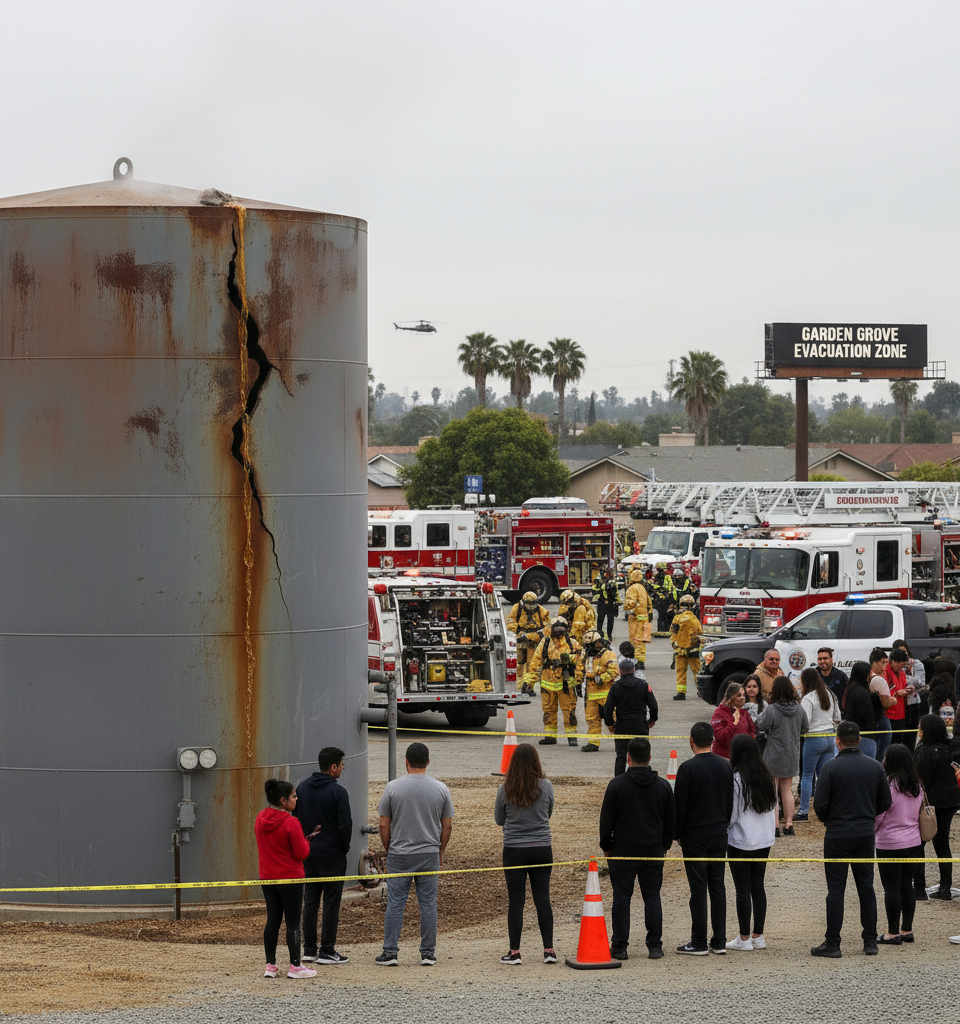
Garden Grove, California – Tens of thousands of Southern California residents are confronting a precarious wait this week as local and state authorities work diligently to avert a potential catastrophe stemming from a compromised chemical storage tank. The situation, which has prompted the precautionary evacuation of approximately 50,000 individuals from the city of Garden Grove, hinges on the structural integrity of a tank that experienced overheating last Thursday and subsequently began venting noxious vapors.
The damaged chemical tank, located at an aerospace company within Garden Grove, a city of roughly 170,000 residents situated about 40 miles south of downtown Los Angeles, developed a significant crack over the weekend. While the visual evidence of damage is alarming, officials expressed a cautious optimism that the crack itself might serve a crucial function by allowing internal pressure to dissipate, thereby reducing the immediate risk of a catastrophic explosion. This development marks a critical phase in the ongoing effort to manage the crisis, with residents holding their breath for a definitive resolution.
Escalating Concerns and Evacuation Efforts
The initial signs of trouble emerged on Thursday when the chemical tank began to overheat, leading to the release of vapors. This event immediately triggered an urgent response from emergency services and hazardous materials teams. Recognizing the severe potential for a worst-case scenario, authorities swiftly initiated a wide-scale evacuation order for a significant portion of Garden Grove. The decision to evacuate 50,000 residents underscores the gravity of the perceived threat and the commitment of officials to prioritize public safety above all else.
The ongoing uncertainty has cast a pall over the community, transforming a bustling suburban area into a zone of apprehension. Residents, displaced from their homes, are now awaiting updates on the stability of the tank and the timeline for their safe return. The incident highlights the inherent risks associated with industrial operations involving hazardous materials, particularly in densely populated urban environments.
The Broader Implications
This incident in Garden Grove could have far-reaching implications for industrial safety regulations and community planning in areas surrounding aerospace and chemical manufacturing facilities. The potential for a catastrophic explosion not only threatens human life but also poses a severe environmental risk, including air and water contamination over a wide area. For the aerospace sector, this event could trigger intensified scrutiny of storage protocols for raw materials and finished products, potentially leading to increased compliance costs and stricter operational guidelines. Companies operating with similar chemical storage infrastructure may face immediate pressure to review their own safety measures and emergency preparedness plans.
Market-wise, while the immediate impact on the broader aerospace or chemical industries might be localized, prolonged disruptions or a negative outcome could influence investor confidence in companies perceived as having inadequate safety controls. Insurers are also closely monitoring the situation, as the financial liabilities associated with such an event could be substantial, encompassing property damage, environmental remediation, business interruption, and potential health claims.
Expert Perspectives on Risk Mitigation
Hazardous materials experts familiar with industrial accidents suggest that the development of a crack, while a visible sign of failure, can indeed act as a safety valve in pressure vessels, provided it is managed carefully and does not propagate rapidly. Their analysis often centers on the precise chemical composition involved, the integrity of the remaining structure, and the external environmental factors influencing the tank. The current focus on pressure relief is consistent with established protocols for managing such incidents, aiming to prevent a sudden and uncontrolled release of energy. However, they also emphasize the unpredictable nature of compromised structures under stress, underscoring the ongoing need for extreme caution and continuous monitoring.
The Path Forward
Moving forward, the immediate priority for authorities is the stabilization of the damaged chemical tank. This will likely involve a multi-pronged approach, potentially including specialized efforts to further relieve pressure, transfer the chemical contents, or reinforce the tank's structure. The timeline for these operations, and consequently for the return of evacuated residents, remains fluid and dependent on continuous evaluations by hazardous materials experts and engineers on site. Comprehensive environmental assessments will also be crucial once the immediate danger is contained, to ensure there are no lingering threats to public health or the ecosystem. The situation in Garden Grove serves as a stark reminder of the delicate balance between industrial activity and public safety in rapidly developing regions.
Residents will continue to monitor official communications closely, hoping for a swift and safe resolution to a crisis that has displaced thousands and underscored the ever-present challenges of industrial risk management.