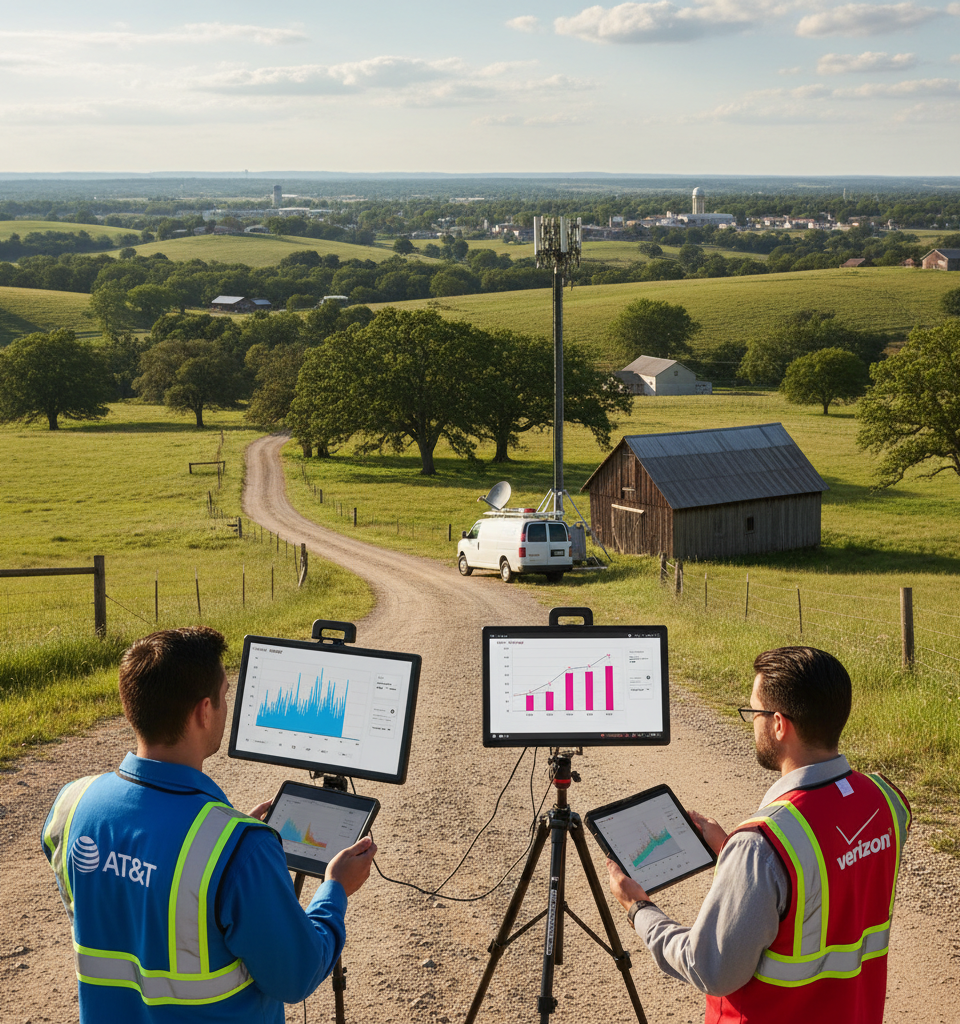
Independent testing in a typical small American town has cast a revealing light on the real-world 5G experiences offered by AT&T, T-Mobile, and Verizon. Unlike previous assessments focused on dense urban centers or major transportation corridors, this study directly measured signal strength and data speeds in areas often underserved, providing crucial data for consumers and policymakers alike.
Context and Significance
For years, the promise of 5G has been heralded as a transformative technology, expected to bridge the digital divide and spur economic growth in rural communities. However, much of the public discourse and prior testing has concentrated on metropolitan areas where carriers initially deployed their most robust infrastructure. This latest investigation shifts the focus, offering a more granular understanding of how these advanced networks perform in smaller, less populated towns. The findings are particularly salient as the US government continues to allocate billions of dollars towards broadband expansion, with 5G rollout being a key component of these initiatives. Reliable, high-speed internet access is no longer a luxury but a fundamental requirement for education, healthcare, and economic participation, making consistent 5G performance outside of cities exceptionally important.
Key Findings and Data Points
The rigorous testing involved three identical Samsung smartphones, one provisioned for each carrier, simultaneously collecting data across various locations within a representative small town. While specific download and upload speeds varied by exact location and carrier, T-Mobile consistently demonstrated the highest average download speeds, often surpassing its competitors by a substantial margin, leveraging its mid-band spectrum. AT&T showed a more balanced performance, with generally reliable connections, while Verizon's 5G Ultra Wideband, when available, offered exceptional speeds but its footprint was notably more limited in the surveyed rural areas compared to its urban presence.
In instances where Verizon's C-band or mmWave was not available, its 'nationwide' 5G often reverted to speeds comparable to or slightly better than LTE. 5 GHz spectrum proving particularly effective for broader coverage and speed in these environments.
Industry and Market Impact
These findings reiterate the competitive dynamics within the US telecommunications market, particularly concerning 5G deployment strategies. T-Mobile's aggressive strategy in mid-band spectrum deployment appears to be yielding tangible advantages in terms of both speed and coverage in non-urban settings. This could translate into significant market share gains if rural consumers prioritize consistent high-speed access. For AT&T and Verizon, the data underscores the challenge of expanding their most potent 5G technologies, like C-band and mmWave, into less profitable rural markets while still delivering a compelling 5G experience. The investment required to build out denser infrastructure in these areas is immense, potentially impacting their capital expenditure cycles and overall profitability metrics in the coming quarters.
Expert Perspectives
Telecommunications analysts generally concur that rural 5G deployment is a complex and capital-intensive endeavor. "What we're seeing here is a reflection of strategic spectrum allocation and infrastructure investment decisions made years ago," stated Dr. Evelyn Reed, a senior analyst at TechConnect Research.
"T-Mobile's early acquisition and rapid deployment of their mid-band assets gave them a distinct advantage in covering broader geographic swaths with decent speeds. " Reed also noted the importance of government subsidies, such as those from the FCC's various broadband funds, in accelerating rural 5G buildouts, suggesting that the competitive landscape may shift further as these funds are utilized.
The Road Ahead
The future of 5G in rural America will be shaped by a combination of continued carrier investment, technological advancements, and federal policy. Carriers are expected to progressively expand their mid and high-band services. Verizon, for instance, has publicly committed to substantial C-band expansion throughout 2024 and beyond, aiming to close coverage gaps.
AT&T is also ramping up its C-band rollout and utilizing a blend of low and mid-band spectrum for broader reach. The ongoing development of new wireless technologies, such as improved beamforming and dynamic spectrum sharing, may also enhance efficiency and extend the reach of high-speed 5G without requiring entirely new infrastructure. Furthermore, the role of fixed wireless access (FWA) as a 5G-powered home internet alternative is growing, especially in areas where fiber optic deployment is economically unfeasible, suggesting that the direct impact of these mobile 5G speeds on underserved households could become even more pronounced.
Rural consumers can anticipate a gradual but steady improvement in 5G availability and performance as carriers continue to invest and as regulatory incentives push for greater coverage. However, the path to ubiquitous, high-speed 5G in every small town remains a multi-year effort, underscoring the ongoing challenges and opportunities facing the wireless industry.