The rapid advancement of artificial intelligence continues to reshape global business operations, and for enterprises operating across borders, the efficiency and accuracy of software development directly impact market entry, product localization, and supply chain integration. Tools that can significantly accelerate the creation of robust, scalable code stacks offer a critical competitive edge, reducing development costs and time-to-market in an increasingly globalized digital economy.
New research introduces AgentRadio, a novel multi-agent system poised to significantly enhance the capabilities of AI in complex enterprise coding tasks. This system enables asynchronous, real-time coordination among multiple AI agents, a development that reportedly led to a team of four AI agents outperforming the highly capable Claude Opus 4.8 on specified coding benchmarks. The findings highlight a paradigm shift in AI collaboration, moving beyond single-agent paradigms towards distributed, coordinated intelligence.
Unpacking AgentRadio's Coordination Mechanism
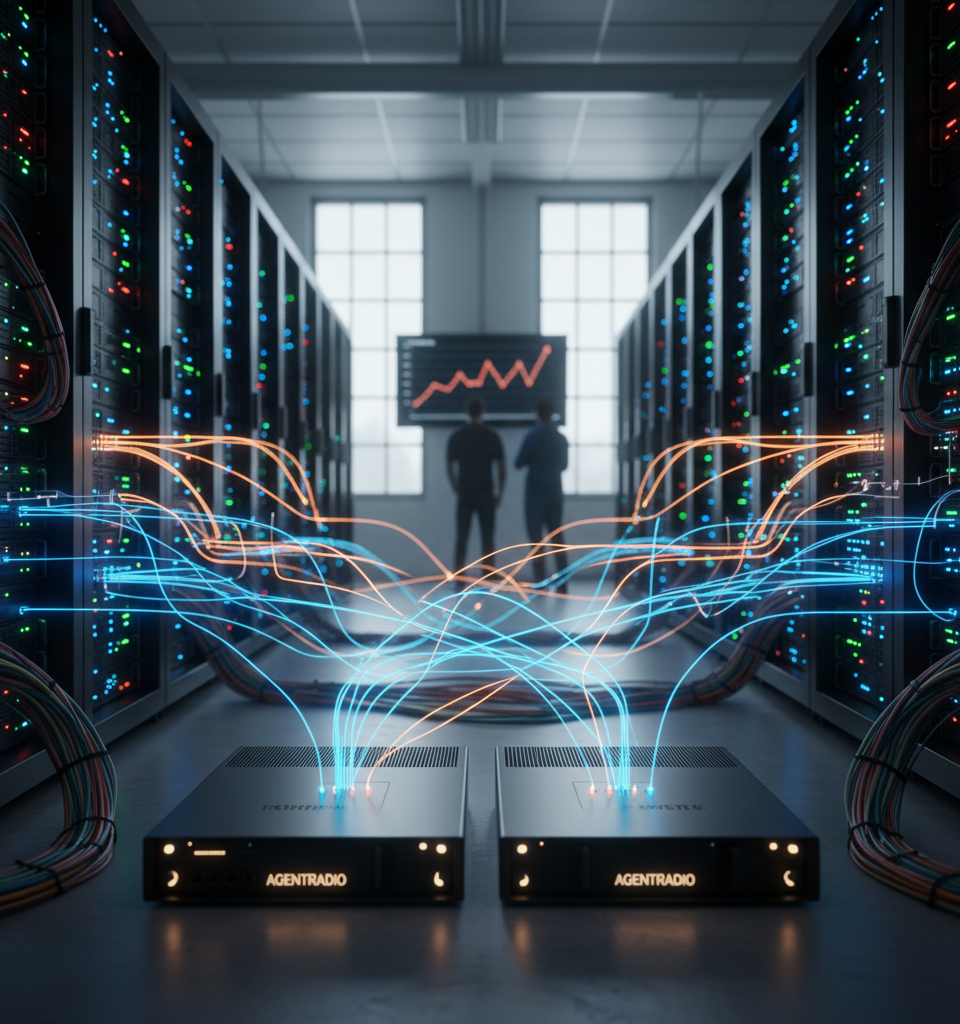
The core innovation behind AgentRadio lies in its ability to facilitate sophisticated, real-time communication and task allocation among diverse AI agents. Unlike traditional AI setups where agents might operate in isolation or with limited, pre-defined interactions, AgentRadio allows for dynamic, asynchronous exchanges of information and progress updates. This enables a team of agents to collaboratively tackle complex problems, breaking them down into manageable sub-tasks and integrating their individual contributions seamlessly. The research suggests that this approach mimics human team dynamics, where individuals specialize and coordinate to achieve a common goal more effectively than a single highly skilled individual.
Performance Benchmarking: A Significant Leap
The most striking claim from the research is the direct comparison with Claude Opus 4.8, a model widely recognized for its advanced reasoning and coding abilities. The team of four AI agents leveraging AgentRadio demonstrably enhanced performance on enterprise coding tasks, reportedly surpassing the capabilities of the standalone Claude Opus 4.8. While the specific nature and complexity of these enterprise coding tasks are not detailed in the initial description, the implication is that AgentRadio's coordinated approach provides a measurable advantage in real-world, high-stakes development scenarios. This suggests that the collective intelligence fostered by AgentRadio can unlock new levels of efficiency and accuracy in software creation.
Industry Implications for Enterprise Development
The introduction of AgentRadio carries significant implications for the enterprise software development landscape. Businesses heavily reliant on custom software, particularly those with intricate legacy systems or complex microservices architectures, could see substantial benefits. The ability of coordinated AI agents to accelerate development cycles, identify and rectify bugs more efficiently, and potentially even optimize code for performance or security could translate into massive cost savings and faster product deployment. This innovation could democratize access to advanced coding capabilities, allowing smaller firms to compete more effectively with larger entities by leveraging powerful AI development teams.
The Evolving Role of AI in Software Engineering
This research underscores a growing trend in artificial intelligence: the shift from single, monolithic models to more distributed, collaborative AI architectures. The future of AI in software engineering is increasingly likely to involve specialized agents working in concert, each contributing its strengths to different phases of the development lifecycle, from requirements analysis and design to coding, testing, and deployment. AgentRadio appears to be an early, compelling example of how such multi-agent systems can be effectively orchestrated to solve real-world industrial challenges.
Future Prospects and Deployment Considerations
Looking ahead, the next steps for AgentRadio and similar multi-agent systems will likely involve further refinement of their coordination protocols, expansion into broader domains beyond enterprise coding, and rigorous testing in diverse real-world environments. For businesses considering integration, critical factors will include the ease of deployment, interoperability with existing development tools, and the ethical implications of autonomous AI agents in sensitive coding environments. Should these systems prove robust and reliable, they could fundamentally alter how enterprise software is conceived, developed, and maintained, driving a new era of AI-powered software factories.