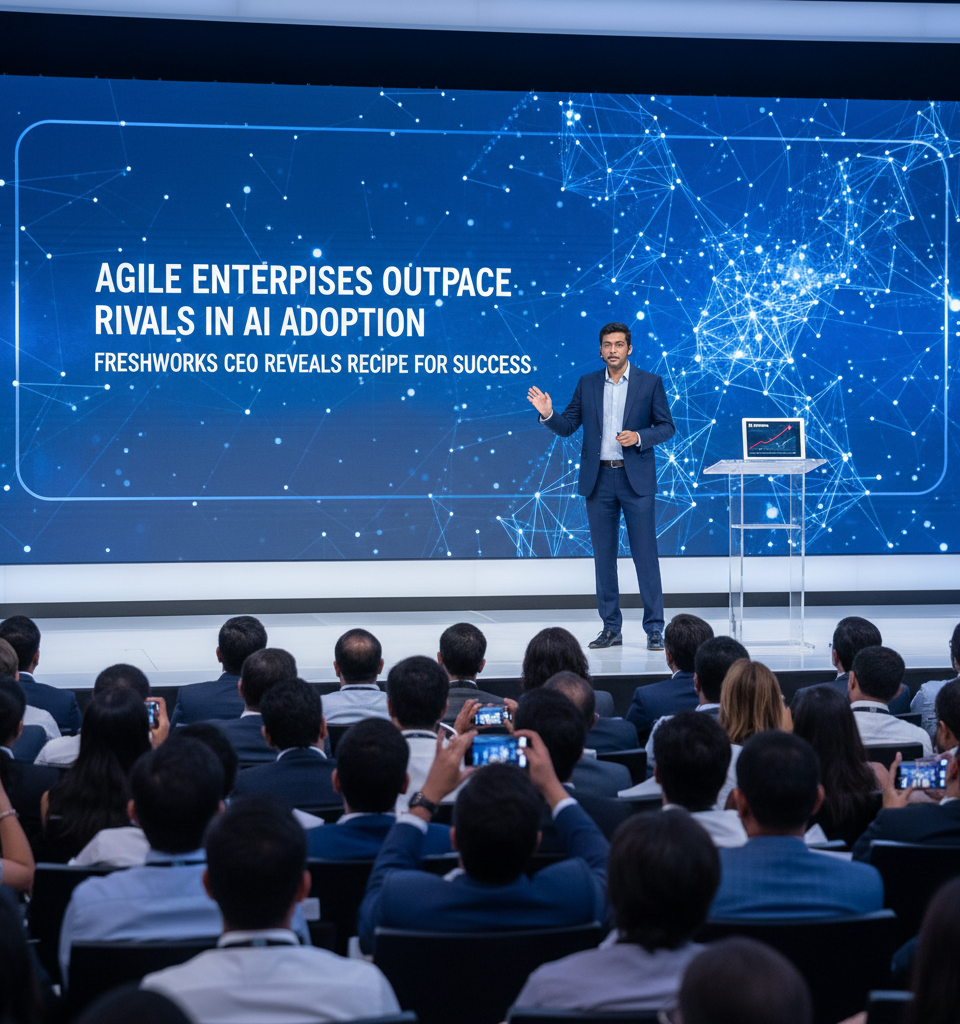
Leading enterprises that are successfully harnessing artificial intelligence are not necessarily those with the deepest pockets, but rather those demonstrating superior operational agility and a commitment to 'starting cleaner,' according to Girish Mathrubootham, CEO of Freshworks. This week, Mathrubootham underscored that the differentiating factor for AI frontrunners lies in their disciplined approach to technology adoption and strategic implementation, fundamentally reshaping how businesses ought to view their AI journey.
This insight arrives as companies globally are grappling with the complexities and immense potential of AI. The current landscape is characterized by a significant investment surge, yet many organizations struggle to translate these expenditures into tangible gains. Mathrubootham's perspective challenges the conventional wisdom that financial muscle alone guarantees innovation, suggesting instead that foundational operational discipline and a readiness to overhaul legacy systems are paramount. This narrative is especially pertinent in an era where AI promises to redefine every facet of business operations, from customer service to supply chain management.
According to Mathrubootham, the core of this 'cleaner start' involves shedding outdated technological baggage and adopting a modular, integrated approach to AI deployment. He specifically highlighted that agile enterprises are focusing on process optimization before layering on AI, ensuring that existing workflows are efficient and data streams are unencumbered. This avoids the common pitfall of automating inefficient processes, which only amplifies existing problems. Furthermore, these winning companies are prioritizing talent development and fostering a culture of experimentation, acknowledging that AI's full potential is unlocked through continuous learning and adaptation. Freshworks, a company known for its customer engagement software, itself leverages AI extensively, offering a practical demonstration of these principles within its own operations and product offerings.
The implications for the broader industry are profound. This shift in focus from mere investment to strategic implementation could redefine competitive advantages across sectors. Businesses stuck with rigid, siloed systems and entrenched operational inefficiencies risk falling further behind if they cannot adapt their approach. The emphasis on agility and cleanliness suggests a move away from monolithic, 'big-bang' AI deployments towards more iterative, focused initiatives that demonstrate value quickly. This approach not only mitigates risk but also builds internal momentum and capability, fostering a virtuous cycle of AI adoption and innovation.
Industry analysts largely echo Mathrubootham's observations. Sarah Johnson, a principal analyst at Tech Insights Group, commented, "The notion that organizations need to clean their house before inviting AI in is gaining significant traction. We're seeing a clear correlation between enterprise agility, data governance maturity, and successful AI integration. Companies that lack these foundational elements often find their AI projects mired in technical debt and organizational resistance." She further noted that the return on investment for AI is dramatically higher in companies that have invested in streamlined data architectures and flexible IT infrastructures.
Looking ahead, the imperative for operational agility will only intensify as AI technologies become more sophisticated and pervasive. Future developments will likely include greater emphasis on AI governance, ethical considerations, and the development of specialized AI talent. Businesses that are currently embracing Mathrubootham's 'cleaner start' philosophy are better positioned to navigate these complexities, integrating advanced AI models like large language models and generative AI into their core operations seamlessly. This strategic advantage will allow them to not only survive but thrive in an increasingly AI-driven market, continually innovating and adapting to new opportunities.
Ultimately, the message is clear: achieving leadership in the AI era is less about the size of an organization's war chest and more about its strategic foresight and operational discipline. The companies that are winning today are building strong foundations, embracing change, and understanding that AI is not just a technology, but a catalyst for fundamental business transformation. Those who fail to adapt to this paradigm risk being left behind in a rapidly evolving technological landscape.