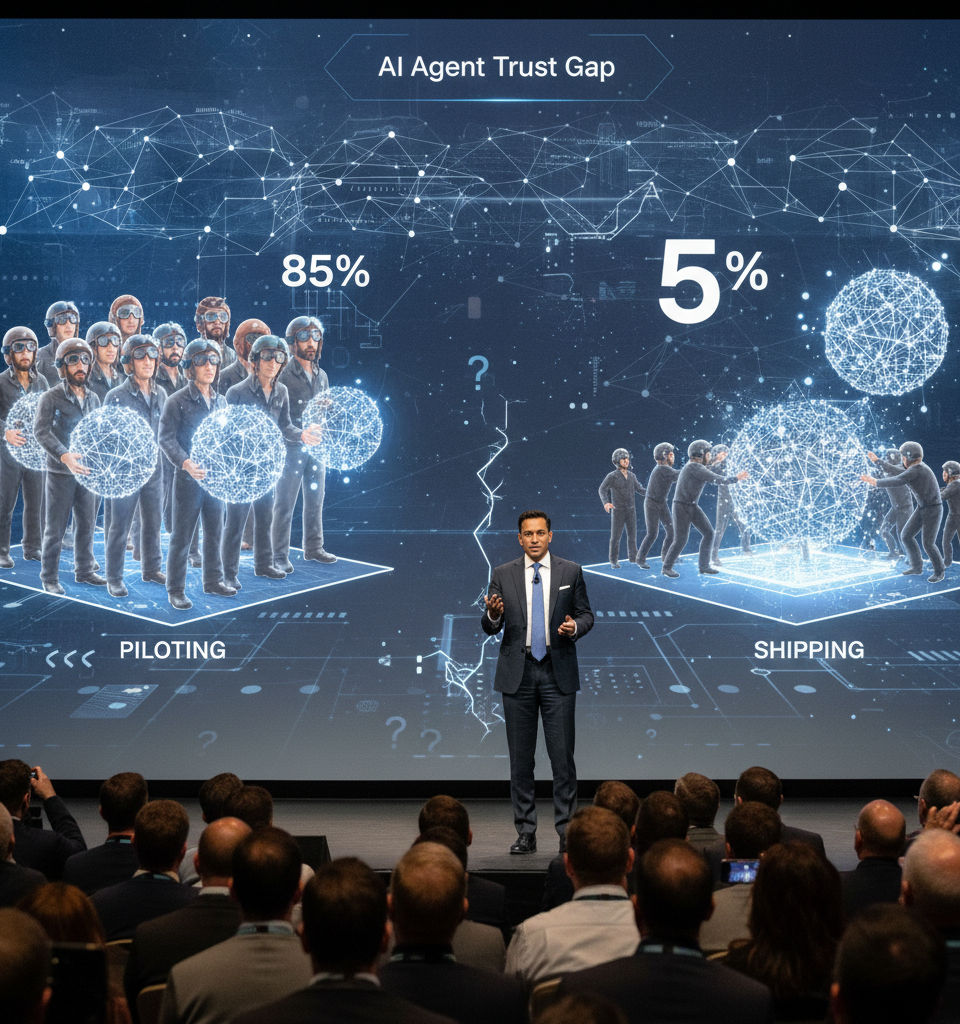
Eighty-five percent of enterprises are actively engaged in pilot programs for AI agents, but a mere 5% have successfully transitioned these agents into live production environments. This stark disparity, a key takeaway from an exclusive interview at the RSA Conference 2026, was attributed by Jeetu Patel, President and Chief Product Officer at Cisco, entirely to a fundamental lack of trust. Patel emphasized that bridging this gap is not merely a matter of efficiency, but a decisive factor distinguishing between market dominance and potential bankruptcy for companies navigating the increasingly AI-driven business landscape.
The Trust Deficit in AI Adoption
Historically, enterprises have embraced new technologies with varying degrees of caution, but the current hesitation surrounding AI agents is unprecedented. While internal experimentation with AI's potential is widespread, the leap to operational deployment is proving to be a formidable hurdle. This is not for a lack of perceived value; AI agents promise revolutionary improvements in efficiency, customer service, and data analysis. However, concerns about reliability, security, and the ability to control autonomous systems are significantly impeding their widespread adoption beyond the pilot phase. The problem, as Patel articulated, is not the specter of "rogue agents," but rather the absence of robust, verifiable trust frameworks.
Cisco's Strategic Imperative and Internal Restructuring
In response to this industry-wide challenge, Patel unveiled a significant internal mandate that he characterized as a fundamental reshaping of Cisco's expansive 90,000-person engineering organization. This strategic pivot aims to embed trust by design into every layer of Cisco's AI development and product offerings. The move signals a proactive recognition from a major technology player that the current paradigm for AI development, which often prioritizes functionality over verifiable reliability, is insufficient for enterprise-grade deployment. This restructuring is expected to involve new methodologies, revised quality assurance protocols, and a renewed focus on explainable AI and robust security measures.
Market Impact and Competitive Landscape
This trust deficit creates a unique competitive environment. Companies that can effectively build and demonstrate trustworthy AI agents stand to gain a substantial advantage, potentially capturing significant market share from competitors stalled in the pilot phase. The economic implications are vast. A report by McKinsey & Company estimated that generative AI alone could add trillions of dollars to the global economy annually, but only if enterprises can overcome these deployment bottlenecks. The current scenario suggests a "winner-take-most" dynamic, where early movers with credible AI solutions will solidify their positions, leaving others to grapple with legacy systems and cautious approaches.
Expert Perspectives on Trust and Transparency
Industry analysts broadly concur with Patel's assessment. Dr. Anya Sharma, a lead analyst in AI ethics and deployment at Gartner, commented, "The challenge isn't the technical capability of AI, but the engineering of confidence. Enterprises need assurance that these agents are predictable, auditable, and secure against both internal errors and external threats. Without transparency into their decision-making processes, the leap of faith required for full production deployment is simply too large for most risk-averse organizations." This sentiment underscores the need for innovations in AI explainability and robust governance frameworks.
The Path Forward: Building Trust by Design
The future of enterprise AI hinges on the industry's ability to develop and implement comprehensive trust architectures. This includes advancements in secure AI lifecycle management, verifiable performance metrics, ethical guardrails, and clear accountability mechanisms. Companies like Cisco are now investing heavily in these areas, understanding that the "next frontier" isn't just about building smarter AI, but building AI that can be trusted. The RSA Conference 2026 served as a critical platform for this discourse, highlighting that the conversation has shifted from "can AI do it?" to "can we trust AI to do it reliably and securely?" The coming years will undoubtedly see intensified efforts in research and development aimed at solidifying the foundational trust necessary for AI agents to reach their full enterprise potential.
Future Implications for Enterprise AI
The mandate from Cisco and the broader industry sentiment suggest a pivot towards more rigorous engineering practices for AI. This will likely lead to the development of new industry standards for AI safety, reliability, and explainability. Furthermore, the emphasis on trust will drive innovation in areas such as federated learning for data privacy, homomorphic encryption for secure computation, and advanced monitoring tools to ensure AI models remain within bounds post-deployment. Enterprises that prioritize these aspects from the outset will not only accelerate their own AI adoption but also contribute to building a more resilient and trustworthy AI ecosystem for everyone, ultimately unlocking the immense value that AI agents promise.