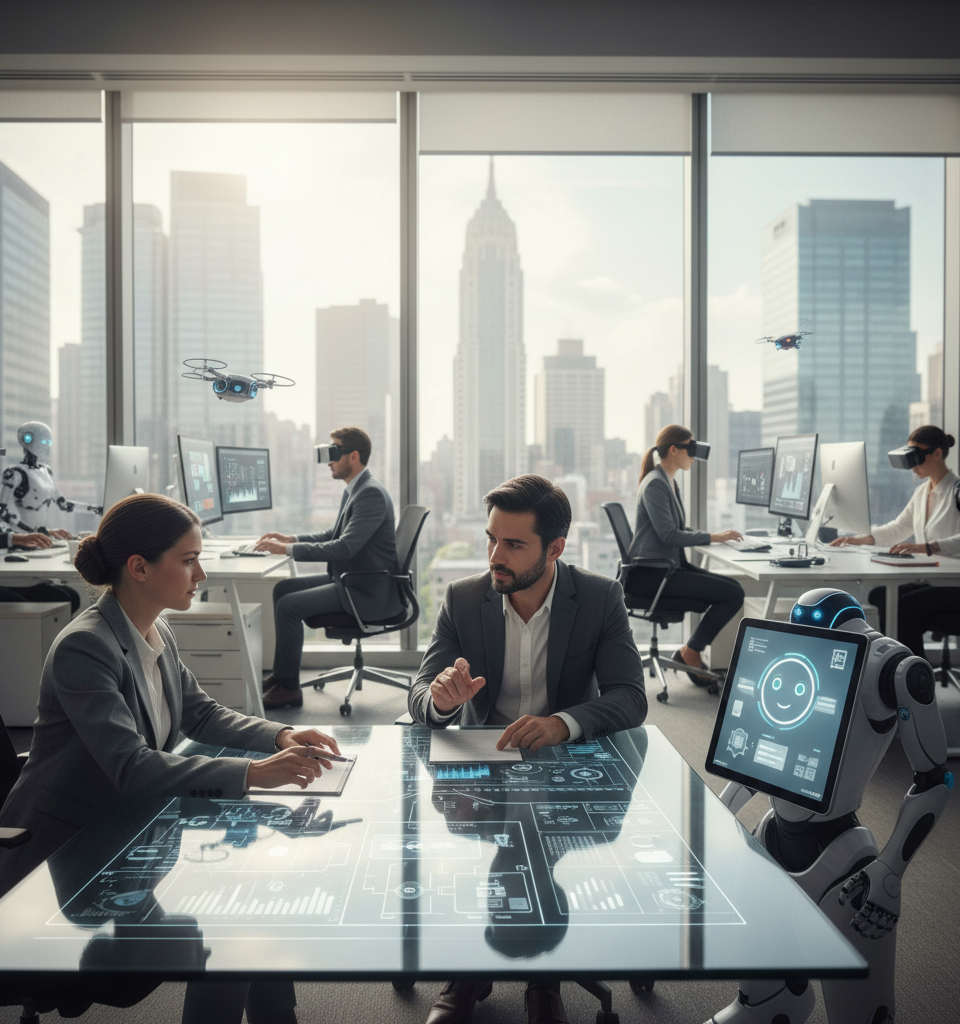
The corporate world is bracing for a profound transformation as artificial intelligence agents increasingly step into roles traditionally held by humans, fundamentally altering the nature of work. Major financial institutions and retail giants are leading this charge, integrating AI as digital assistants, operational managers, and customer concierges across their ecosystems. This strategic pivot, driven by advancements in machine learning and automation, suggests that the concept of an AI "coworker" is rapidly moving from theoretical discussion to operational reality, necessitating a re-evaluation of human roles and organizational structures.
The Dawn of the AI-Augmented Enterprise
This burgeoning trend reflects a broader industry-wide movement towards hyper-automation and intelligent augmentation. Organizations are leveraging AI not merely as a tool but as an integral part of their operational fabric. The immediate impact is seen in the automation of repetitive tasks, freeing human employees to focus on more complex, creative, and strategically valuable work. This shift is not just about efficiency; it's about fundamentally rethinking how value is created and delivered within a modern enterprise. The historical context for this can be traced back to early automation in manufacturing, but the current wave of AI agents represents a significant leap, capable of learning, adapting, and interacting in ways previously confined to science fiction.
JPMorgan Chase and Retailers Lead the Charge
" This comprehensive strategy aims to embed AI at every level of the organization, from back-office operations to client-facing services. Beyond finance, the retail sector is also experiencing a similar disruptive integration. Walmart, for instance, has embarked on extensive internal AI initiatives to optimize inventory management, personalize customer experiences, and streamline supply chain logistics.
These examples illustrate a clear industry consensus: AI agents are not a fringe technology but a core component of future business models, designed to boost productivity, enhance decision-making, and open new avenues for growth.
Widespread Industry Impact and Adoption
The ripple effects of this integration are vast, touching virtually every industry. In healthcare, AI agents are assisting with diagnostic pre-analysis and patient scheduling; in manufacturing, they are optimizing predictive maintenance and quality control. The global market for AI in enterprise applications is projected to reach over $100 billion by 2027, according to recent market analyses, growing at a compound annual growth rate (CAGR) exceeding 25%. This rapid expansion is fueled by the promise of significant ROI, including cost reductions, improved operational efficiency, and enhanced customer satisfaction. Early adopters report gains in productivity upwards of 15-20% in specific AI-augmented workflows.
Expert Perspectives on Human-AI Collaboration
Industry analysts and thought leaders emphasize the critical importance of preserving human-centric skills amidst this technological surge. "While AI agents will handle data processing and routine tasks, the uniquely human attributes—creativity, emotional intelligence, critical thinking, and complex problem-solving—will become even more valuable," commented Dr. Anya Sharma, a leading AI ethicist. "Organizations must invest in reskilling their workforce to leverage these 'human' strengths, transforming employees into supervisors and collaborators with their AI counterparts, rather than competitors." The consensus is that successful integration will depend on how effectively human workers can transition into roles that require strategic oversight, ethical judgment, and interpersonal communication, areas where AI still consistently lags.
The Evolving Role of the Human Employee
As AI agents assume more responsibilities, the human workforce will increasingly be called upon to lean into their innate human capabilities. This involves embracing roles that demand strategic thinking, empathy, innovation, and complex relational dynamics. The shift implies a future where human employees are not replaced but re-platformed, focusing on higher-order tasks, creative strategizing, and the nuanced aspects of human interaction that machines cannot replicate. Training programs and organizational culture will need to evolve to support this new paradigm, emphasizing continuous learning and adaptability as core competencies.
Future Implications and Ethical Considerations
The trajectory points toward an increasingly sophisticated integration of AI into daily work life. Future AI agents are expected to become more autonomous, capable of proactive problem-solving and even contributing to strategic planning. However, this advancement also brings forth critical ethical and societal questions regarding job displacement, data privacy, algorithmic bias, and the overall impact on human agency. Regulators, corporations, and academic institutions are grappling with how to ensure responsible AI development and deployment. The success of this transition will depend not only on technological prowess but also on careful ethical consideration and robust policy frameworks to navigate the complexities of a truly human-AI collaborative future.