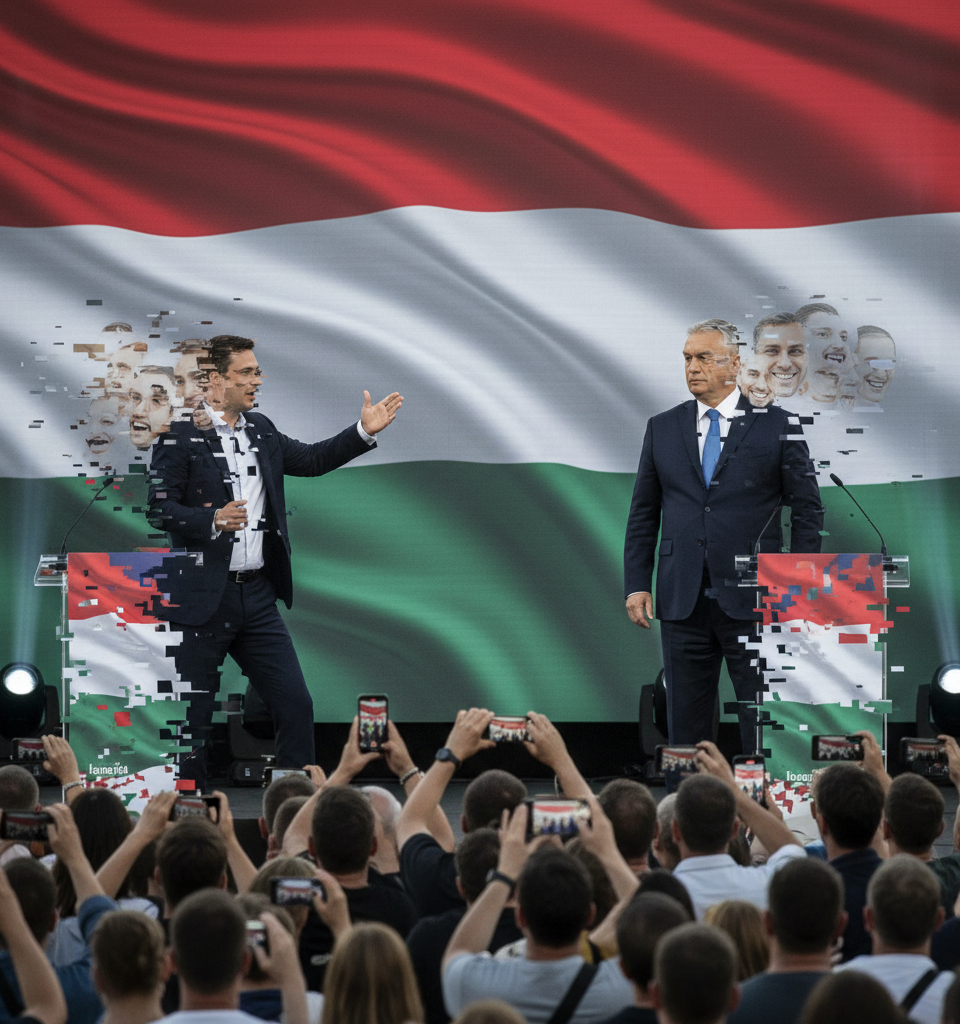
BUDAPEST – Hungary's upcoming general election is being significantly impacted by a wave of AI-generated videos and sophisticated disinformation campaigns targeting Prime Minister Viktor Orbán's leading rival. These digitally manipulated narratives aim to discredit and undermine the opposition candidate, Péter Magyar, who has rapidly emerged as a formidable threat to Orbán's 16-year tenure, raising urgent concerns about the weaponization of artificial intelligence in democratic processes and the erosion of journalistic integrity.
The Disinformation Landscape: A Growing Threat
The strategic deployment of AI-powered content in political campaigns marks a concerning evolution in how elections are contested. For years, Orbán's Fidesz party has been accused of leveraging state media and well-funded propaganda networks to maintain its grip on power. However, the introduction of AI-generated videos, including 'deepfakes' that convincingly depict individuals saying or doing things they never did, represents a new frontier in information warfare. This development is particularly critical in a country where media pluralism has diminished, making it harder for citizens to discern fact from fiction.
Key Details: Targeting the Challenger
The AI-generated videos primarily focus on Péter Magyar, a former government insider who broke ranks with Orbán's administration earlier this year and has since galvanized significant public support. These videos often feature distorted audio or cleverly edited footage designed to provoke outrage, cast doubt on Magyar's credibility, or associate him with unpopular political figures and ideologies. While the specific creators of these materials are often obscured, their rapid dissemination across social media platforms, often by anonymous accounts, points to a coordinated effort to influence public opinion in the highly polarized Hungarian political environment.
Broader Implications for Democracy and Information Integrity
This incident in Hungary is not an isolated event but rather indicative of a global trend where AI tools are being increasingly exploited to create and spread sophisticated disinformation. The ability of AI to generate highly realistic, yet entirely fabricated, video and audio content poses a significant challenge to media organizations, fact-checkers, and electoral commissions worldwide. As AI technology becomes more accessible and advanced, the cost and effort required to produce compelling misinformation decrease, potentially democratizing the spread of falsehoods and further eroding public trust in news sources and democratic institutions.
Expert Analysis: A New Era of Political Warfare
Security and digital forensics experts warn that the Hungarian election could serve as a case study for future AI-driven political manipulation. Dr. Elena Petrova, a disinformation researcher at the University of Warsaw, stated, "What we are seeing in Hungary is a chilling demonstration of how easily AI can be weaponized to undermine electoral integrity. The sophistication of these deepfakes means that even a discerning audience can be misled, and the speed of their dissemination makes effective counter-measures incredibly difficult." She added that the lack of robust regulatory frameworks for AI in political campaigning exacerbates the problem.
Regulatory Gaps and the Search for Solutions
The current legal and technological frameworks are ill-equipped to handle the scale and subtlety of AI-powered disinformation. Most countries lack specific legislation addressing the malicious use of AI in political campaigns, and platforms like Facebook, X (formerly Twitter), and TikTok are struggling to effectively moderate and remove such content. Technology companies are investing in detection tools, but the arms race between AI generation and detection remains fierce. There is a growing call for international cooperation and standardized policies to combat this emerging threat, including mandatory labels for AI-generated content and stricter penalties for its malicious use.
The Road Ahead: Potential Outcomes and Future Elections
As Hungary approaches its election, the impact of these AI-generated videos will be closely watched. Should Orbán secure another term, it could embolden other political actors globally to adopt similar tactics, further normalizing the use of AI in election interference. Conversely, if Magyar's campaign effectively counters the disinformation and maintains public trust, it could provide valuable lessons for future elections. The Hungarian experience underscores the urgent need for robust media literacy initiatives, technological advancements in deepfake detection, and strong regulatory measures to safeguard democratic processes in an increasingly AI-driven world.