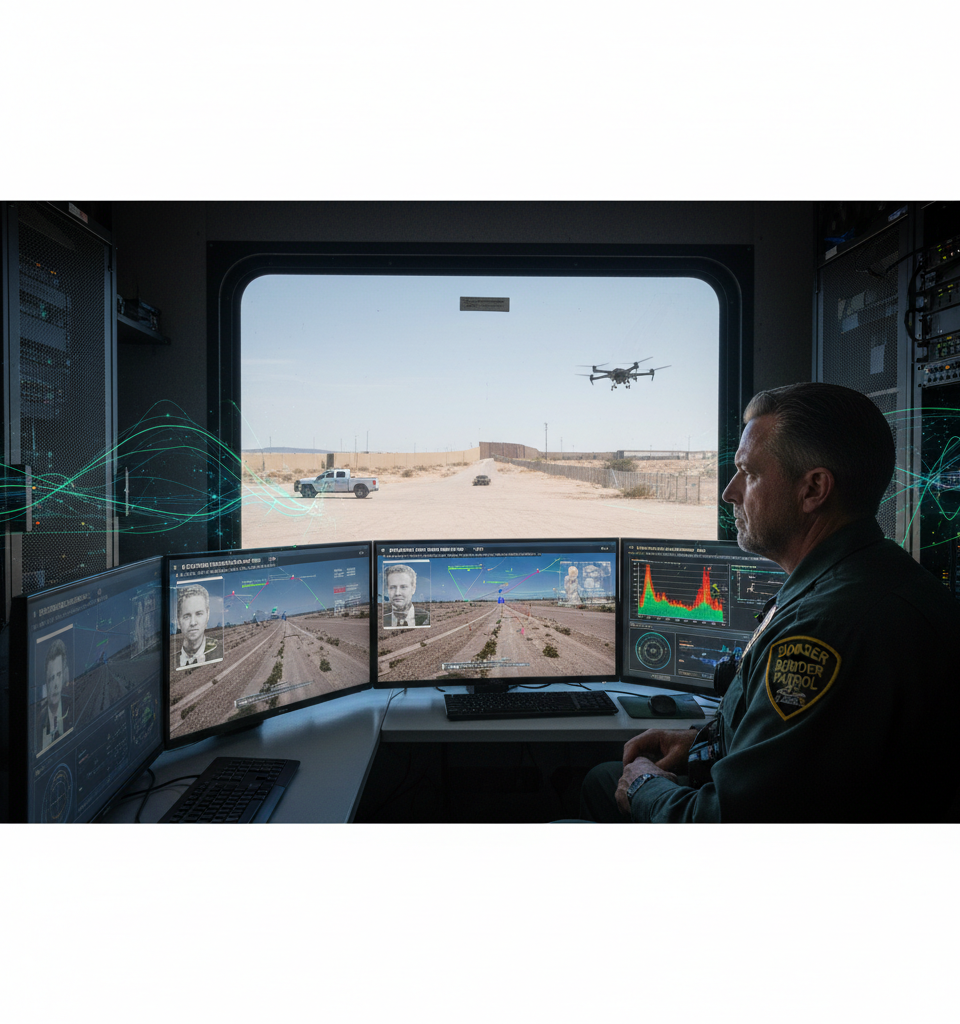
The substantial financial commitments made to border security during the Trump administration have catalyzed a rapid expansion in the adoption and development of artificial intelligence-powered surveillance systems, fundamentally reshaping the landscape of immigration enforcement. This surge in spending has not only bolstered existing technologies but has also drawn a fresh cohort of technology companies into the competitive arena of border monitoring, eager to capitalize on lucrative government contracts and deploy advanced AI solutions for detection, identification, and analysis along national frontiers.
The Catalytic Effect of Trump-Era Funding
Historically, border security has relied on a combination of physical barriers, human patrols, and more rudimentary sensing technologies. However, the Trump administration’s focus on border reinforcement, epitomized by its pursuit of a border wall, was accompanied by parallel, less publicized, but equally significant investments in high-tech surveillance. Billions of dollars were allocated to agencies like Customs and Border Protection (CBP) and Immigration and Customs Enforcement (ICE), with a significant portion earmarked for technological enhancements.
This policy shift created an unprecedented demand for sophisticated solutions, enabling private sector innovation to flourish in areas like computer vision, machine learning, and autonomous systems. The rationale was to supplement or even surpass human capabilities in vast, often remote, border regions, thereby increasing efficiency and reducing operational costs in the long term.
Emergence of Advanced AI Solutions
The infusion of capital has accelerated the deployment of cutting-edge AI. Companies are now offering AI systems capable of autonomously identifying objects, distinguishing between humans and animals, detecting suspicious patterns, and even predicting movements across complex terrains. For instance, CBP has invested in surveillance towers equipped with AI-driven cameras that can process live video feeds, flagging anomalies to human operators. Drones, once primarily for aerial reconnaissance, are now integrating AI for real-time threat assessment and target tracking. Furthermore, biometric recognition systems leveraging AI are being deployed at ports of entry, significantly speeding up identification processes while enhancing security checks. These systems promise a "smarter" border, less dependent on constant human vigilance across thousands of miles of varied terrain.
Shifting Market Dynamics and New Entrants
This robust government spending has fundamentally altered the competitive landscape within the defense and security technology sector. Traditional defense contractors are now facing nimble, tech-first startups specializing in AI and data analytics. Companies that previously focused on commercial applications, such as facial recognition software or drone analytics, are now pivoting to the lucrative government security market. This influx of new players is fostering rapid innovation, driving down costs through increased competition, and pushing the boundaries of what's technologically feasible for border enforcement. The market for AI-powered surveillance, once a niche segment, is fast becoming a significant growth area within the broader defense technology industry, attracting substantial venture capital.
Expert Perspectives on Efficacy and Ethics
While proponents within government agencies and the tech sector laud the efficiency and enhanced security capabilities offered by AI, external experts and civil liberties advocates raise pertinent questions. Dr. Elena Petrova, a defense technology analyst at the Heritage for Emerging Technologies Institute, notes, "The sheer volume of data these AI systems generate poses significant challenges for storage, processing, and human oversight.
" Concerns around algorithmic bias, particularly in facial recognition of diverse populations, and the potential for mass surveillance without adequate transparency or accountability, remain central to the ethical debate. The effectiveness of AI in deterring illegal crossings versus merely displacing them to different areas is also a point of ongoing academic scrutiny.
Looking Ahead: The Future of AI in Border Security
The trajectory for AI in border security points towards increasing autonomy and integration. Future developments are likely to include more sophisticated predictive analytics that can anticipate migration patterns based on economic, social, and environmental factors, allowing for proactive resource deployment. We can also expect to see closer integration of various AI systems, creating a comprehensive, interconnected surveillance network. However, alongside technological advancements, there will be growing pressure for greater ethical oversight, robust accountability frameworks, and public discourse on the societal implications of such pervasive surveillance. The balance between national security imperatives and individual privacy rights will continue to be a critical, evolving challenge, shaping the next generation of AI-driven border technologies.