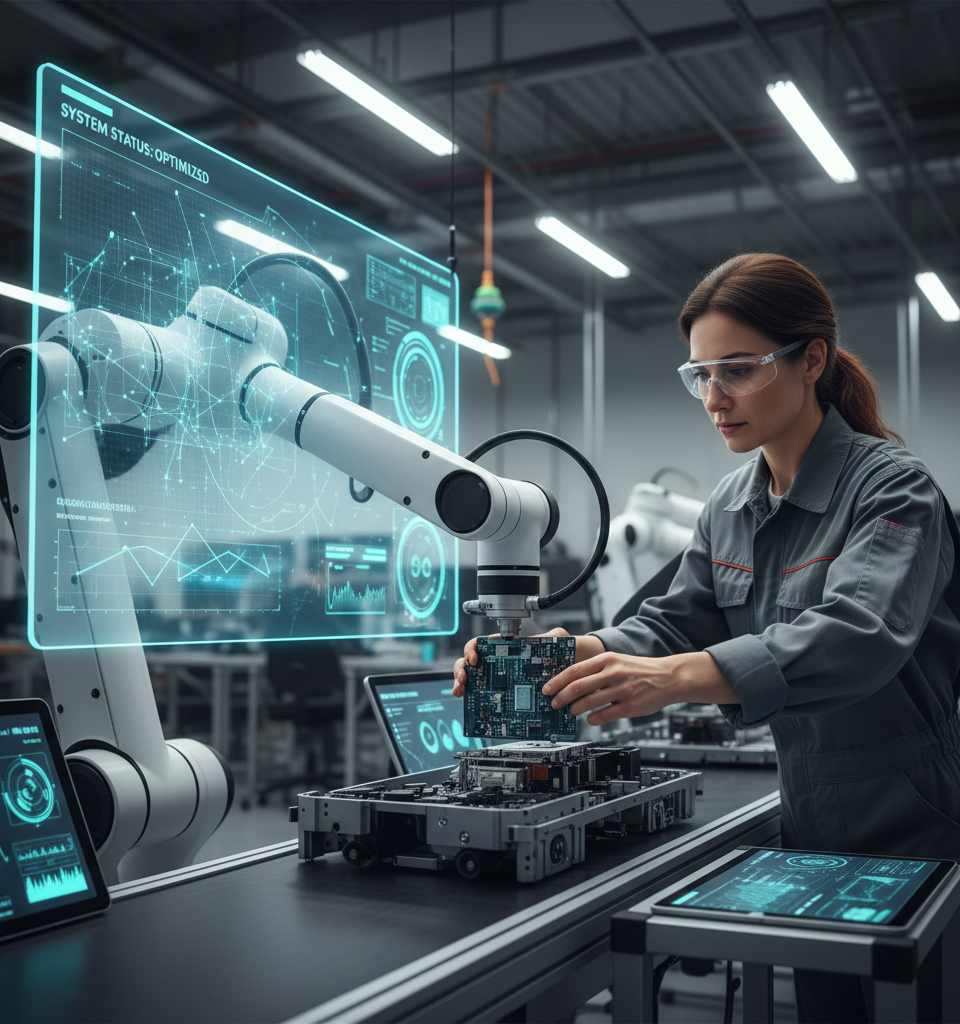
The rapid integration of artificial intelligence (AI) is fundamentally transforming the capabilities and accessibility of collaborative robots, colloquially known as cobots. This evolution is positioning cobots for a much wider array of applications across various industries, making them simpler to operate and significantly smarter in their interactions and tasks. The enhanced intelligence is fostering a new era of human-robot collaboration, promising improved efficiency and flexibility in manufacturing and service sectors.
Previously, cobots, while inherently designed for safe interaction with humans, often required specialized programming and were best suited for repetitive, well-defined tasks. The computational limitations restricted their adaptability to dynamic environments or tasks requiring nuanced decision-making. This often meant extensive setup times and a narrower range of implementable scenarios, somewhat limiting their widespread adoption despite their safety benefits. The current advancements address these historical constraints, unlocking new frontiers for robotic deployment.
The core of this transformation lies in sophisticated AI algorithms that enable cobots to learn from demonstrations, understand natural language commands, and adapt to unforeseen changes in their environment. This move towards smarter perception and cognitive abilities significantly reduces the need for complex, line-by-line coding, replacing it with more intuitive teaching methods. For example, a cobot can now be taught a new task by simply guiding its arm through the motion, or by processing visual cues, a stark contrast to older, more cumbersome programming protocols. This simplification is paramount for companies lacking dedicated robotics engineers, democratizing access to automation.
Broadening Industrial Horizons
The impact on various industries is substantial. In manufacturing, cobots are moving beyond simple pick-and-place operations to more intricate assembly, quality inspection, and even delicate handling of materials. Their enhanced intelligence allows them to adjust to variations in product batches or reconfigure tasks on the fly, crucial in an era demanding agile production lines. Furthermore, in logistics and warehousing, AI-powered cobots can optimize routes, sort packages with greater accuracy, and assist in inventory management, thereby streamlining operations and reducing human error.
Expert Outlook on Future Integration
Industry analysts consistently highlight the scalability and flexibility offered by these new-generation cobots. Experts anticipate a significant increase in return on investment (ROI) for businesses that adopt these intelligent machines, primarily due to reduced training times, increased operational uptime, and the ability to redeploy cobots across different tasks with minimal recalibration. The consensus points towards an acceleration in the adoption curve across small and medium-sized enterprises (SMEs) which historically found advanced automation cost-prohibitive.
The Path Ahead: Enhanced Autonomy and Collaboration
Looking ahead, the trajectory for AI-infused cobots involves even greater autonomy and more seamless human-robot interfaces. Research and development are focusing on improving predictive maintenance capabilities, allowing cobots to anticipate and report potential issues before they cause downtime. Further innovations are expected in areas like collective intelligence, where multiple cobots can coordinate complex tasks autonomously, and in advanced haptic feedback systems that will make physical collaboration even safer and more intuitive. The future promises environments where humans and cobots work side-by-side, each leveraging their unique strengths to achieve unprecedented levels of productivity and innovation.