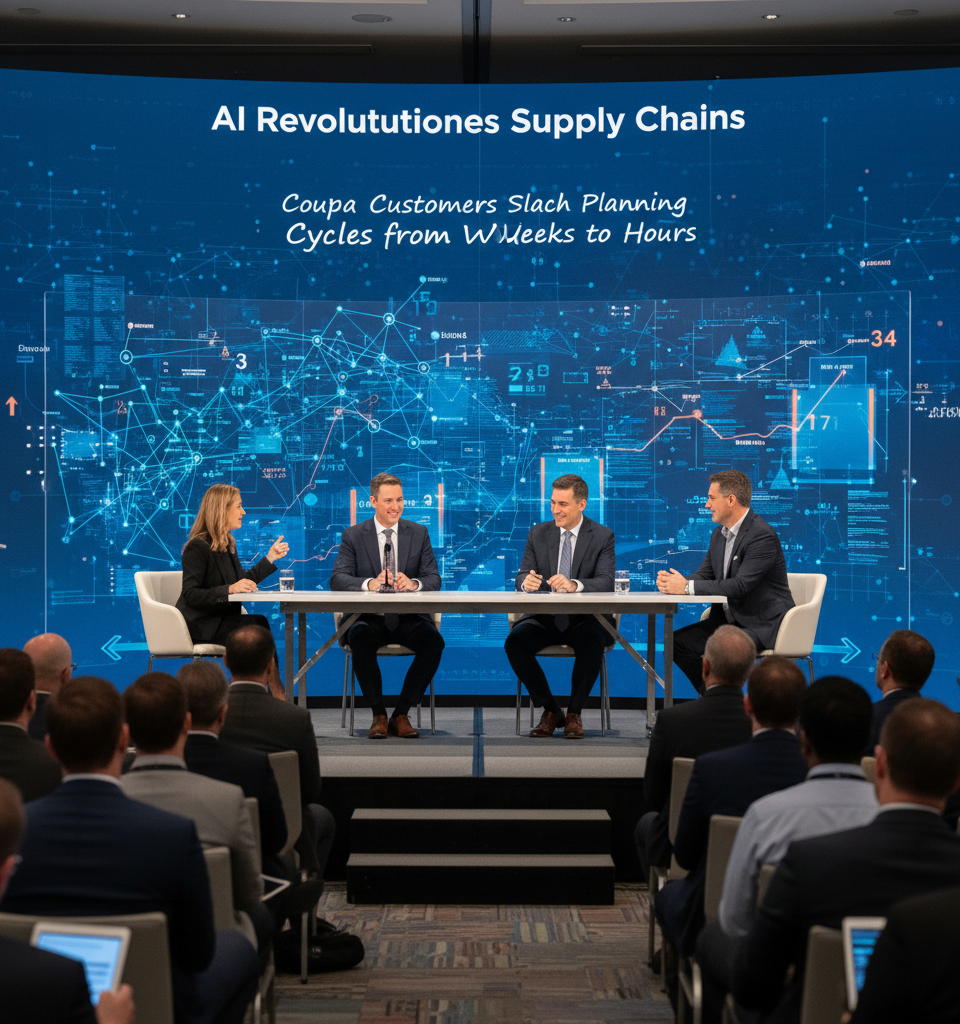
Leading companies are rapidly embracing artificial intelligence to reshape their supply chain operations, with Coupa customers at the forefront of this digital transformation. At the Inspire 2026 conference, executives and users of Coupa's business spend management platform highlighted how AI-driven tools and sophisticated transportation optimization are not merely enhancing efficiency but fundamentally altering the speed and agility of complex supply chains. The overarching sentiment, encapsulated by the phrase "AI is the new UI," underscores a shift towards intuitive, AI-powered interfaces that automate decision-making and streamline processes that once required extensive manual intervention.
The Urgency of Automation
The push for automation in supply chains is not new, but recent global disruptions – from pandemics to geopolitical tensions – have amplified the urgency. Traditional planning cycles, often stretching over several weeks or even months, proved inadequate in volatile markets. Companies struggled with a lack of real-time visibility, inefficient resource allocation, and slow responses to unforeseen events. Coupa's integration of AI, particularly in areas like spend analysis, procurement, and logistics, aims to close these gaps, allowing businesses to predict demand more accurately, optimize routes, and manage inventory dynamically. This shift represents a significant evolution from reactive problem-solving to proactive, predictive management.
Quantifiable Gains and Customer Success Stories
Attendees at Inspire 2026 shared compelling evidence of AI's impact. One presenter, a logistics manager from a major retail conglomerate, detailed how their firm reduced its monthly sales and operations planning (S&OP) cycle from three weeks to under 48 hours using Coupa's AI-enabled forecasting and scenario planning tools. Another example cited a manufacturing company that, through intelligent freight optimization powered by AI, achieved a 15% reduction in transportation costs within six months, alongside a 10% improvement in on-time delivery rates. These demonstrable results are fueling further investment and adoption of AI technologies across various industries. The integration of AI extends beyond simple data analysis, enabling systems to learn from past performance, identify patterns, and recommend optimal solutions with minimal human oversight.
Reshaping the Supply Chain Landscape
This rapid adoption of AI is poised to fundamentally reshape the broader supply chain and logistics industries. Companies that effectively leverage these advanced tools will gain a significant competitive advantage, characterized by superior responsiveness, reduced operational costs, and enhanced resilience. The ability to simulate various scenarios and predict potential bottlenecks in real-time allows for more robust contingency planning. Furthermore, the integration of AI into procurement processes is leading to smarter supplier selection and contract negotiation, driving down overall spend and mitigating risks associated with supply chain disruptions.
Expert Perspectives on AI's Trajectory
Industry analysts and supply chain experts largely concur with the positive outlook presented at Inspire 2026. Dr. Evelyn Chen, a professor of supply chain management at a leading university, commented, "What we're witnessing is a paradigm shift where AI is moving from being a supporting technology to a core operational intelligence. It's no longer just about automating tasks but about automating decision-making at scale." She emphasized the importance of data quality and ethical considerations in AI deployment, noting that while the technology offers immense potential, its effectiveness is deeply tied to the underlying data architecture and human oversight. Other experts highlighted the growing trend of generative AI in supply chain design, allowing companies to create entirely new, optimized network configurations.
The Road Ahead: Hyper-automation and Cognitive Supply Chains
The future implications of AI in supply chain management point towards even higher levels of automation and the emergence of what some term "cognitive supply chains." This next phase will involve AI systems that can learn, adapt, and autonomously execute complex decisions across the entire supply chain ecosystem, from sourcing raw materials to final delivery. Upcoming developments include enhanced predictive maintenance for logistics assets, more sophisticated demand sensing that incorporates external factors like social media trends and weather patterns, and the wider application of digital twins for real-time operational mirroring and simulation. As companies continue to invest in these capabilities, the traditional manual and often fragmented approaches to supply chain management will likely become relics of the past, paving the way for truly intelligent and self-optimizing networks.