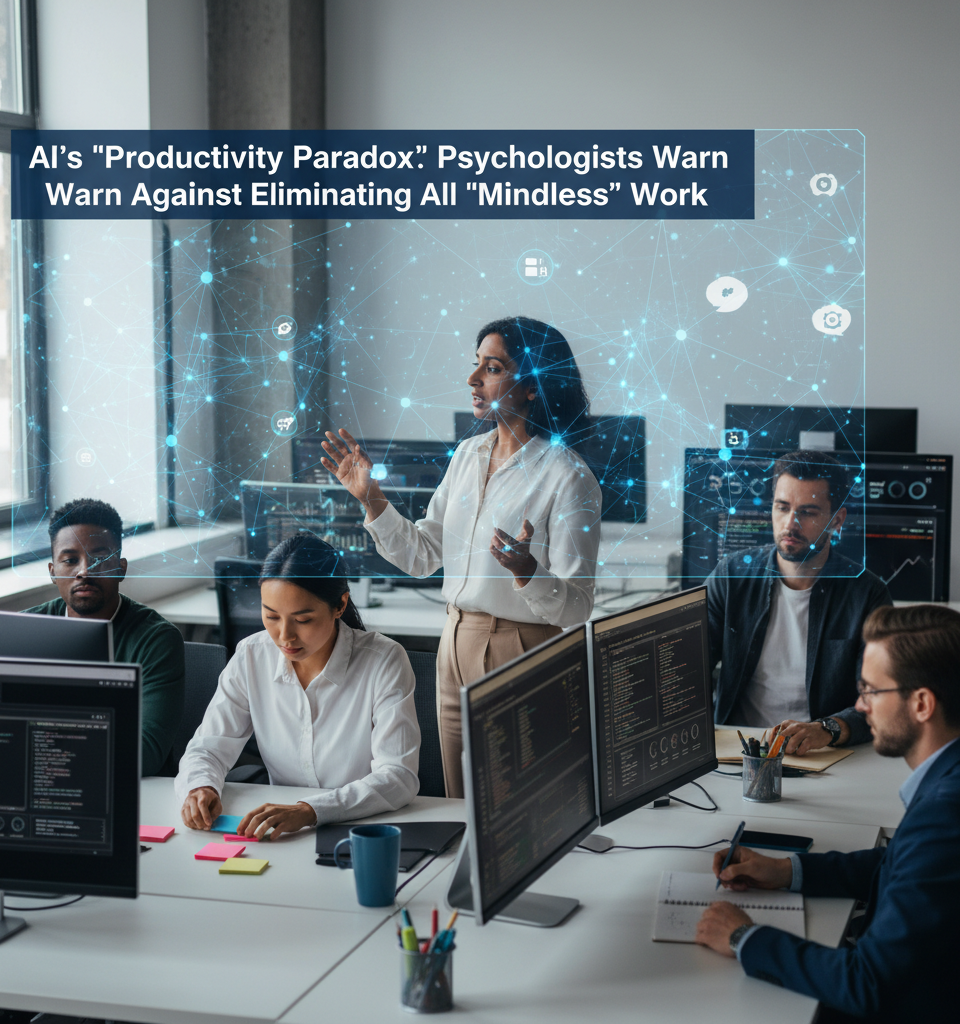
San Francisco, CA – The relentless march of artificial intelligence into the modern workplace, heralded as a liberator from drudgery, is confronting an unexpected psychological hurdle. While AI systems are rapidly being deployed to automate repetitive and low-cognitive-load tasks – from data entry to routine correspondence – a burgeoning body of research from psychologists and cognitive scientists suggests that these very 'mindless' activities may be crucial for maintaining mental bandwidth, fostering creativity, and preventing burnout. This emerging paradox challenges the prevailing corporate narrative that efficiency gains should always trump the nuanced needs of the human mind.
The Unseen Value of 'Grunt Work'
Historically, the pursuit of labor-saving technologies has always focused on offloading undesirable tasks. From the agricultural revolution to the industrial age, advancements aimed to free humans from physical toil. AI represents the latest frontier, promising to unburden knowledge workers from cognitive chores. However, psychologists like Dr. Sandi Mann, a senior lecturer at the University of Central Lancashire and author of 'The Science of Boredom,' argue that moments of low-stimulation, often found in repetitive work, are not wasted time. Instead, they serve as vital periods for the brain to consolidate memories, engage in diffuse thinking, and generate novel ideas. This 'incubation' period is critical for complex problem-solving and innovation.
Expert Insights and Cognitive Implications
Studies cited by researchers indicate that during periods of boredom or engagement in routine tasks, the brain's Default Mode Network (DMN) becomes highly active. The DMN is associated with self-reflection, planning, and creative thought. "When we're constantly engaged in high-cognitive-load tasks, our brains are in a state of hyper-focus, leaving little opportunity for the DMN to activate and do its essential work," explains Dr. Maria Sanchez, a cognitive psychologist specializing in workplace well-being. "Eliminating all 'grunt work' under the guise of efficiency could lead to a workforce that is perpetually overstimulated, mentally fatigued, and ultimately less innovative." This perspective contrasts sharply with projections from firms like McKinsey & Company, which estimate AI could automate up to 30% of current work activities by 2030, potentially unlocking trillions in economic value.
Industry Reactions and A Shifting Paradigm
The implications for business are profound. Companies investing billions in AI platforms, such as Microsoft's Copilot and Google's Gemini, are primarily driven by the promise of enhanced productivity and cost savings. For instance, a recent report by PwC suggested AI could boost global GDP by $15.7 trillion by 2030, partly through increased labor productivity. However, ignoring the psychological costs could undermine these gains. "The goal should not be to eradicate mundane tasks entirely, but to strategically reallocate them, understanding that some level of low-demand activity is beneficial," says David Lee, a senior HR consultant focusing on AI integration. "Forward-thinking organizations are beginning to explore blending AI-driven efficiency with human-centric work design, perhaps by integrating 'mind-wandering' breaks or structured downtime rather than fully automating every last simple task."
The Call for 'Mindful Automation'
Leading experts advocate for a more nuanced approach, coining the term 'mindful automation.' This strategy involves critically assessing which tasks are truly detrimental to human well-being and which, despite their apparent simplicity, offer cognitive benefits. "It's about finding the sweet spot where AI augments human potential without inadvertently diminishing our innate cognitive processes," says Dr. Ethan Cross, a research fellow at the Stanford Institute for Human-Centered AI. He proposes that companies consider designing work environments where employees have designated periods for diffuse thinking, perhaps even integrating AI-generated 'breaks' that prompt low-stakes, creative challenges rather than constant high-pressure output.
Future Workforce Design and Ethical AI
The conversation around AI's impact is evolving beyond just job displacement to encompass cognitive health. Future workplace design will likely need to incorporate insights from psychology and neuroscience to create truly sustainable and productive environments. This could involve AI tools designed not just for task completion but also for monitoring cognitive load and suggesting periods of disengagement. Ethical AI development, therefore, must extend beyond bias and privacy to include an understanding of human psychology, ensuring that these powerful technologies uplift rather than inadvertently diminish our mental capacities. As AI continues its rapid deployment, the challenge for leaders will be to leverage its power thoughtfully, ensuring that the quest for efficiency does not come at the expense of human flourishing and innovation.
Redefining Productivity in an AI Era
The debate highlights a crucial redefinition of 'productivity.' In a world increasingly augmented by AI, productivity may not solely be measured by the volume of output, but also by the quality of thought, innovation, and long-term mental resilience of the workforce. Companies that grasp this distinction, embracing AI as a partner in nuanced work design rather than a blunt instrument for total automation, are likely to cultivate healthier, more creative, and ultimately more competitive teams in the AI-driven economy.