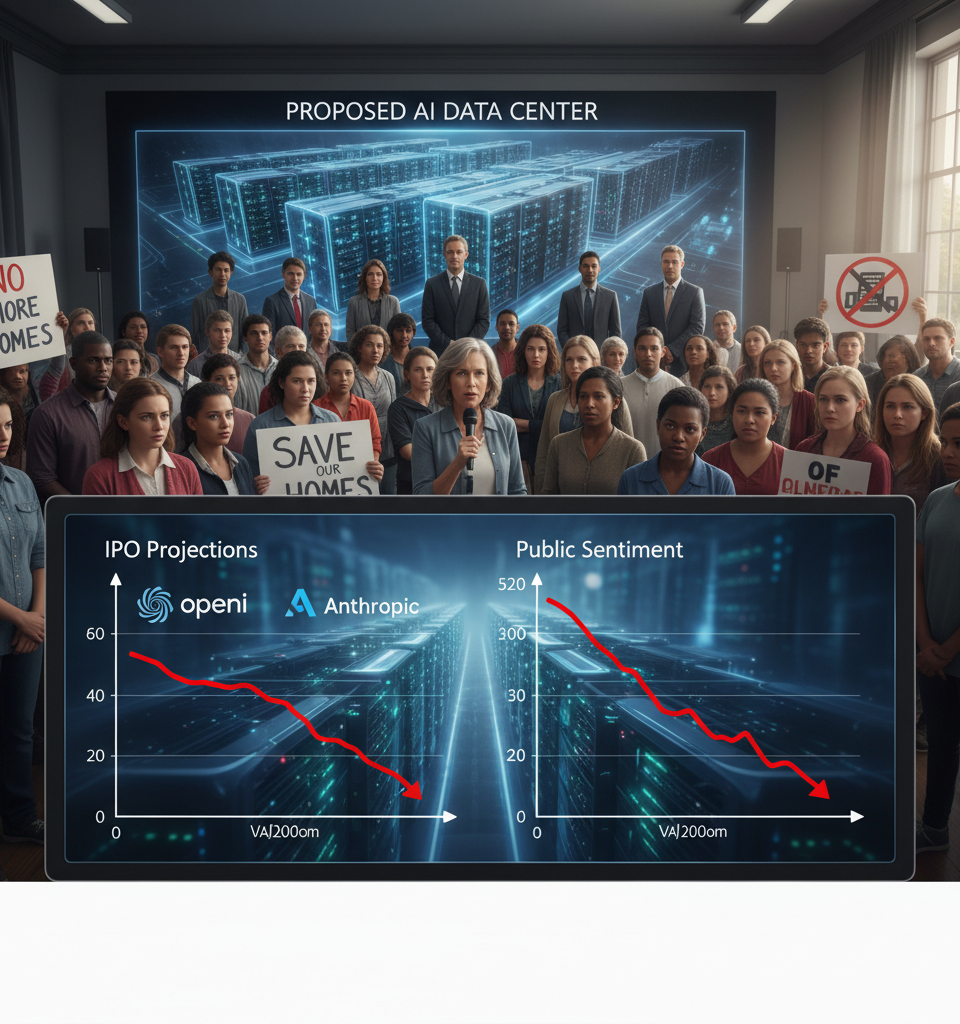
The burgeoning optimism surrounding artificial intelligence, once championed as the next technological frontier, is facing a growing public backlash that threatens to derail the ambitious IPO plans of industry frontrunners like OpenAI and Anthropic. This mounting discontent, fueled by concerns over AI ethics, job displacement, and the environmental footprint of expansive data centers, casts a long shadow over a sector previously characterized by unbridled growth and investor enthusiasm. The confluence of public skepticism and the sheer scale of infrastructural demands is creating a socio-political flashpoint, positioning AI and data center development as a potential flashpoint in upcoming midterm elections and demanding a strategic pivot from tech titans.
This shift in public sentiment represents a critical juncture for the AI industry. For years, narratives surrounding AI focused on its transformative potential across healthcare, finance, and logistics. However, the rapid proliferation of generative AI tools, coupled with high-profile incidents of algorithmic bias and misinformation, has eroded trust. Simultaneously, the physical manifestation of AI's power—massive, energy-guzzling data centers—are increasingly drawing ire from local communities and environmental advocates. These facilities, essential for processing the vast datasets underpinning AI models, demand immense power grids and water supplies, often straining local resources and contributing to carbon emissions. This evolving perception is particularly problematic for companies like OpenAI, reportedly exploring a valuation upwards of $80 billion, and Anthropic, recently valued at over $18 billion, as they prepare to court public investors.
Key metrics underscore the scale of this challenge. A recent Pew Research Center study indicated that nearly 60% of Americans are more concerned than excited about AI's development. This concern directly translates to public opposition to the physical infrastructure required. Data center construction, predicted to grow at a compound annual growth rate (CAGR) of over 10% through 2030, is encountering fierce NIMBYism (Not In My Backyard). For instance, in Loudoun County, Virginia – often dubbed 'Data Center Alley' – opposition groups have successfully pushed for moratoria on new builds, citing noise pollution, visual blight, and strain on utilities. These local battles are symptomatic of a broader societal re-evaluation of technology's societal costs, challenging the long-held assumption that innovation automatically equates to public good.
The implications for the broader technology landscape are profound. Beyond affecting individual IPOs, a sustained public backlash could trigger regulatory interventions, potentially leading to stricter environmental impact assessments, data governance frameworks, and even moratoria on data center construction in sensitive areas. This could significantly increase operational costs for tech giants accustomed to rapid expansion, forcing them to invest heavily in sustainable practices, community engagement, and transparent AI development. Furthermore, it could shift investment away from purely performance-driven AI models towards those that prioritize ethical considerations and resource efficiency, fundamentally altering market dynamics.
Industry analysts are keenly observing these developments. "The days of 'move fast and break things' are unequivocally over for big tech, especially concerning AI," notes Emily Chen, a senior analyst at Tech Insights Group. "Public relations disasters, regulatory scrutiny, and grassroots opposition to data center development can wipe billions off valuations overnight. Companies pursuing IPOs will need to articulate a compelling narrative not just of innovation and profit, but of responsible stewardship and genuine societal benefit. Environmental, Social, and Governance (ESG) factors are no longer peripheral; they are central to investor confidence and public acceptance." Chen suggests that companies might need to spend 15-20% more on sustainable infrastructure and community outreach to mitigate these risks.
Looking ahead, the narrative around AI and data centers will undoubtedly intensify. Upcoming midterm elections are likely to feature candidates championing either technological advancement or environmental protection and community rights, putting these issues squarely on the political agenda. Tech companies, rather than merely lobbying, will need to proactively engage in public education campaigns, invest in transparent AI explainability, and demonstrably commit to sustainable data center operations, including renewable energy sourcing and water efficiency. Research into less resource-intensive AI architectures (e.g., 'green AI') will also become paramount, driven as much by public pressure as by scientific curiosity.
The future success of AI, particularly in terms of gaining public trust and securing investor confidence, hinges on its ability to navigate this complex socio-political landscape. Failure to address these concerns could result in a chilling effect on innovation, increased regulatory burdens, and ultimately, a significant setback for a technology poised to redefine the 21st century. The impending IPOs of OpenAI and Anthropic will serve as crucial bellwethers, testing the market's appetite for AI in an era of heightened public scrutiny and environmental consciousness.
Ultimately, the challenge extends beyond mere public relations; it necessitates a fundamental re-evaluation of the tech industry's social contract. As AI models grow more powerful and data centers more pervasive, the industry must proactively address privacy concerns, ethical implications, and environmental impacts, or risk facing a protracted period of public and political resistance that could stifle its ambitious trajectory. The opportunity for AI to truly transform society still exists, but it is now inextricably linked to the industry's capacity for responsibility and transparency.