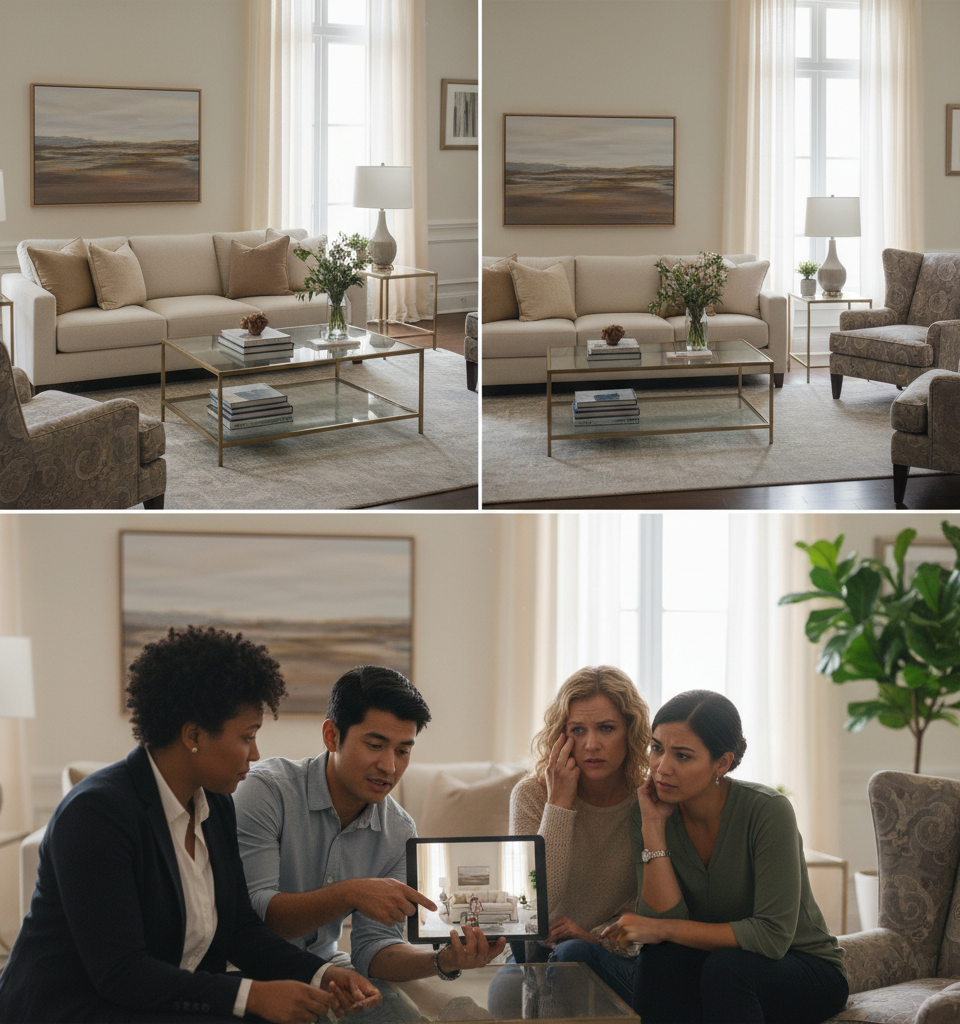
The burgeoning reliance on artificial intelligence for real estate staging is facing a significant hurdle, as inconsistencies in spatially rendered listing photos are increasingly undermining buyer trust. Homebuyers navigating online platforms are discovering discrepancies between AI-staged images of the same room, leading to confusion and skepticism about a property's true representation. This issue, often subtle but impactful, highlights a critical need for advanced AI solutions that can maintain spatial coherence across multiple angles, a development now emerging as a key differentiator in the digital property market.
The core problem stems from traditional AI staging often treating each photo as an isolated canvas, rather than understanding the cohesive spatial relationship between different views of the same area.
The Erosion of Buyer Confidence
For decades, visually compelling real estate listings have been paramount, evolving from static photographs to 3D virtual tours. The advent of AI staging aimed to democratize access to professional-grade visuals, offering cost-effective and rapid transformations of empty or poorly furnished spaces. However, early iterations of this technology frequently overlooked the crucial element of spatial consistency. A common scenario involves an AI-staged living room where an armchair appears in one corner from a wide shot, but inexplicably shifts or disappears when viewed from a different angle, for instance, looking towards a fireplace. This visual discord, though seemingly minor, acts as a subconscious red flag for potential buyers, fostering doubt about the authenticity of the listing. In an industry where trust is paramount, such inconsistencies can deter serious inquiries and prolong sales cycles for valuable properties, ultimately impacting a broker's bottom line.
Unpacking the Technical Challenge
The fundamental challenge lies in the way many current AI staging algorithms operate. They are often trained on vast datasets of individual room images and tasked with populating a vacant space based on stylistic cues and optimal furniture placement for a single perspective. This single-angle optimization overlooks the three-dimensional reality of a room. Multi-angle AI staging, by contrast, employs more sophisticated algorithms that understand the geometry of the space from various camera positions. This requires the AI to construct a rudimentary 3D model of the room, or at least maintain a consistent virtual asset library that respects spatial relationships across different photographic angles. This approach ensures that a virtual sofa placed in a specific corner remains in that exact location, regardless of whether the photo is taken from the doorway, a window, or zoomed in on a particular feature. This represents a significant leap from fragmented image processing to more holistic spatial understanding.
Industry Repercussions and Market Dynamics
The real estate sector, particularly large brokerages and online listing platforms, is feeling the pressure to adopt more reliable AI staging solutions. Companies that fail to provide spatially consistent visuals risk losing market share to competitors offering a more trustworthy and seamless viewing experience. According to a recent industry report by the National Association of Realtors (NAR), 91% of buyers find photos and virtual tours to be extremely important in their home search. Discrepancies in AI-generated imagery can lead to higher bounce rates on listings and increased complaints from potential buyers, negatively impacting brand reputation. While the initial investment in advanced multi-angle AI staging may be higher, the long-term benefits in terms of buyer engagement, reduced time on market, and enhanced trust are projected to yield significant returns. For instance, properties with consistent and high-quality visual presentations often command a 5-7% higher asking price than those with subpar visuals.
Expert Insights on the Evolution of AI in Real Estate
Real estate technologists and AI ethicists are converging on the importance of spatial consistency. Dr. Evelyn Reed, a leading expert in applied AI for architectural visualization, stated, "The early enthusiasm for AI staging often outpaced its spatial intelligence. Buyers aren't just looking at pictures; they're trying to mentally inhabit the space. Any inconsistency breaks that immersion and creates a cognitive dissonance that undermines the perceived honesty of the listing." She emphasizes that the industry is moving towards AI solutions that are not merely aesthetically pleasing but are also geometrically accurate and representationally faithful, paving the way for a more ethical and effective deployment of AI in property marketing.
The Road Ahead: Towards Hyper-Realistic and Trustworthy Visuals
The future of AI staging is undoubtedly multi-angled and spatially aware. Upcoming developments include richer integrations with LiDAR scanning for highly accurate room mapping, allowing AI to place furniture with millimeter precision and consistent perspective from any angle. Furthermore, the incorporation of advanced neural rendering techniques will enable even more photorealistic lighting and material interactions that are dynamically consistent across various viewpoints. This trajectory points towards a future where online property listings are virtually indistinguishable from professional photography, yet offer the unprecedented flexibility and cost-effectiveness of AI. As these technologies mature, they will not only enhance buyer trust but also streamline the entire property marketing workflow, setting new benchmarks for visual excellence and spatial integrity in real estate.