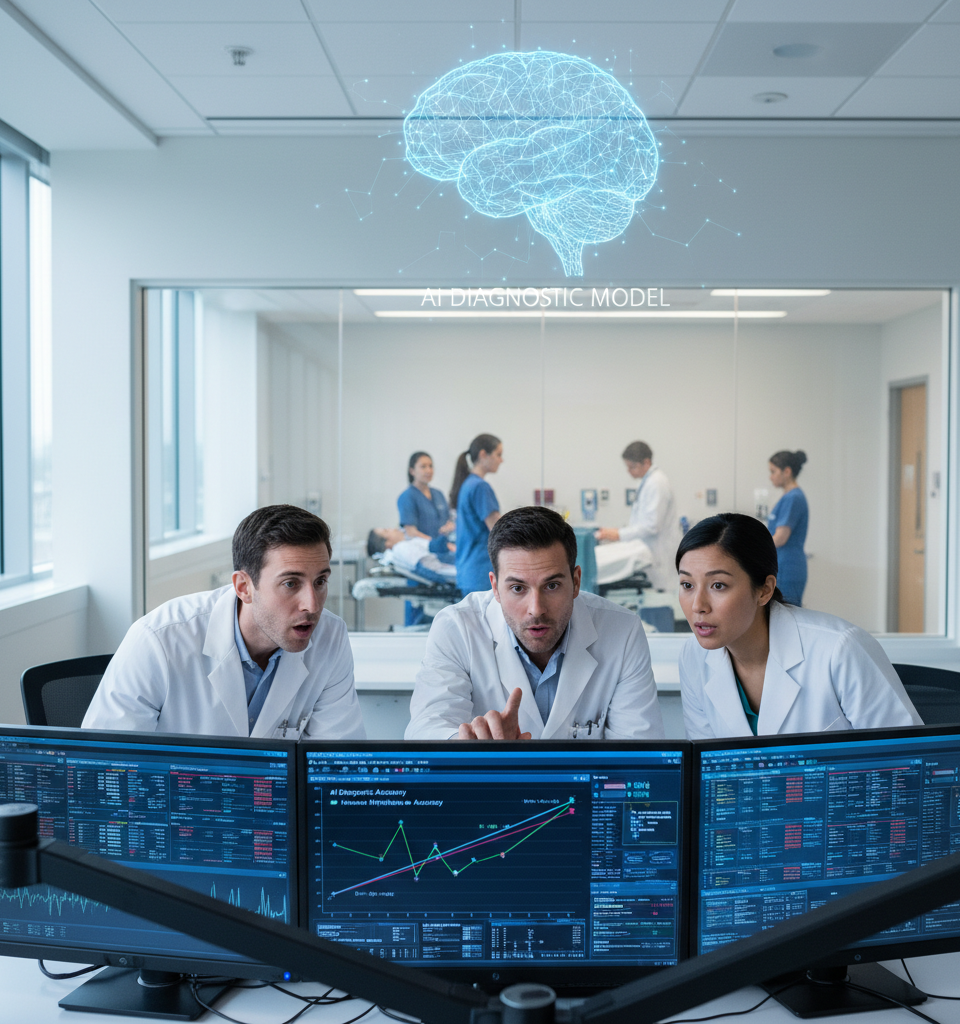
A recent study conducted by Harvard Medical School researchers has shown that artificial intelligence, specifically large language models (LLMs), demonstrated superior accuracy in diagnosing emergency room patients compared to two human physicians. The findings, which analyzed AI's performance across various medical scenarios including real-world ER cases, represent a significant milestone in the integration of AI into clinical practice and raise important questions about the future of medical diagnostics. This research provides compelling evidence that advanced AI can offer a new paradigm for patient care, potentially reducing misdiagnoses and improving outcomes in high-pressure environments.
Context and Background
For decades, artificial intelligence has been heralded as a transformative force for healthcare, with promises ranging from accelerating drug discovery to revolutionizing diagnostics. However, practical applications, particularly those directly impacting patient care, have progressed cautiously. The diagnostic process in emergency medicine is inherently complex, often requiring rapid decision-making with incomplete information, making it a critical area where human error can have severe consequences.
Historical attempts to implement AI in diagnostics have often been limited by data availability, algorithmic complexity, and regulatory hurdles. This Harvard study distinguishes itself by leveraging the power of contemporary large language models, showcasing their ability to process vast amounts of medical text and extrapolate diagnoses with remarkable precision. The findings underscore a pivotal moment where AI transitions from a theoretical aid to a demonstrably more accurate diagnostic tool in specific contexts than its human counterparts.
Key Details of the Study
The study, whose specific publication details and exact numerical findings were not explicitly detailed in the provided description but centered on the comparative diagnostic accuracy, utilized at least one advanced large language model to analyze anonymized patient data from real emergency room encounters. These cases encompassed a diverse range of conditions, from common ailments to rare and complex presentations. The AI model's diagnoses were then rigorously compared against those rendered independently by two experienced emergency room physicians.
The key finding indicated that the AI achieved a higher diagnostic accuracy rate than either of the human doctors, suggesting a more consistent and precise identification of medical conditions. While the precise percentage difference was not specified, the qualitative outcome points to a significant performance gap. Researchers carefully controlled for biases and ensured the scenarios were representative of typical ER challenges.
Industry and Market Impact
This research is poised to send ripples across the healthcare industry, particularly among diagnostic companies, health tech startups, and established medical institutions. The prospect of integrating highly accurate AI diagnostics could lead to substantial investments in AI-powered tools, potentially creating a multi-billion-dollar market for medical AI solutions. Pharmaceutical companies might also benefit from more precise patient stratification, while insurance providers could see a reduction in costs associated with incorrect diagnoses and subsequent unnecessary treatments.
However, the adoption will also necessitate significant infrastructure upgrades, data privacy enhancements, and robust regulatory frameworks to ensure ethical and safe deployment. Hospitals, grappling with physician burnout and rising operational costs, may view AI as a strategic asset to improve efficiency and patient care quality.
Expert Perspective
Medical experts and AI ethicists are weighing in on the implications of these findings. Dr. Anya Sharma, a leading AI in medicine researcher, commented, “This study is a powerful validator for AI’s potential, but it’s crucial to remember that AI is a tool to augment, not replace, human expertise.
” Others, like Dr. Ben Carter, an emergency physician with two decades of experience, expressed both cautious optimism and skepticism regarding widespread integration. “While impressive, the clinical workflow integration, liability, and the initial resistance from the medical community will be substantial hurdles.
” The consensus is that while the technology is promising, a phased, carefully managed implementation is essential.
What's Next: Future Implications
The immediate future will likely involve more extensive clinical trials and pilot programs aimed at validating AI diagnostic models in diverse hospital settings and across different patient demographics. Research will focus on refining these models to handle rare diseases, atypical presentations, and multimodal data (incorporating imaging, lab results, and genomic information). Regulatory bodies, such as the FDA, will accelerate the development of guidelines and approval processes for AI as a medical device, addressing issues of safety, efficacy, and accountability.
Furthermore, medical education will need to adapt, incorporating AI literacy and training physicians to effectively collaborate with AI tools. The long-term vision includes a hybrid healthcare model where human clinicians leverage AI as a sophisticated co-pilot, enhancing diagnostic accuracy, reducing cognitive load, and ultimately leading to more equitable and efficient patient care globally. Collaborative efforts between tech companies, medical institutions, and policymakers will be critical in navigating this transformative era.