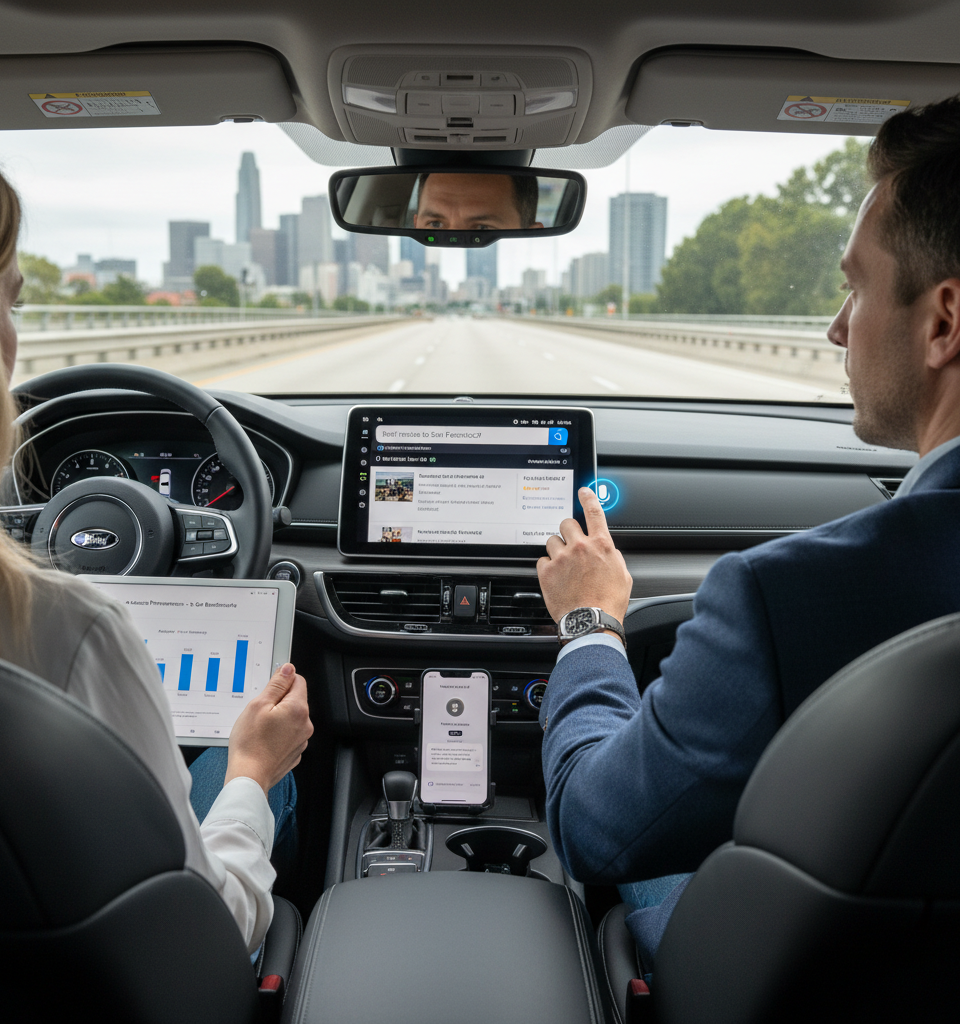
In a burgeoning development for in-car technology, a practical assessment of leading AI voice assistants, specifically Perplexity AI and OpenAI's ChatGPT, within a CarPlay interface has identified Perplexity AI as the superior performer for in-vehicle query resolution and information delivery. This evaluation, conducted under real-world driving conditions, aimed to ascertain which generative AI model offered a more robust and reliable experience beyond the relatively basic functionalities of standard built-in assistants like Apple's Siri. The findings underscore a pivotal shift towards more sophisticated, context-aware AI integration in automobiles, promising enhanced driver assistance and greater access to real-time information while on the move.
The growing appetite for advanced in-car connectivity and intelligent personal assistants underpins the significance of this comparison. For years, drivers have relied on rudimentary voice commands for navigation, calls, and music playback. However, the advent of large language models (LLMs) like ChatGPT and Perplexity AI has introduced the possibility of an entirely new paradigm: an assistant capable of answering complex questions, summarizing information, and even engaging in natural-language conversations, all hands-free. This evolution addresses a critical need for enhanced productivity and information access in an environment where visual distraction must be minimized, potentially redefining safety and convenience standards in modern vehicles.
Key findings from the comparison highlighted Perplexity AI's particular strength in delivering concise, source-backed answers, making it exceptionally well-suited for a driving context where detailed but quick responses are paramount. While ChatGPT also demonstrated impressive conversational capabilities, its tendency to generate longer, more elaborate responses without immediate source citation was often a drawback in the dynamic environment of a moving vehicle. For instance, when asked for specific route information or historical facts about a passing landmark, Perplexity AI frequently provided a succinct answer coupled with its source, allowing the driver to quickly digest the information and continue focusing on the road. In contrast, ChatGPT might offer a more expansive narrative, which, while informative in other settings, proved less efficient for brief, in-car interactions.
The broader industry implications of these findings are substantial, suggesting a potential shift in how automotive manufacturers and infotainment developers approach AI integration. The market for in-car connectivity is projected to reach $38 billion by 2027, driven by consumer demand for seamless digital experiences. Companies like Apple and Google, with their CarPlay and Android Auto platforms, are at the forefront, but the underlying AI layers present a new competitive battleground. The superior performance of a specialized AI like Perplexity AI in real-world driving scenarios could spur partnerships or acquisitions, as automotive giants seek to embed the most effective conversational AI into their next-generation vehicles. This could also challenge the dominance of existing proprietary voice assistants, pushing them to rapidly evolve their capabilities or risk obsolescence.
Industry analysts are keenly observing these developments. "The ability to provide accurate, concise, and contextually relevant information without diverting driver attention is the holy grail for in-car AI," states Dr. Evelyn Reed, a lead automotive technology analyst at GlobalTech Insights. "Perplexity AI's approach of combining LLM capabilities with real-time web search and citation generation is proving to be a particularly effective model for this constrained environment. This could set a new benchmark for what drivers expect from their in-car assistants, moving beyond basic commands to truly intelligent co-pilots." She further elaborates that the emphasis on verifiable information, a core aspect of Perplexity AI's design, is also a critical safety feature, as misinformation delivered at high speeds could have severe consequences.
Looking ahead, the integration of advanced AI into CarPlay and other automotive systems is poised for rapid evolution. Future iterations may see these AI models gaining even deeper contextual understanding, leveraging vehicle sensor data, and even anticipating driver needs based on patterns and preferences. The competition among AI developers to optimize their models for specific environments, such as the automotive cabin, will intensify. We can expect further advancements in multimodal AI, allowing for not just voice interaction but also visual cues and even biometric feedback integration to create a truly personalized and proactive in-car assistant experience. The journey from basic voice control to a fully intelligent, conversational automotive co-pilot is well underway, with models like Perplexity AI carving out a significant lead in this transformative race.