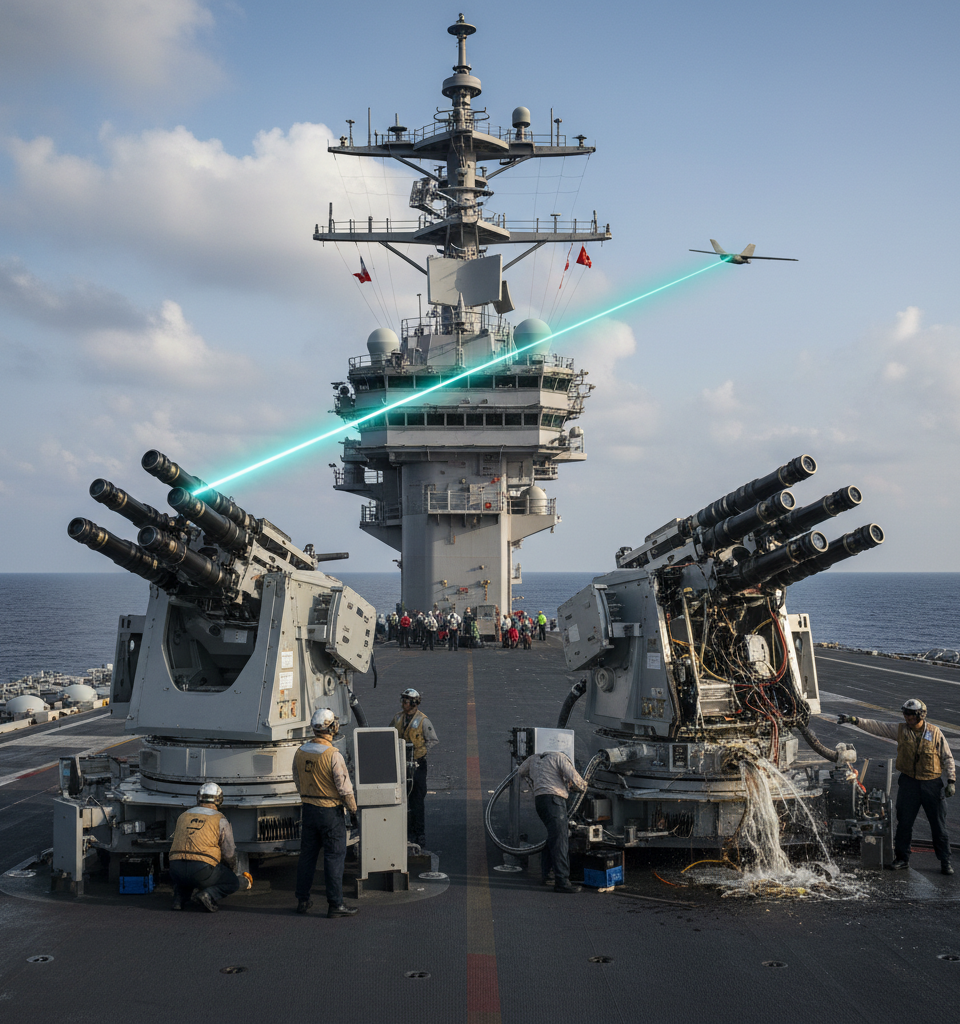
S. W. Bush. The live-fire exercise, conducted in October 2025, marked a critical step towards integrating directed energy weapons into the Navy's formidable arsenal, as photos released to the Defense Visual Information Distribution Service (DVIDS) on April 20 confirmed the successful deployment of a 20-kilowatt laser system from the carrier's flight deck.
The Strategic Imperative of Laser Integration
This development comes amidst growing global tensions and the proliferation of inexpensive yet effective drone technology, posing significant threats to naval assets. The Navy's declaration earlier this year that "the dream of a laser on every ship can become a real one" underscores the strategic imperative to counter these evolving challenges. Historically, naval defense has relied on costly kinetic interceptors to neutralize aerial threats, a paradigm that laser weapons promise to disrupt by offering a more cost-effective and potentially limitless engagement capability. The ability to deploy such a system on an aircraft carrier—a centerpiece of naval power projection—significantly enhances its self-defense capabilities against swarming drone attacks and other emerging threats, fundamentally altering the calculus of maritime engagements.
Technical Details and Operational Significance While the specific designation of the 20-kilowatt laser system has not been fully disclosed, its successful deployment from the highly complex environment of an aircraft carrier's flight deck is a testament to significant engineering achievements.
Aircraft carriers, with their vast power generation capacities and extensive deck space, present both an ideal and a challenging platform for such weaponry. The immense power requirements of high-energy lasers, which can exceed hundreds of kilowatts for more advanced applications, are more readily met by a nuclear-powered supercarrier compared to smaller surface combatants. However, the operational environment of a flight deck—characterized by constant vibrations, electromagnetic interference from aircraft operations, and the need for robust atmospheric compensation systems—demands an exceptionally rugged and precise weapon system.
Broader Industry and Geopolitical Implications
This successful test is poised to have profound implications for the defense industry and geopolitical landscape. Manufacturers of directed energy systems, such as Lockheed Martin, Raytheon Technologies, and Northrop Grumman, are likely to see increased investment and demand for more powerful and compact laser weapons. The shift towards laser-based defense could also trigger a reevaluation of naval shipbuilding priorities, potentially influencing the design of future warships to better integrate these systems. Geopolitically, the U.S. Navy's enhanced defensive capabilities could serve as a deterrent, particularly in contested maritime regions, and may spur rival nations to accelerate their own directed-energy weapon development programs, igniting a new phase in the global arms race.
Expert Analysis on the Dual Nature of Carriers
Military strategists and defense analysts have long debated the suitability of aircraft carriers as laser platforms. Dr. Evelyn Reed, a senior fellow at the Center for Strategic and International Studies (CSIS), notes, "The carrier's sheer size and power generation are undeniable assets for directed energy weapons. However, the exposure of a flight-deck mounted system to the elements and the inherent vulnerability of a high-value asset like a carrier mean that these systems must be incredibly resilient and effectively integrated into the carrier's broader defense architecture. It's a high-risk, high-reward proposition." The concern remains that while a carrier offers an unmatched power source, its importance also makes it a prime target, meaning any laser system must offer truly transformative defense to justify its emplacement.
The Path Forward: Escalating Power and Integration
The successful 20-kilowatt test is merely the beginning. The Navy's long-term vision includes deploying significantly more powerful laser weapons, potentially in the 100-300 kilowatt range, capable of neutralizing supersonic missiles and even larger UAS formations. Future developments will focus on improving beam quality, enhancing atmospheric compensation technologies, and integrating these systems seamlessly into the carrier's combat systems, allowing for faster target acquisition and engagement. Furthermore, research into solid-state lasers and fiber lasers continues, aiming to reduce the physical footprint and increase the efficiency of these formidable weapons, bringing the "dream of a laser on every ship" closer to reality, perhaps even for smaller vessels as technology matures over the next decade.