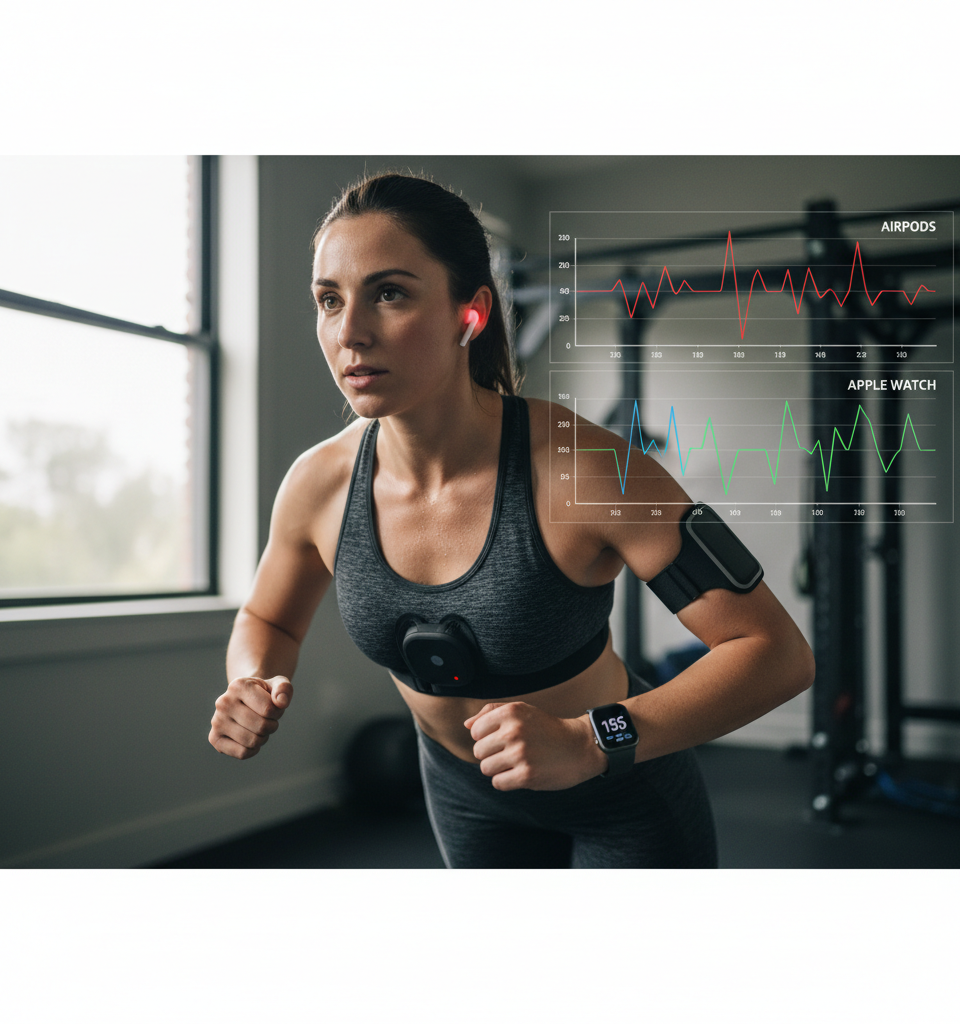
As the lines between personal tech and health monitoring increasingly blur, a significant question has emerged regarding the efficacy of consumer devices marketed with wellness features. Specifically, the integration of heart rate monitoring into Apple's widely popular AirPods has sparked interest, prompting a direct comparison against industry-standard accuracy. This examination sought to ascertain whether these ubiquitous wireless earbuds can genuinely offer trustworthy heart rate data for fitness activities.
The burgeoning market for wearable health technology underscores an evolving consumer demand for convenient, integrated solutions to track personal well-being. Historically, accurate heart rate monitoring often necessitated dedicated devices, most notably chest straps, which have long been considered the gold standard due to their direct contact and electrical signal detection. The advent of optical sensors in wrist-worn devices like the Apple Watch broadened accessibility, offering a compromise between convenience and precision. The potential addition of reliable heart rate tracking to an already popular audio device like AirPods represents a significant leap in this trend, offering unparalleled convenience if accuracy can be assured.
The testing methodology employed a direct comparative approach. AirPods, presumably leveraging their built-in optical sensors or other physiological measurement capabilities, were evaluated alongside an Apple Watch – itself a widely accepted, though not perfect, consumer-grade heart rate monitor – and a Polar chest strap. The Polar chest strap served as the control, representing the highest tier of accuracy available to consumers for heart rate data collection during physical exertion. This multi-device comparison aimed to quantify the degree of variance, if any, between the AirPods' readings and these established benchmarks.
Should the AirPods demonstrate a high degree of accuracy, it could profoundly impact the wearable technology market. Current fitness tracking often involves multiple devices, or at least dedicated wristwear. Integrating reliable heart rate data directly into earbuds would offer a streamlined, less obtrusive experience for users. This could lead to increased adoption of health monitoring features among a broader demographic who might not otherwise invest in a separate fitness tracker or smartwatch. For competitive brands, it would set a new bar for feature integration and sensor performance in audio accessories.
While the detailed results of the comparison were not specified, the core inquiry revolves around whether AirPods can provide data accurate enough to be actionable for athletes and casual exercisers alike. Precision in heart rate monitoring is crucial for various applications, from optimizing workout intensity zones to identifying potential cardiovascular anomalies. Any significant deviation or inconsistency could render the feature largely ornamental rather than functional for serious fitness tracking or health insights.
The implications extend beyond individual users to the broader health and wellness industry. Companies developing fitness apps and platforms are constantly seeking reliable data inputs. If AirPods can consistently deliver accurate heart rate data, they could become a foundational sensor for a new generation of integrated health applications, further solidifying Apple's ecosystem dominance. This would enable developers to create more sophisticated personalized training programs and health insights without requiring users to purchase additional hardware.
Looking ahead, the findings from this type of rigorous testing will be instrumental in shaping consumer expectations and product development cycles. Should the AirPods prove accurate, it would validate the potential of integrating advanced biometric sensors into everyday devices, pushing the boundaries of what consumers expect from their personal electronics. Conversely, if accuracy falls short, it would highlight the technical challenges of reliable heart rate monitoring in form factors like earbuds and reinforce the continued relevance of dedicated fitness devices.
Ultimately, the value proposition of AirPods for heart rate monitoring hinges entirely on its demonstrable accuracy. For fitness enthusiasts and health-conscious individuals, the convenience factor is undeniable, but it is secondary to the reliability of the data. This evaluation underscores a critical juncture in wearable technology: the transition from feature proliferation to performance validation, ensuring that advertised capabilities genuinely meet user needs and expectations for health and wellness tracking.