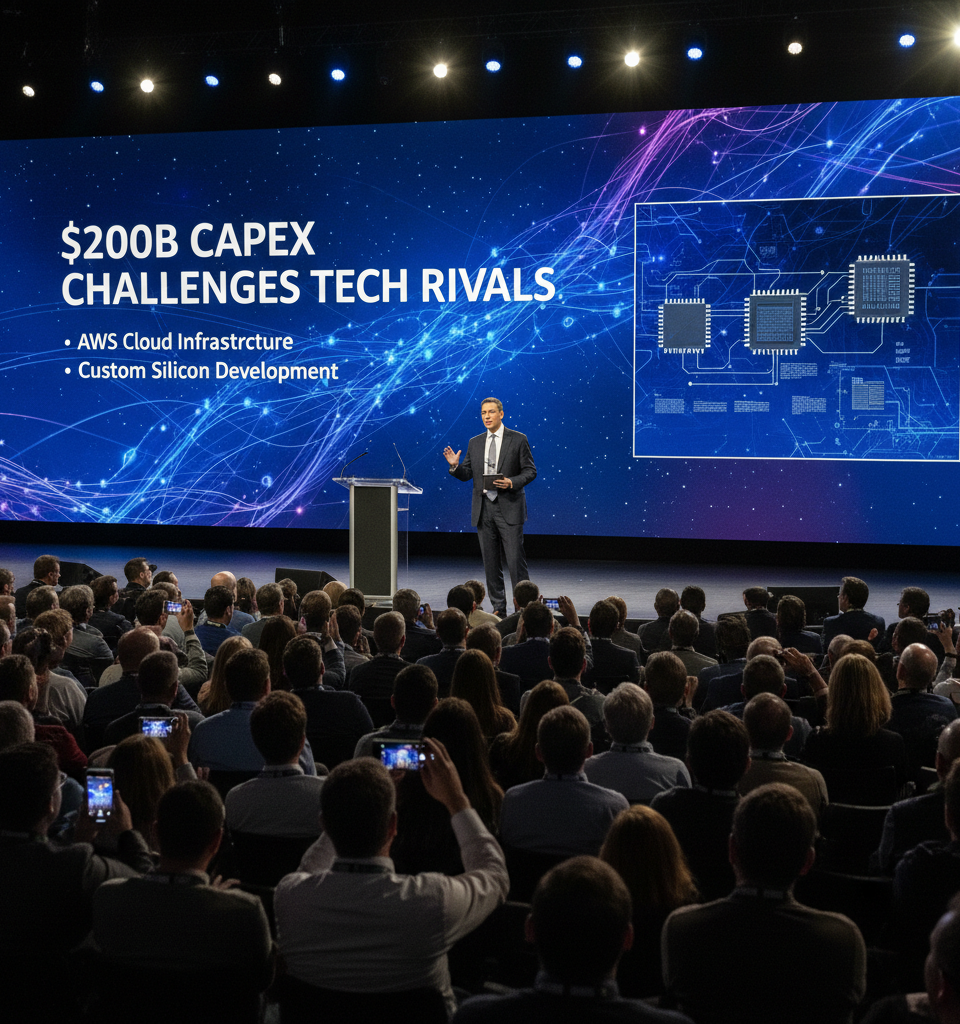
Amazon CEO Andy Jassy has unleashed a strategic broadside against key technology rivals, including Nvidia, Intel, and SpaceX's Starlink, while vehemently defending the e-commerce and cloud giant's formidable $200 billion capital expenditure in his recently released annual shareholder letter. The extensive 28-page document, published today, served not only as a customary report to investors but also as a powerful declaration of Amazon's ambitious technological trajectory, particularly in artificial intelligence, logistics, and satellite internet.
Contextualizing Amazon's Strategic Imperative
Jassy's assertive tone and detailed justifications arrive amidst a period of intense scrutiny over Amazon's spending and profitability. Historically, Amazon has prioritized long-term growth over short-term earnings, a strategy that has often drawn both admiration and criticism. The $200 billion capex over the past two years, primarily funneled into expanding Amazon Web Services (AWS) data centers, fulfillment networks, and cutting-edge R&D, underscores the company's commitment to maintaining its leadership across diverse sectors. This investment is framed as essential for securing future market dominance and fending off encroaching competition across its burgeoning business divisions.
Diving Deep into Jassy's Competitive Stance
In a move that has sent ripples through the industry, Jassy explicitly addressed competitive threats and Amazon's unique approach to innovation. Regarding Nvidia and Intel, Jassy highlighted Amazon's significant investments in custom silicon, including their Graviton processors for AWS and Trainium/Inferentia chips for AI workloads. He asserted that Amazon's in-house chip development provides superior performance-to-cost ratios for specific cloud applications, directly challenging the dominance of traditional chip makers in data centers. "We continue to invent on top of our custom silicon," Jassy wrote, "which delivers better price-performance than running on x86." Furthermore, Jassy delved into Amazon's Project Kuiper, its low Earth orbit (LEO) satellite internet constellation, positioning it as a direct alternative to SpaceX's Starlink, emphasizing its potential to serve unserved and underserved global populations with reliable, high-speed broadband.
Broad Impact on the Technological Landscape
Jassy's letter represents a potent declaration of war on multiple fronts, signaling Amazon's intent to reduce reliance on third-party suppliers and solidify its vertical integration. For the semiconductor industry, Amazon's aggressive push into custom silicon could temper future growth opportunities for Intel and, to a lesser extent, Nvidia, by shifting a portion of the lucrative data center chip market in-house. In the satellite internet arena, Project Kuiper's reported $10 billion investment and projected launch of thousands of satellites will undoubtedly intensify competition with Starlink, potentially driving down prices and accelerating global broadband access. This internal competition could also spur further innovation as established players react to Amazon's formidable entry.
Expert Analysis and Industry Response
Industry analysts have taken note of the letter's combative undertones. "Jassy's letter isn't just a defense of CapEx; it's a strategic roadmap that clearly delineates Amazon's battlegrounds for the next decade," remarked Sarah Pinder, a senior tech analyst at Gartner. "Their pivot towards in-house silicon and aggressive stance on satellite internet illustrates a broader trend among tech giants to control more of their supply chain and fundamental infrastructure." Others suggest that while Amazon's investments are substantial, execution will be key. "Amazon's track record of innovation is undeniable, but challenging incumbents like Nvidia, with their vast ecosystem, or Starlink, with its early lead, will require sustained effort and flawless delivery," commented Dr. Rajesh Singh, a professor of technology management at Stanford University.
The Road Ahead: Future Implications
Looking forward, the implications of Amazon's strategy are multifaceted. The continued development of custom chips could lead to a more fragmented and competitive semiconductor market, benefiting cloud customers through more specialized and efficient hardware. For Project Kuiper, the coming years will be critical as Amazon aims to launch thousands of satellites, with a target of half its planned constellation in orbit by 2026. Success in these ventures will not only diversify Amazon's revenue streams but also further entrench its position as an indispensable technological utility provider globally. Investors will be closely watching for signs of return on this massive $200 billion investment, with the long-term profitability of these ambitious projects under intense scrutiny.
Ultimately, Jassy's letter frames Amazon not merely as a retailer or cloud provider, but as a holistic technology powerhouse actively shaping the future across diverse, capital-intensive sectors. His defense of significant spending underscores a company deeply committed to innovation and aggressive market expansion, prepared to challenge established leaders and redefine industry standards in the process.