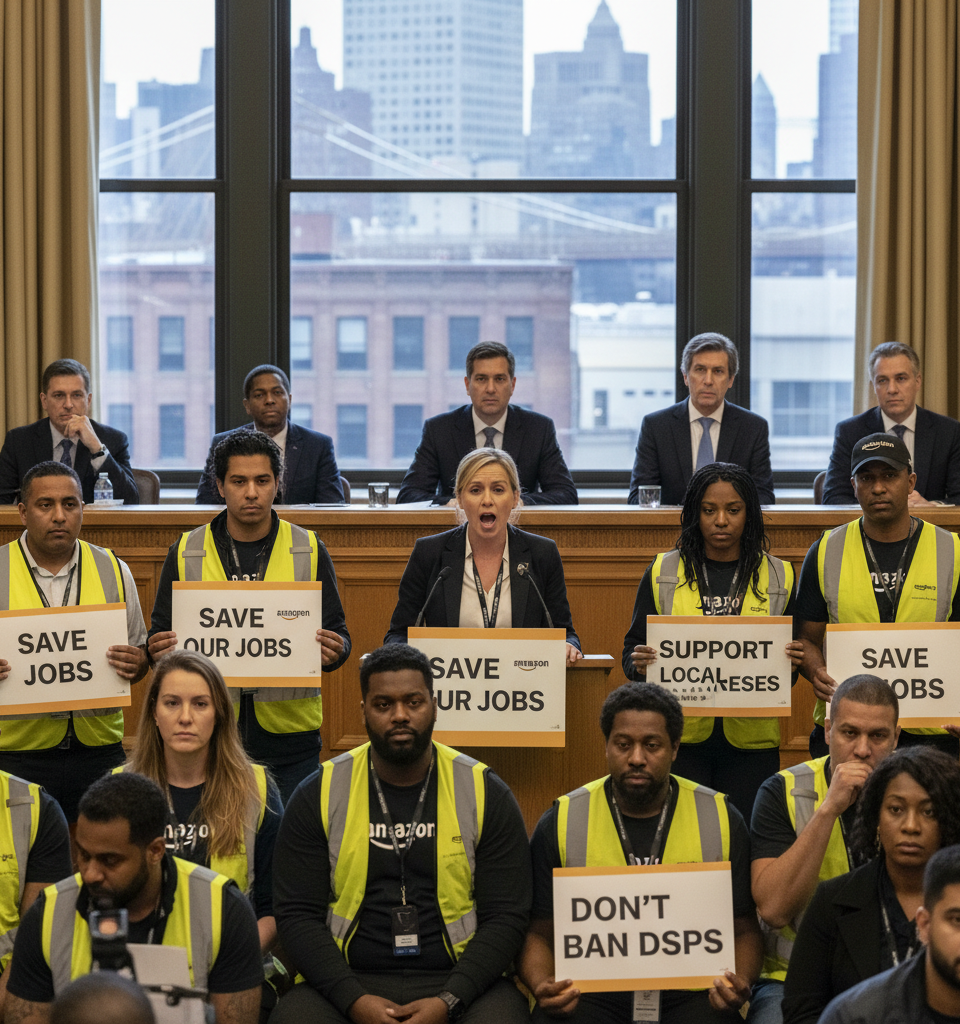
NEW YORK, NY – Amazon's extensive Delivery Service Partner (DSP) network in New York City is bracing for a potential seismic shift following a contentious day-long hearing at the City Council on a bill that threatens to outlaw the use of subcontractors for last-mile delivery services. The proposed legislation, if enacted, would force e-commerce giants like Amazon to directly employ their legions of drivers, a move that DSP owners and industry analysts warn could decimate the current operational model, leading to job losses and increased delivery costs for consumers across the metropolitan area.
The Looming Regulatory Shift and Its Context
This legislative push, spearheaded by Council Member Tiffany Cabán, is part of a broader national trend to enhance worker protections and reduce perceived exploitation within the burgeoning gig economy and contract labor models. Supporters argue that the bill would provide crucial benefits, stable wages, and collective bargaining rights to delivery drivers currently classified as independent contractors or employees of small DSPs. However, for Amazon and its estimated 70+ DSPs operating in New York City, which collectively employ thousands of drivers, the proposal represents an existential threat to a system built on localized, entrepreneurial logistics firms. This mirrors other recent legislative efforts, such as California's Assembly Bill 5 (AB5), which similarly aimed to redefine employment status for gig workers, though its implementation and impact have faced significant legal challenges and amendments.
Key Details of the Proposed Legislation
The bill's core provision, as discussed during the recent City Council hearing, would legally reclassify delivery drivers as direct employees of the primary contracting company – in this case, Amazon – rather than of intermediary DSPs. Testimonies from DSP owners painted a bleak picture, with many stating that their businesses, which operate on thin margins often ranging from 3-5%, would be unsustainable under such a mandate. These small business owners highlighted the significant capital investments they've made, including purchasing fleets of Amazon-branded vans (often leased) and hiring hundreds of local employees. They argue that Amazon’s business model inherently relies on these smaller entrepreneurial units for flexibility, scalability, and local market expertise, a structure that would unravel if forced to absorb the direct employment costs and complexities of thousands of drivers.
Industry-Wide Ramifications Beyond Amazon
While Amazon is the most prominent target due to its sheer scale, the implications of this 'no subcontractor' bill extend far beyond the e-commerce giant. The delivery and logistics sector across New York City relies heavily on similar subcontracting models, impacting couriers, food delivery services, and even some freight operations. Analysts predict that if passed, the legislation could set a precedent for other cities and states, potentially reshaping the entire last-mile delivery landscape nationwide. This could lead to a significant consolidation of the delivery market, as smaller logistics firms, unable to bear the increased operational costs, exit the market, leaving larger corporations with dominant control and potentially reduced service flexibility.
Expert Insights and Economic Projections
Economists and labor market experts are divided on the long-term impact. Dr. Eleanor Vance, a labor economics professor at NYU, stated, "While the intent to improve worker conditions is commendable, an abrupt shift like this without a comprehensive transition plan could lead to unintended consequences. We could see a reduction in overall delivery jobs as companies automate or consolidate, and a potential increase in delivery costs for consumers as businesses pass on higher labor expenses." Conversely, advocacy groups like the Gig Workers Alliance argue that direct employment offers greater stability, benefits, and fair wages, ultimately boosting the local economy through better-compensated workers. Early estimates suggest that an immediate transition could lead to an approximate 15-25% increase in operational costs for affected delivery companies in NYC, a financial burden that will inevitably be transferred to consumers or force companies to reduce delivery speed and capacity.
What's Next: Legislative Path and Industry Response
The bill now moves through the City Council's legislative process, with further committee hearings and potential amendments expected in the coming months. Amazon and the DSP community are expected to intensify their lobbying efforts, presenting data on potential job losses, economic disruption, and the adverse impact on consumer services. Should the bill pass, it is almost certain to face legal challenges from affected businesses, potentially leading to lengthy court battles, similar to those seen with AB5. The outcome will not only determine the future of Amazon's delivery operations in one of its largest markets but could also serve as a critical test case for labor regulations in the evolving gig economy nationwide. The definitive vote is anticipated before the end of the year, setting the stage for a critical inflection point for the city's robust delivery infrastructure.
Potential Long-Term Outcomes
The long-term outcome remains uncertain. If the bill becomes law and withstands legal challenges, Amazon would likely be forced to either drastically restructure its NYC operations, potentially integrating delivery drivers as direct employees with commensurate benefits and wages, or significantly reduce its delivery footprint in the city, relying more on third-party logistics (3PL) providers operating under different legal frameworks. This could also accelerate the adoption of autonomous delivery technologies or drone services in urban environments to mitigate soaring labor costs. Conversely, a failure of the bill could embolden other companies to maintain their existing subcontracting models, further delaying comprehensive labor reforms for gig and contract workers in other urban centers. The decision will undoubtedly have ripple effects across the entire supply chain.