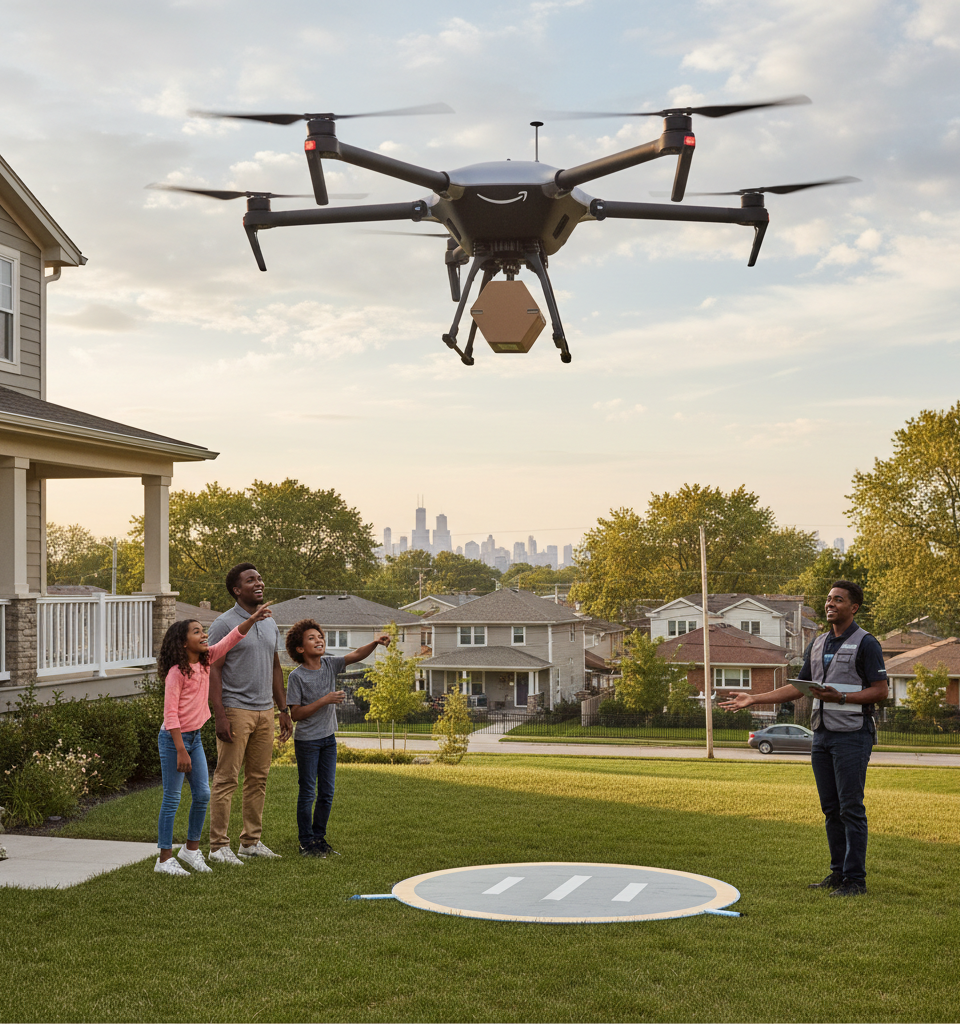
Amazon's long-held ambition for widespread drone delivery is rapidly moving from concept to reality, with Chicago and its south suburbs emerging as a critical early battleground for this technological frontier. The e-commerce giant's CEO, Andy Jassy, recently underscored the company's commitment to scaling its Prime Air drone delivery program, articulating a staggering target of distributing 500 million packages each year globally within the coming decade via this nascent technology. This aggressive expansion strategy includes current pilot tests and operations across eight U.S. cities, with an additional four, including Chicago, soon to join their ranks.
This initiative marks a significant turning point in logistic innovation, extending beyond traditional ground transportation to harness the airspace above communities. For the communities in Chicago's south suburbs, this means not only the promise of accelerated package delivery but also potential transformations in local infrastructure, employment, and even the visual landscape of daily life. The deployment in these areas is not merely a technical rollout but a strategic maneuver to gauge public acceptance, refine operational efficiencies, and navigate the complex regulatory environment surrounding unmanned aerial vehicles.
Key to Amazon's strategy is the systematic expansion of its Prime Air footprint. While specific operational details for the Chicago region are still in development, the company has begun conducting pilot tests and operating in several other U.S. cities. These early deployments are crucial for gathering data on flight paths, package handling, battery life in varying conditions, and customer experience. The goal of 500 million packages annually underscores the scale of Amazon's aspirations, positioning drone delivery as a core component of its future logistics network, rather than a mere niche service.
The advent of large-scale drone delivery systems like Prime Air holds considerable implications for the broader logistics and retail industries. Competitors may be compelled to accelerate their own drone or automated delivery solutions, potentially spurring a new era of rapid, localized delivery services. This could disrupt traditional last-mile delivery models, impacting established courier services and the postal system. Furthermore, it could reshape consumer expectations regarding delivery speed and convenience, setting new benchmarks for e-commerce platforms.
While the original source does not include expert analysis or external viewpoints, it’s clear that the successful integration of drones into civilian airspace presents a myriad of challenges. These include securing regulatory approvals from federal aviation authorities, addressing public concerns regarding noise pollution and privacy, and ensuring the safety and reliability of autonomous flight operations in diverse weather conditions. Amazon’s methodical approach, starting with limited pilot programs, indicates an awareness of these complexities.
Looking ahead, the expansion into Chicago's south suburbs will undoubtedly serve as a critical proving ground for Amazon's long-term drone ambitions. The insights gained from these operations will be instrumental in refining the Prime Air program for even broader deployment. Should these pilots prove successful, it could pave the way for a more widespread integration of drone delivery across urban and suburban environments, fundamentally altering how goods are transported and received worldwide over the next decade. The trajectory of Amazon’s Prime Air program suggests that the skies above homes and businesses could soon become a bustling corridor for commercial delivery drones.