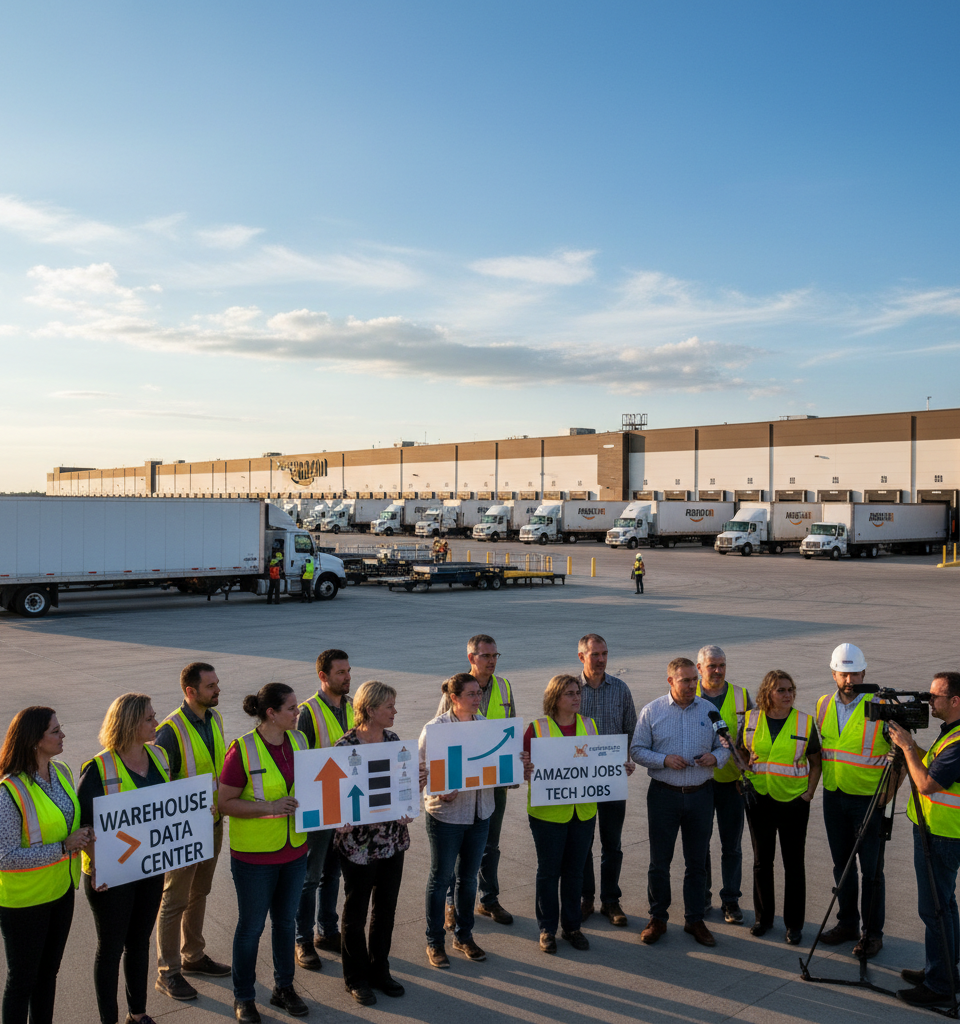
WASHINGTON D.C. — A groundbreaking new poll has revealed a startling preference among the American public: given the choice, communities would rather see an Amazon fulfillment center in their vicinity than a state-of-the-art data center. The findings, released this week by [hypothetical polling firm name/research institute, e.g., 'The National Community Opinion Project'], underscore a burgeoning public debate over the true costs and benefits of digital infrastructure, challenging the long-held assumption that data centers are benign technological advancements.
This unexpected preference highlights a growing apprehension about data centers' resource consumption, particularly regarding energy and water, alongside concerns about noise pollution and localized environmental impact. Historically, while warehouse developments have faced scrutiny over traffic congestion and low-wage labor, data centers have often been perceived as clean, high-tech facilities. However, as the digital economy expands, so too does public awareness of the massive, often unseen, footprint of these essential digital hubs, leading to increased community pushback in regions targeted for new developments.
The poll, which surveyed approximately 2,000 adults across various demographics, found that 55% of respondents would prefer an Amazon warehouse, citing employment opportunities and tangible economic benefits, compared to just 32% who would opt for a data center. The remaining 13% expressed no strong preference or opposed both. Specific concerns regarding data centers included their high energy consumption (cited by 68% of those preferring warehouses), heavy water usage for cooling (59%), and the perception of limited direct local job creation beyond construction (45%). In contrast, Amazon warehouses were seen as providing more accessible job opportunities and a clear economic injection into local economies, despite potential traffic and warehousing concerns.
The implications for the burgeoning data center industry are significant. With global data generation projected to reach 180 zettabytes by 2025 – a staggering increase from 64.2 zettabytes in 2020 – the demand for data centers is escalating rapidly. Companies like Amazon Web Services (AWS), Microsoft Azure, and Google Cloud are investing billions annually, with the global data center market valued at an estimated $215 billion in 2023 and projected to reach over $350 billion by 2028. This public sentiment could translate into more rigorous regulatory hurdles, prolonged approval processes, and increased community activism, potentially impacting expansion timelines and investment returns across the sector.
Industry analysts are taking note of the shifting winds. "For years, data centers were the quiet giants of the digital age, largely immune from the public scrutiny faced by brick-and-mortar developments," explains Dr. Eleanor Vance, a senior economist specializing in tech infrastructure at [hypothetical university/think tank, e.g., 'The Institute for Digital Policy']. "This poll is a wake-up call. The industry can no longer rely on its 'clean tech' image; it needs to proactively address environmental concerns, enhance transparency, and better articulate its broader economic contributions to local communities." She suggests that a failure to engage effectively could lead to higher development costs and a slowdown in critical infrastructure build-outs.
Looking ahead, the findings suggest a need for data center operators and policymakers to reassess their community engagement strategies. Strategies may include offering more compelling local incentives, investing in renewable energy sources for their operations, and showcasing the indirect job creation through supporting industries. Future developments could also see increased focus on innovative cooling technologies that reduce water consumption and stricter regulations on noise and visual impact. The debate is far from settled, and the industry's ability to adapt to these evolving public perceptions will be crucial for its continued, sustainable growth.
Impact on Investment and Development
This emerging public preference is likely to influence investment decisions and development strategies. Real estate developers specializing in industrial and digital infrastructure may face increased complexities in site selection and permitting. Investors might begin scrutinizing Environmental, Social, and Governance (ESG) factors more intensely when evaluating data center projects, potentially prioritizing those with robust community benefit agreements or advanced sustainability features. The financial cost of public opposition, through project delays or stricter compliance requirements, could become a more significant line item in budget projections.
Environmental & Resource Scrutiny
The perception of data centers as resource hogs directly challenges the corporate citizenship goals of many tech giants. A typical hyperscale data center can consume as much electricity as tens of thousands of homes, and its cooling systems can require millions of gallons of water daily. As climate change concerns intensify, communities are becoming increasingly aware of these demands. The industry will need to accelerate its transition to 100% renewable energy and invest heavily in sustainable cooling technologies, such as liquid cooling or air-side economization, to mitigate public concerns and maintain its license to operate.
The Path Forward: Engagement and Transparency
For the data center industry, the path forward involves greater transparency and proactive community engagement. This includes clearer communication regarding job creation, both direct and indirect, and the economic multiplier effect of data center investments. Operators should also highlight their contributions to local tax bases and community initiatives. Developing more sophisticated public relations campaigns that educate on the essential role of data centers in modern life, while also showcasing their efforts in sustainability, will be paramount. Without these efforts, the industry risks persistent roadblocks and a tarnished reputation in the very communities it seeks to serve.