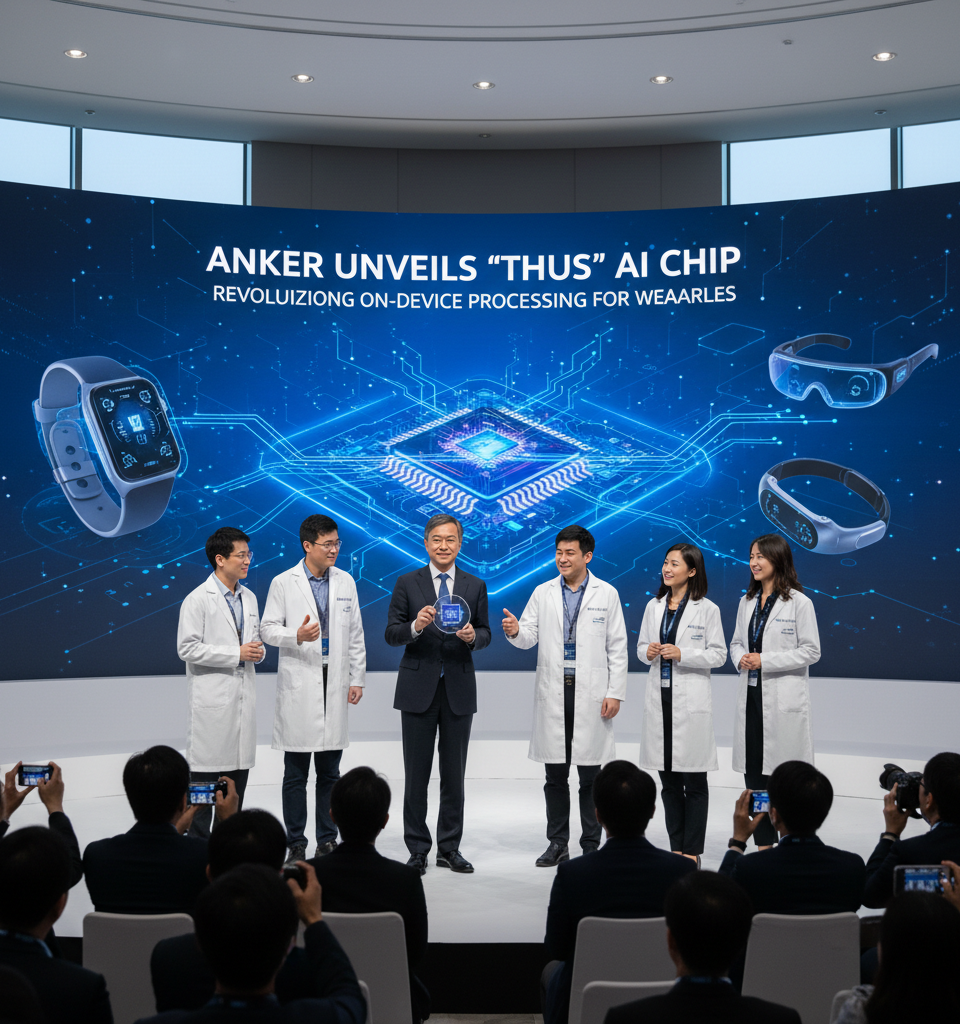
The Dawn of On-Device AI: Anker's Strategic Leap
Anker's foray into proprietary chip development underscores a strategic pivot towards deeper integration of AI in its product ecosystem. By developing the Thus chip, Anker aims to circumvent the latency and privacy concerns often associated with cloud-based AI processing, instead delivering real-time intelligent features directly from the device. This move positions Anker at the forefront of the burgeoning on-device AI trend, an area increasingly seen as critical for the next generation of consumer electronics, particularly in the audio and wearable sectors. The company's press materials hail Thus as the "first Compute-in-Memory (CIM) AI audio chip with neural networks," highlighting its architectural innovation inspired by the biological efficiency of the human brain, where data storage and processing are seamlessly intertwined.
Unpacking the "Thus" Chip: Performance and Design
The core innovation of the Thus chip lies in its Compute-in-Memory (CIM) architecture. Unlike traditional Von Neumann architectures, which separate memory and processing units, CIM integrates these functions, drastically reducing data transfer bottlenecks and energy consumption. Anker elaborates that this design mirrors the human brain's efficiency, allowing for faster, more power-efficient AI computations. While specific technical specifications such as transistor count, clock speed, or dedicated neural processing unit (NPU) tera-operations per second (TOPS) have not yet been fully disclosed, the emphasis is clearly on optimizing AI workloads for ultra-low power consumption, critical for extending battery life in small, portable devices like headphones and potentially smartwatches or fitness trackers.
Industry Ramifications and Market Impact
Anker's introduction of the Thus chip sends a clear signal to the competitive consumer electronics market. It illustrates a growing trend among device manufacturers to vertically integrate key components, gaining greater control over performance, cost, and innovation cycles. This could put pressure on third-party AI chip providers, especially in the low-power edge AI segment. The move is expected to intensify the arms race in on-device AI capabilities, potentially leading to a new wave of innovative features in headphones – from advanced noise cancellation and personalized audio profiles to real-time translation and biometric monitoring, all processed locally for enhanced privacy and responsiveness. The global market for AI in consumer electronics is projected to reach over $50 billion by 2028, and Anker is clearly positioning itself to capture a significant share of this growth.
Expert Insights on Anker's Strategic Move
Industry analysts are keenly observing Anker's aggressive entry into chip design. Dr. Elara Vance, a lead semiconductor analyst at TechInsights, commented, "Anker's 'Thus' chip represents a significant strategic diversification. By controlling the silicon, they can optimize hardware and software in a way that smaller players or those reliant solely on off-the-shelf components cannot. The CIM architecture is particularly interesting for power-constrained devices, offering a pathway to truly intelligent, always-on features without compromising battery life." Another expert, Mr. Kenji Tanaka from Global Data Intelligence, added, "This isn't just about Anker's products; it's about setting a benchmark. If successful, it could force other consumer tech giants to re-evaluate their reliance on external chip suppliers for their AI ambitions."
The Road Ahead: Future Implications and Product Rollout
The immediate future will see the Thus chip integrated into Anker's new headphones, with their debut scheduled for Anker Day on May 21st. Beyond headphones, the CIM architecture holds immense potential for expansion across Anker's diverse product portfolio, including portable speakers, smart home devices, and potentially even their charging solutions. This proprietary chip could enable highly personalized user experiences, adaptive noise cancellation, sophisticated speech recognition, and advanced health tracking features, all executing AI models directly on the device. Anker's commitment to on-device AI, powered by Thus, could pave the way for a more robust, private, and responsive ecosystem of connected devices, fundamentally reshaping how consumers interact with their technology. The Anker Day event is anticipated to provide further details on the technical specifications of the Thus chip, its capabilities within the new headphone product, and Anker's long-term vision for on-device AI integration. Investors and consumers alike will be watching closely to see if Anker's bold venture into silicon design can truly deliver a new paradigm of intelligent consumer electronics.