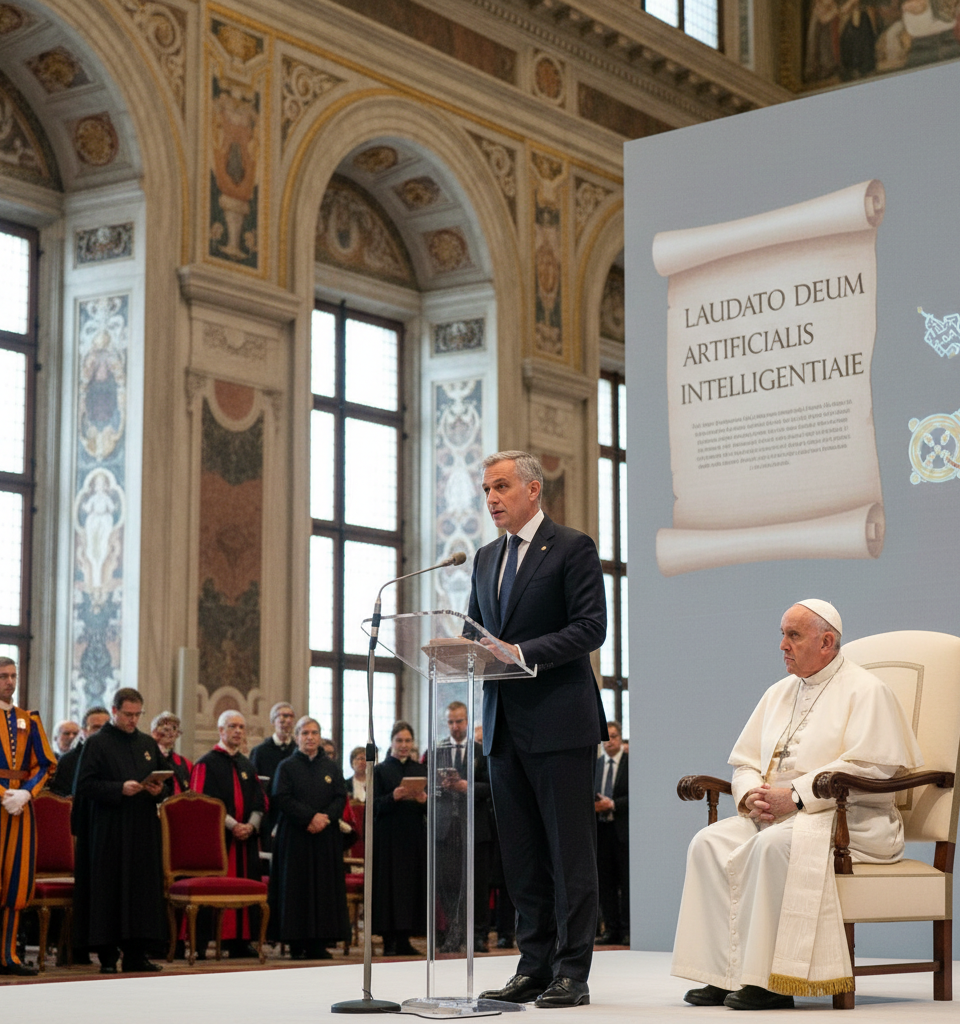
VATICAN CITY – The Vatican has announced that Christopher Olah, a co-founder of prominent artificial intelligence company Anthropic, will be a featured speaker at the official presentation of Pope Leo XIV's inaugural encyclical, "Magnifica Humanitas." The high-profile event is scheduled for May 25 at the Vatican’s Synod Hall, marking a significant convergence of theological leadership and cutting-edge technological development.
The forthcoming encyclical, whose title translates to "Magnificent Humanity," is expected to critically examine the profound societal and ethical implications of artificial intelligence. The Vatican’s decision to include a figure from the vanguard of AI development underscores the institution's acknowledgment of the technology's transformative power and the urgent need for a moral framework to guide its evolution.
A Defining Moment for AI Ethics
This announcement arrives amidst growing global discourse surrounding the responsible development and deployment of AI. Pope Leo XIV's foray into this complex field with a formal encyclical – a pastoral letter from the Pope to all the bishops of the Catholic Church – signals the gravity with which the Holy See views the challenges and opportunities presented by AI. Encyclicals often serve as foundational texts for Catholic social teaching, providing moral guidance on contemporary issues.
Christopher Olah's participation lends a crucial industry perspective to the Vatican's initiative. Anthropic, known for its focus on AI safety and the development of large language models like Claude, has been at the forefront of advocating for ethical considerations in AI research and application. His presence suggests a concerted effort to foster dialogue between spiritual leaders and technical innovators on shaping a future where AI serves humanity without compromising core values.
The Scope of "Magnifica Humanitas"
The Vatican's preliminary details indicate that "Magnifica Humanitas" will specifically address the protection of human dignity in the age of artificial intelligence. This theme is likely to encompass a wide range of issues, including algorithmic bias, data privacy, the future of work, autonomous decision-making systems, and the potential impact of advanced AI on human autonomy and societal structures. The encyclical is expected to call for a human-centric approach to AI, emphasizing ethical design, transparency, and accountability.
Historically, papal encyclicals have played pivotal roles in shaping global conversations on justice, peace, and human rights. "Rerum Novarum" (1891) addressed industrial capitalism and labor rights, while "Laudato Si'" (2015) focused on environmental stewardship and climate change. "Magnifica Humanitas" is poised to similarly influence ethical considerations within the rapidly advancing tech sector and spark broader societal reflections on humanity's relationship with intelligent machines.
Industry Response and Anticipation
The inclusion of an AI co-founder like Olah at such a significant Vatican event is a novel development, reflecting an evolving engagement strategy from the Holy See towards scientific and technological advancements. It suggests a recognition that the ethical challenges posed by AI require collaborative solutions spanning various sectors, including technology, academia, and religious institutions. The AI industry is keenly watching for the encyclical's contents, hoping it will provide a robust ethical compass without stifling innovation.
Experts anticipate that the encyclical will not only outline moral principles but also encourage international cooperation and policy development for responsible AI governance. The Vatican's global reach and moral authority could significantly amplify discussions around AI ethics, potentially influencing international legal frameworks and corporate policies. The May 25 presentation is expected to be a landmark event, drawing attention from policymakers, technologists, ethicists, and religious communities worldwide, all seeking guidance on navigating the complex landscape of artificial intelligence.
Looking Ahead: A Dialogue on Humanity's Future
The forthcoming launch of "Magnifica Humanitas" is not merely a religious event; it is projected to be a critical junction in the ongoing global dialogue about the future of humanity in an age increasingly shaped by artificial intelligence. The presence of a prominent AI industry leader at the Vatican serves as a powerful symbol of the urgent need for interdisciplinary collaboration to ensure that technological progress aligns with human flourishing. The world awaits the Pope's insights, hoping they will provide a moral bedrock for AI's journey forward, protecting the 'magnificent humanity' it seeks to serve.