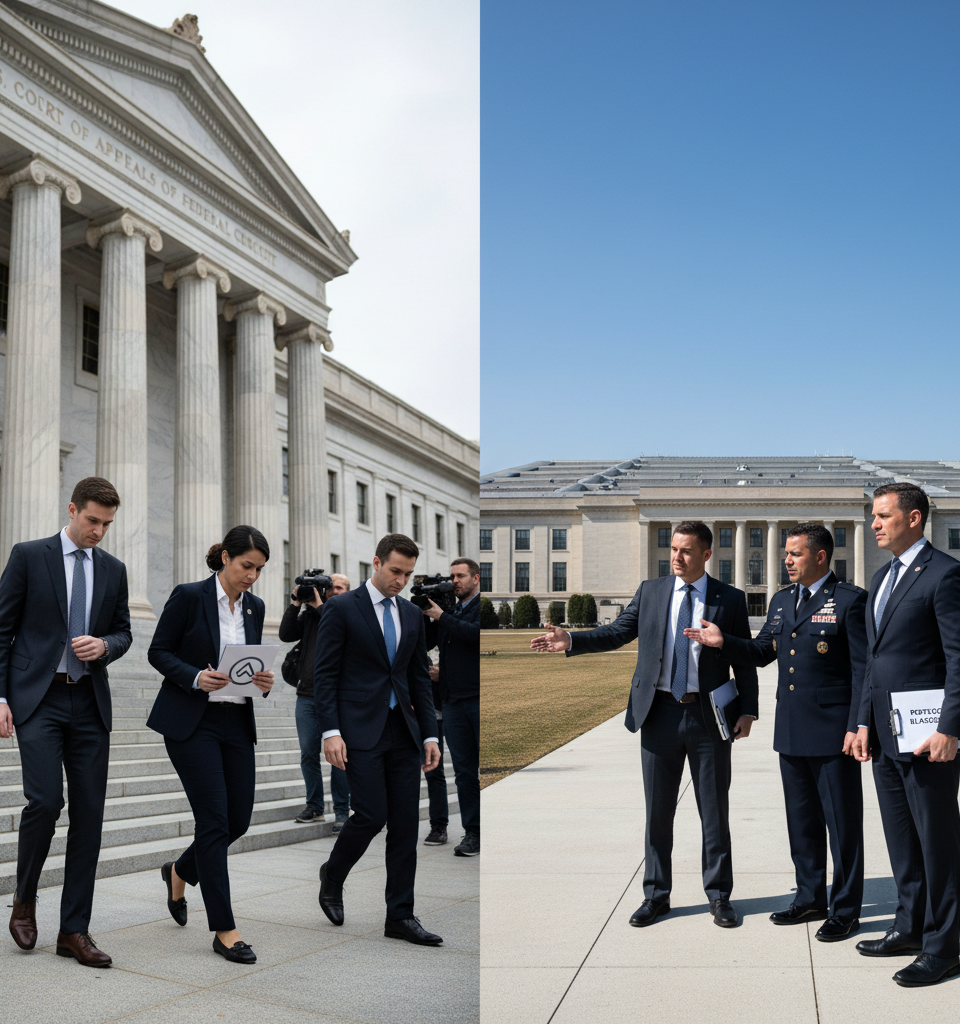
WASHINGTON D.C. — In a significant legal defeat for one of the leading artificial intelligence developers, Anthropic's urgent request for an emergency stay against its blacklisting by the U.S. Department of Defense (DoD) has been denied by a federal appeals court. The U.S. Court of Appeals for the Federal Circuit delivered its ruling late Tuesday, effectively upholding the Pentagon's decision to exclude the company from future federal contracts, at least for the immediate future. This denial punctuates a growing legal dispute between the innovative AI firm and the nation's largest defense agency, raising critical questions about transparency and fairness in high-stakes government procurement.
This dispute emerged after Anthropic was reportedly sidelined from a lucrative, multi-year AI integration contract, valued potentially in the hundreds of millions of dollars. The company claims the blacklisting was arbitrary and lacked due process, alleging the DoD failed to provide adequate justification for its decision to bar them from bidding on subsequent government projects. The stakes are particularly high as the Pentagon increasingly seeks to integrate advanced AI capabilities across its operations, from logistics and intelligence to advanced weaponry systems, making access to these contracts crucial for AI firms vying for market dominance.
Anthropic, renowned for its Claude large language model and its commitment to AI safety, had sought the emergency injunctive relief to prevent immediate and irreparable harm to its business reputation and financial prospects. The company argued that being blacklisted by such a prominent federal agency sends a chilling signal to the broader private sector, potentially hindering its ability to secure commercial contracts as well. Legal representatives for Anthropic expressed disappointment with the court's decision but indicated their commitment to pursuing the full merits of their lawsuit challenging the underlying blacklisting.
Broader Implications for AI Government Contracts
The denial carries substantial implications for the rapidly evolving landscape of AI development and its intersection with government contracting. It underscores the challenges faced by innovative tech companies in navigating complex federal procurement regulations, which have historically favored established defense contractors. As the DoD plans to invest billions into AI initiatives over the next five years—with projected spending reaching $3 billion annually by 2027—the criteria and processes for awarding these contracts are under intense scrutiny. This case could set precedents for how non-traditional defense vendors, particularly those focused on cutting-edge AI, engage with the government.
Moreover, this incident highlights the opaque nature of some aspects of federal contracting. Critics often point to a lack of transparency in how vendors are evaluated and, more critically, how they might be disqualified. For an AI company like Anthropic, whose valuation recently soared past $18 billion following substantial investments from Google and Amazon, access to government contracts is not just about revenue but also about establishing leadership and influence within a strategically critical sector. The precedent set by this case could influence how other AI giants, including OpenAI and Google DeepMind, approach federal opportunities.
Expert Reactions and Future Outlook
Industry analysts are closely watching the proceedings. Dr. Evelyn Reed, a senior fellow at the Center for Strategic and International Studies, commented, "This ruling, while procedural, is a stark reminder that even the most innovative tech companies are subject to the government's stringent and often bureaucratic contracting rules. It emphasizes the need for clearer guidelines and potentially new regulatory frameworks tailored for the unique characteristics of AI technologies and the firms developing them." She added that the long-term impact on Anthropic's federal ambitions remains uncertain, but the immediate message is clear: the bar for challenging Pentagon decisions is exceptionally high.
Financial markets have yet to show significant reaction, but the ongoing legal battle could introduce an element of uncertainty for Anthropic's investors. While federal contracts represent a fraction of major AI firms' total revenue, the prestige and strategic importance of working with the DoD are invaluable. The ruling might also prompt other AI companies to reassess their strategies for engaging with government clients, potentially leading to increased lobbying efforts for more transparent and AI-specific procurement policies.
What Lies Ahead
Despite the appeals court's denial of the stay, Anthropic's overarching lawsuit against the Department of Defense will continue. The company is expected to press forward with its claims that the blacklisting was improper and that they were denied due process. This will involve a more thorough examination of the DoD's decision-making process and the evidence, or lack thereof, justifying Anthropic's exclusion. The outcome of the main lawsuit could still force the Pentagon to either reinstate Anthropic as an eligible contractor or provide a more detailed and legally defensible explanation for its actions.
This legal saga is far from over. Future proceedings will likely involve extensive discovery, potentially revealing more about the inner workings of Pentagon procurement for advanced technologies. The case could ultimately redefine the relationship between innovative AI companies and the U.S. government, influencing how the world's most powerful military acquires and deploys the next generation of artificial intelligence. Observers will be keen to see if this legal challenge prompts the DoD to refine its contractor evaluation and disqualification procedures, particularly as AI becomes an increasingly integral component of national security strategy.