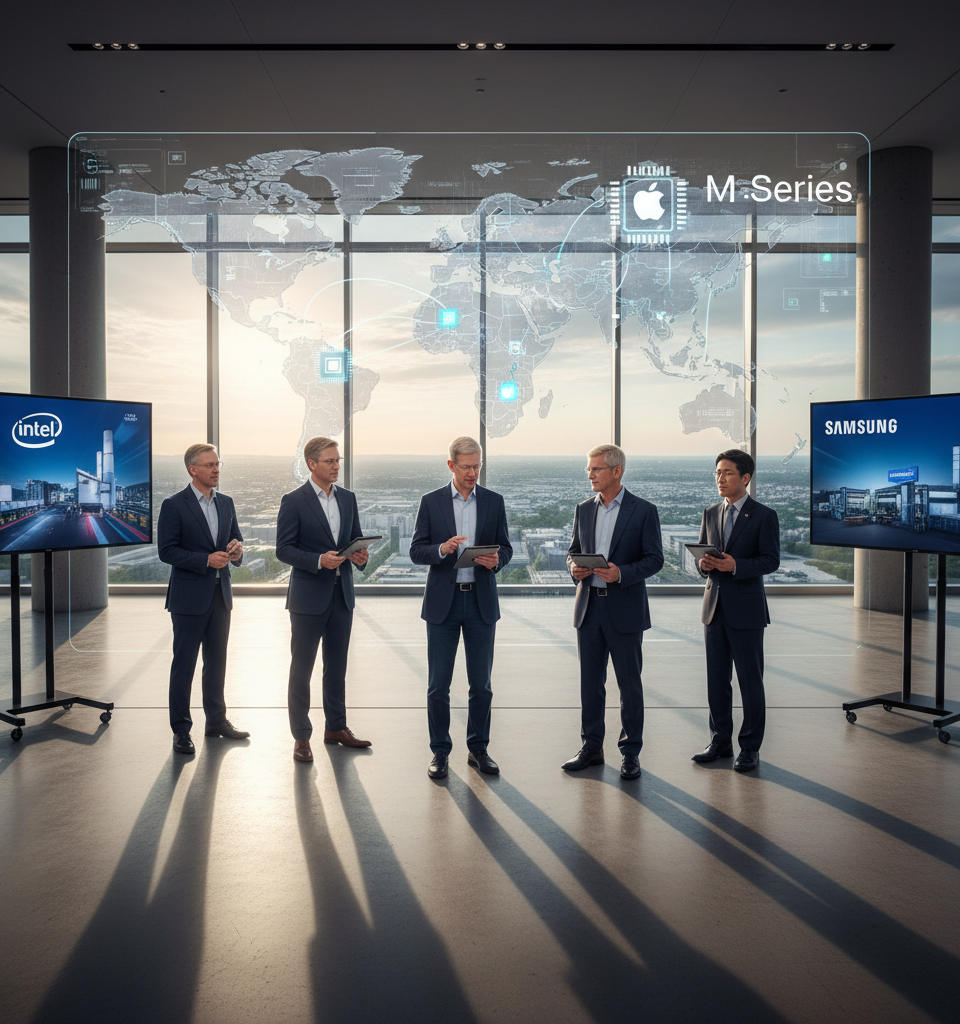
Cupertino, California — Apple Inc. is reportedly engaging in early-stage discussions with Intel Foundry and Samsung Foundry regarding the potential production of some of its custom-designed M-series processors. This revelation, first reported by Bloomberg, marks a significant potential shift in Apple's finely tuned silicon strategy, which has, for nearly a decade, relied almost exclusively on Taiwan Semiconductor Manufacturing Company (TSMC) for its advanced chip fabrication needs.
The discussions, while still preliminary, underscore Apple's apparent interest in diversifying its supply chain for critical components. For years, TSMC has been the sole manufacturer of Apple's powerful A-series and M-series chips, a partnership that underpinned the tech giant's transition away from Intel processors in its Mac lineup. This exclusive arrangement has been a cornerstone of Apple's hardware innovation, leveraging TSMC's industry-leading process technologies.
Shifting Supply Chain Dynamics
The potential outreach to Intel and Samsung carries substantial weight within the semiconductor industry. Apple's volume and technological demands are immense, making any contract from the company highly coveted. For Intel Foundry, led by Pat Gelsinger, securing even a fraction of Apple's M-series production would be a monumental victory, validating its ambitious turnaround strategy and its push into the foundry business.
Intel has publicly stated its aim to become the world's second-largest foundry by 2030, and an Apple contract would provide a significant boost in capital utilization and advanced process development. Similarly, for Samsung Foundry, already a major player in the contract manufacturing space, winning Apple's business would intensify its rivalry with TSMC and potentially secure a substantial revenue stream. Samsung previously manufactured some of Apple's A-series chips before TSMC became the sole supplier around the A9 chip generation.
Industry Impact and Competitive Implications
Should Apple proceed with multiple foundry partners, the implications for the global semiconductor market would be profound. TSMC, currently enjoying unprecedented demand and technological leadership, could face competitive pressure. While Apple's business represents a significant portion of TSMC's advanced node revenue, diversification would reduce TSMC's dependency on a single, albeit massive, client. For the broader industry, it could signal a move towards a more distributed, resilient supply chain, especially in light of recent geopolitical tensions and the push for greater domestic chip production in various regions. Companies like Intel are heavily investing billions in new fabs in Arizona, Ohio, and Germany, often with substantial government subsidies, to enhance regional chip manufacturing capabilities.
Expert Perspectives
Industry analysts are keenly watching these developments. "Apple's motivation is likely rooted in supply chain resilience and cost negotiation leverage," commented Jan Dawson, Chief Analyst at Jackdaw Research. "Having multiple suppliers minimizes risks associated with geopolitical events or production disruptions at a single foundry. It also gives Apple more bargaining power in pricing conversations for future chip generations." Others point to the increasingly complex and expensive nature of advanced chip manufacturing. "The sheer capital expenditure required for leading-edge nodes is astronomical," noted Patrick Moorhead of Moor Insights & Strategy. "Apple might be looking to share that burden or ensure access to a broader range of cutting-edge technologies as competition intensifies."
The Road Ahead: Future Implications
The road from exploratory talks to actual production is long and fraught with challenges, including technological alignment, cost structures, and intellectual property considerations. Intel, for instance, is still in the process of ramping up its most advanced nodes, such as the Intel 3 and Intel 18A processes, which would be necessary to meet Apple's demanding specifications. Samsung, while possessing advanced capabilities, has faced its own challenges in yield and process consistency compared to TSMC in certain previous generations.
Nevertheless, the significance of these discussions cannot be overstated. If successful, Apple's move could usher in a new era of multi-sourcing for its critical silicon, reshaping the competitive landscape for foundries and strengthening its own position against future supply chain shocks. The tech world will be watching closely to see if these early talks blossom into tangible manufacturing agreements, fundamentally altering the dynamics of high-performance computing chip production.