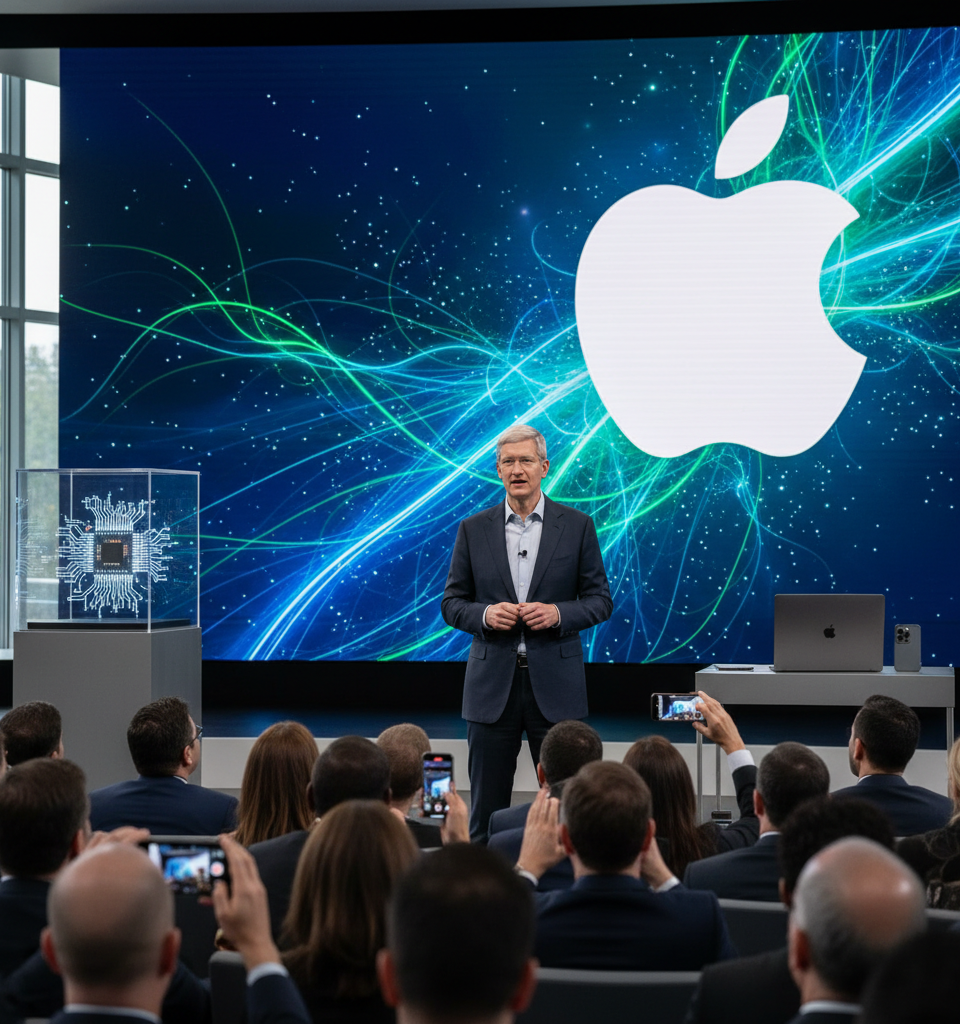
Amidst a backdrop of robust financial performance and the unexpected announcement of Tim Cook's departure, Apple Inc. is grappling with a formidable challenge: a deepening global semiconductor shortage that threatens to curtail its future growth. The tech behemoth, having just closed a record-breaking fiscal period, is bracing for what CEO Cook described as "RAMageddon," a severe bottleneck in essential memory components critical to its product lines.
Record-Breaking Performance Masks Underlying Vulnerabilities
Apple's recent earnings report painted a picture of extraordinary success, fueled by sustained demand for its iPhones, Macs, and services. The company announced its highest-ever quarterly revenue, exceeding analyst expectations and demonstrating remarkable resilience in a tumultuous global economy. This surge in sales underscores Apple's dominant market position and its ability to captivate consumers worldwide. However, the glittering financial results are now overshadowed by pronouncements of impending supply chain disruptions, particularly impacting readily available RAM for core products, which could significantly hamper the company's ability to meet future demand.
The Lingering Spectre of "RAMageddon"
Tim Cook, during what is anticipated to be one of his final earnings calls, explicitly warned investors and the market about the impending "RAMageddon." This term, quickly adopted by market analysts, highlights the severe constraint on Random Access Memory (RAM) components. While Apple has historically managed its supply chain with unparalleled efficiency, the current confluence of increased demand globally, pandemic-induced manufacturing disruptions, and geopolitical tensions has created an unprecedented bottleneck. Cook's candid admission signals a potential slowdown in product availability, directly impacting sales volumes and potentially eroding profit margins in the coming quarters.
Broader Industry Ripples and Market Impact
Apple's predicament is a microcosm of a much larger global crisis impacting virtually every sector reliant on semiconductors, from automotive to consumer electronics. The scarcity of chips is driving up costs, delaying production, and forcing companies to re-evaluate their sourcing strategies. For Apple, a company renowned for its tightly integrated hardware and software ecosystem, any disruption in component supply can have cascading effects, potentially delaying product launches or limiting inventory, thus impacting its competitive edge. The broader tech market is watching closely, understanding that if even a titan like Apple is vulnerable, smaller players face even more severe headwinds.
Expert Analysis: A Test of Apple's Resilience
Industry analysts are divided on the long-term impact on Apple. Some view Cook's warning as a prudent and transparent disclosure, suggesting that Apple's robust cash reserves and long-standing relationships with suppliers might enable it to navigate the storm better than its competitors. "Apple's supply chain is legendary for its robustness, but even they aren't immune to a global crisis of this magnitude," commented Sarah Chen, a senior tech analyst at Global Insight Partners. "This will be a true test of their ability to innovate not just in product, but in operational flexibility." Others are more cautious, pointing out that even minor delays in a highly competitive market can grant advantages to rivals and impact consumer sentiment.
The Path Forward: Diversification and Strategic Partnerships
Looking ahead, Apple's strategy will likely involve a multifaceted approach to mitigate the chip shortage. This could include further diversification of its supply chain, exploring new manufacturing partnerships, and potentially investing directly in semiconductor fabrication capacities, as some rivals have considered. The transition of leadership following Cook's departure also introduces an element of strategic uncertainty. The new CEO will inherit the immediate challenge of navigating these supply constraints while simultaneously steering Apple's long-term vision in an increasingly complex geopolitical and technological landscape. The company's ability to innovate beyond hardware, particularly in its rapidly growing services sector, may provide additional cushions against hardware-centric setbacks in the interim.
The coming months will be crucial for Apple as it endeavors to balance unprecedented demand with critical supply limitations, all while under new leadership. The resolution of the global chip shortage remains uncertain, casting a long shadow over the tech industry's immediate future and Apple's continued dominance.