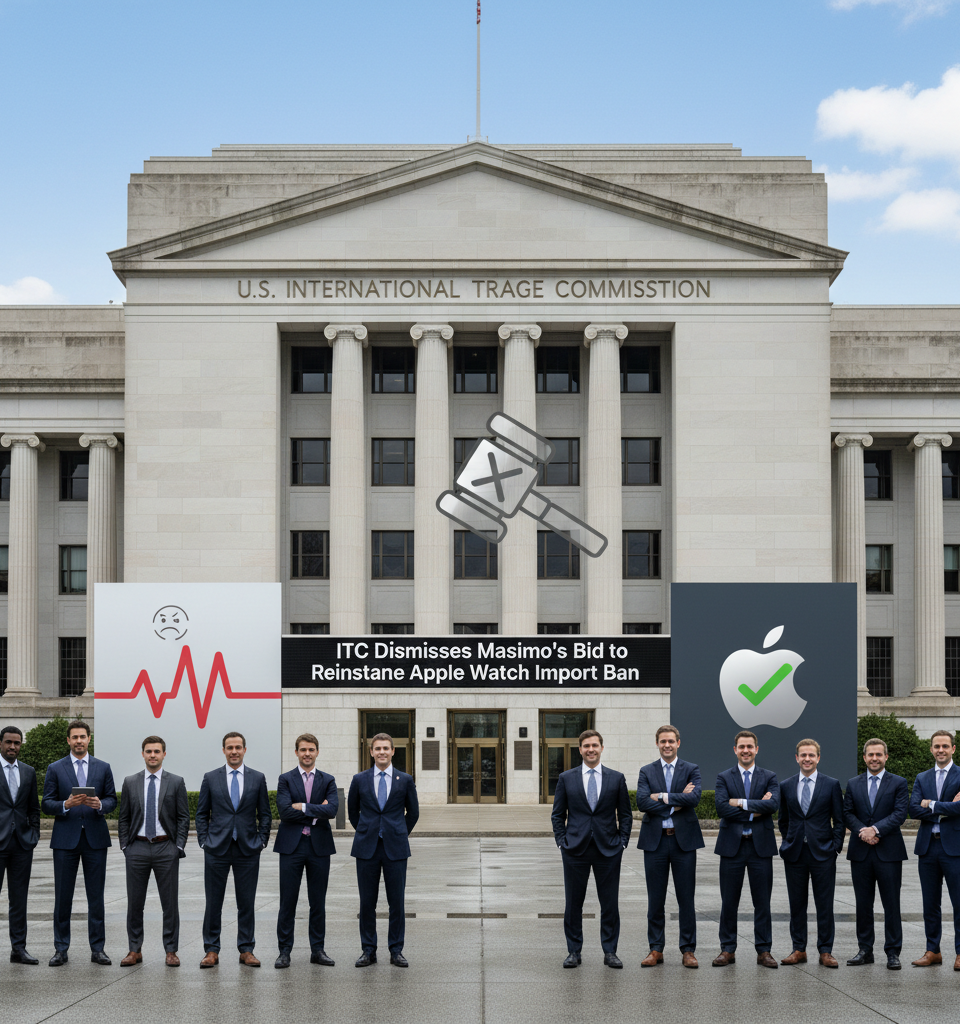
The U.S. International Trade Commission (ITC) has handed Apple a crucial win, dismissing Masimo's request to reimpose an import ban on specific Apple Watch models. The ITC's decision, announced on Wednesday, March 6, 2024, effectively upholds its earlier ruling from January, which found that modified versions of the Apple Watch Series 9 and Ultra 2 did not infringe on Masimo's patented blood oxygen monitoring technology. This development allows Apple to continue selling its latest smartwatch iterations in the U.S. market, relieving pressure on the company following a challenging period marked by the legal battle.
Background of the Dispute
This ruling is the latest chapter in a protracted legal saga that began when medical technology firm Masimo accused Apple of infringing on its pulse oximetry patents, claiming Apple poached employees and incorporated Masimo's technology into the Apple Watch without authorization. The dispute escalated significantly in October 2023 when the ITC initially found that Apple had indeed infringed on Masimo's patents, leading to a limited import and sales ban on certain Apple Watch models, including the Series 9 and Ultra 2. While Apple briefly removed these models from its U.S. online store and retail shelves in late December, it quickly introduced modified versions that omitted the disputed blood oxygen feature, allowing sales to resume after a temporary pause and an appeals court intervention. Masimo's latest motion was an attempt to block these redesigned watches, arguing they still contained infringing technology.
Key Details of the ITC Ruling
Masimo had filed an emergency motion requesting the ITC to halt the sale of Apple's redesigned smartwatches, asserting that the modifications made were insufficient to circumvent the original patent infringement finding. However, the ITC's latest order explicitly denied this request. While the full reasoning for the denial has not yet been publicly released, the decision strongly suggests that the commission is satisfied with Apple's technical workarounds. Apple's earlier modifications involved software updates and, crucially, removing the problematic blood oxygen saturation (SpO2) functionality from watches sold in the U.S. after December 18, 2023. These watches are still capable of heart rate monitoring and ECG readings but lack the SpO2 feature, which was central to Masimo's patent claims. A federal appeals court had previously allowed Apple to sell these modified watches while the ITC reviewed Masimo’s enforcement request.
Industry and Market Impact
This ruling carries significant implications for both Apple and the broader wearable technology market. For Apple, it removes a substantial legal and reputational distraction, ensuring its critical Apple Watch product line remains unimpeded in a key market. Analysts estimate that the Apple Watch generated approximately $14 billion in revenue for Apple in 2023. A prolonged ban would have severely impacted Apple's wearables segment, especially during crucial sales periods. The decision also validates Apple's strategy of quick technical adaptation in response to legal challenges. For the medical technology sector, it highlights the increasing convergence of consumer electronics and health monitoring, underscoring the complexities of intellectual property in rapidly evolving technological landscapes. Competitors in the smartwatch market, such as Samsung and Google (Fitbit), will be closely watching how these patent disputes influence product development and feature integration.
Expert Perspectives
Legal experts suggest that the ITC's decision indicates a high bar for enforcing patent infringement claims, particularly when technical modifications are introduced. "This ruling suggests the ITC found Apple's workarounds to be genuinely non-infringing, at least for the time being," commented intellectual property lawyer Sarah Chen. "It's a strong signal that companies can mitigate legal risks through design changes post-ruling." Financial analysts echoed the sentiment, with Wedbush Securities analyst Dan Ives noting, "This is a clear win for Apple, removing an overhang right before their next earnings call. The Apple Watch is a crucial part of their ecosystem and this decision provides stability." The removal of the ban clears the path for Apple to focus on its product roadmap and potentially reintroduce the SpO2 feature in U.S. models, either through a licensing agreement with Masimo or entirely new, non-infringing technology, if and when the legal landscape permits.
What's Next?
While this ITC decision is a victory for Apple, the broader legal battle with Masimo is far from over. Masimo still has ongoing patent infringement litigation against Apple in federal court, with a jury trial pending for the remaining claims. Furthermore, the U.S. Court of Appeals for the Federal Circuit is set to hear Apple's appeal against the ITC's initial infringement finding later this year. This means that while Apple can continue selling its current modified watches, the ultimate fate of the blood oxygen feature and the potential for future disputes remains uncertain. Both companies are likely to continue aggressively pursuing their legal strategies, making this a closely watched case in the intersection of health tech and consumer electronics. Apple's ability to maintain unimpeded sales of its flagship wearable device while navigating these legal challenges will be a key determinant of its performance in the competitive wearables market in the coming years.