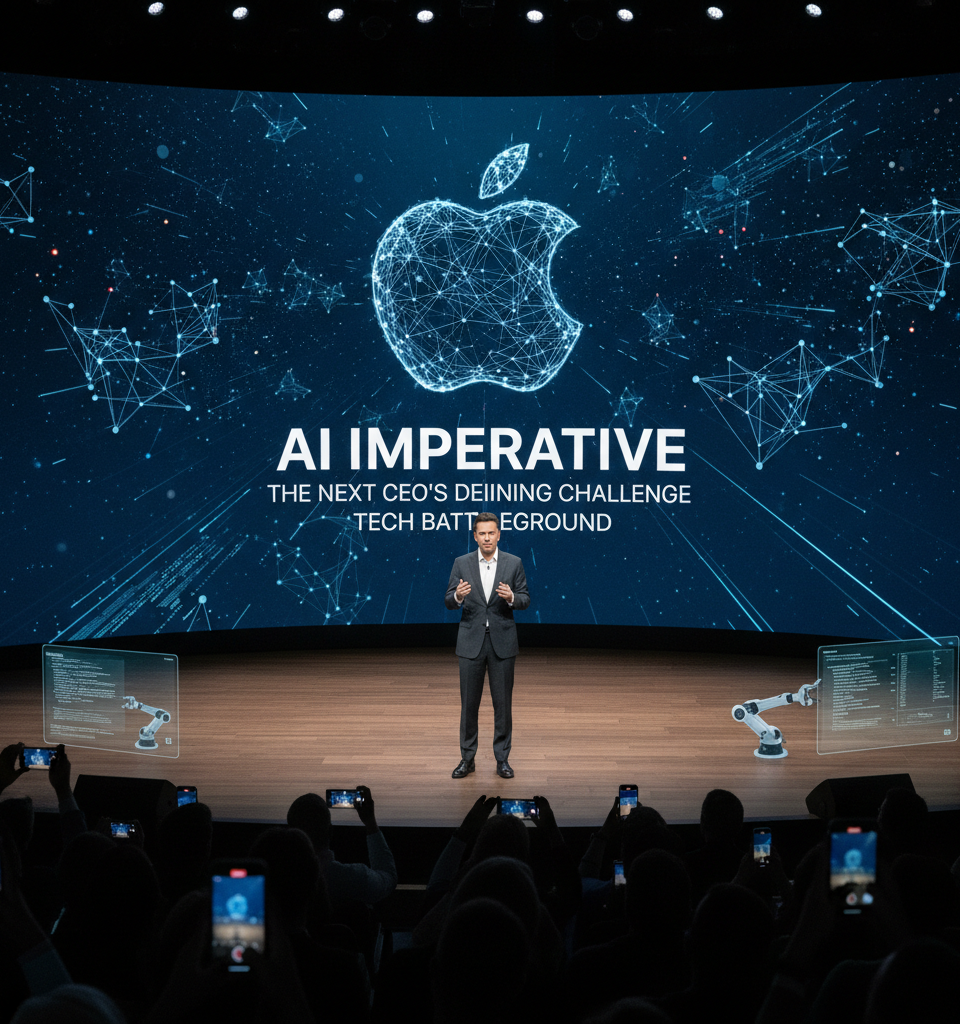
The future leadership of Apple Inc. is inextricably linked to its ability to innovate significantly in artificial intelligence, a challenge poised to define the tenure of CEO Tim Cook's eventual successor. The consensus among analysts and industry observers is that while Cook has masterfully guided Apple to unprecedented financial success and market valuation, the company has yet to deliver a truly "killer app" in the burgeoning AI space.
This critical oversight is now seen as the primary hurdle for Apple's continued dominance, placing immense pressure on potential future leaders, with whispers increasingly pointing to John Ternus, Apple's Senior Vice President of Hardware Engineering, as a formidable figure to spearhead this transformation.
The Strategic Imperative of AI Innovation
Apple's current market capitalization, hovering around $2.7 trillion, and its consistent brand loyalty are undeniable testaments to its operational prowess and product ecosystems. However, in the rapidly evolving tech sector, past successes do not guarantee future leadership. Companies like Microsoft, bolstered by significant investments in OpenAI, and Google, with its Gemini models, have made aggressive strides in consumer-facing AI. Apple's Siri, despite being an early entrant, has largely been perceived as lagging in capabilities compared to newer, more sophisticated AI assistants and services. The absence of a flagship AI product risks ceding vital market share in a domain that is expected to redefine user interactions with technology, impacting everything from personal computing to automotive interfaces.
Tim Cook's Legacy and The AI Gap Tim
Cook's tenure, commencing in 2011, has been characterized by an extraordinary period of growth, diversification into services, and supply chain mastery. Under his leadership, Apple's services revenue alone reached $85.2 billion in fiscal year 2023, a considerable achievement. Yet, critics argue that the innovation curve, particularly in transformative software capabilities like advanced AI, plateaued somewhat compared to the Steve Jobs era. While Apple has integrated AI elements across its products, such as in computational photography and personalized health tracking, these have been incremental improvements rather than groundbreaking, standalone AI experiences competitive with offerings from its peers. The market implicitly values this AI gap; rivals demonstrating strong AI roadmaps often attract higher investor confidence.
The Industry-Wide Race for AI Supremacy
The broader technology industry is locked in a high-stakes race for AI dominance. Companies are pouring billions into research and development, acquiring AI startups, and retraining workforces. Microsoft's $13 billion investment in OpenAI and Google's relentless pursuit of AI model development underscore the strategic importance. Even smaller players are carving out niches with specialized AI applications. For Apple, traditionally a trendsetter, its current stance in AI could be likened to its position in the search engine market two decades ago – a comfortable distance behind the leaders, but with far greater potential repercussions given AI's pervasive nature. Failure to innovate significantly could lead to gradual erosion of its ecosystem's perceived value and a softening of its premium brand image.
Analyst Perspectives and Future Outlook Analysts from firms like Wedbush
Securities highlight the urgency. Dan Ives stated in a recent note, "The next CEO's primary mandate will be to unlock Apple's massive AI potential. The market is demanding a clear, compelling AI narrative." Many believe that Apple possesses latent advantages, including its vast user base of over 2 billion active devices, powerful custom silicon (M-series and A-series chips), and an unparalleled data privacy reputation. Harnessing these assets to deliver privacy-centric, on-device AI innovations could be Apple's unique differentiator. The challenge lies in translating this potential into tangible, user-facing products that captivate the market in the same way the iPhone or Mac did.
The Road Ahead: John Ternus and Apple's AI Strategy
The spotlight on John Ternus is not without reason. As the head of hardware engineering, he has overseen the development of Apple's custom silicon, which is critical for on-device AI processing. His intimate understanding of Apple's core technological strengths could be instrumental. The next CEO will need to not only foster internal AI development but also potentially pursue strategic acquisitions or partnerships that can accelerate Apple's AI roadmap. We anticipate that upcoming product announcements, especially those tied to the WWDC (Worldwide Developers Conference) keynotes, will contain increasingly direct references to Apple's evolving AI strategy, possibly hinting at a more cohesive platform or a new class of AI-powered features designed to redefine user experience and interaction. The stakes are profoundly high; Apple’s continued trajectory as a global innovation leader hinges on its ability to truly conquer the AI frontier.