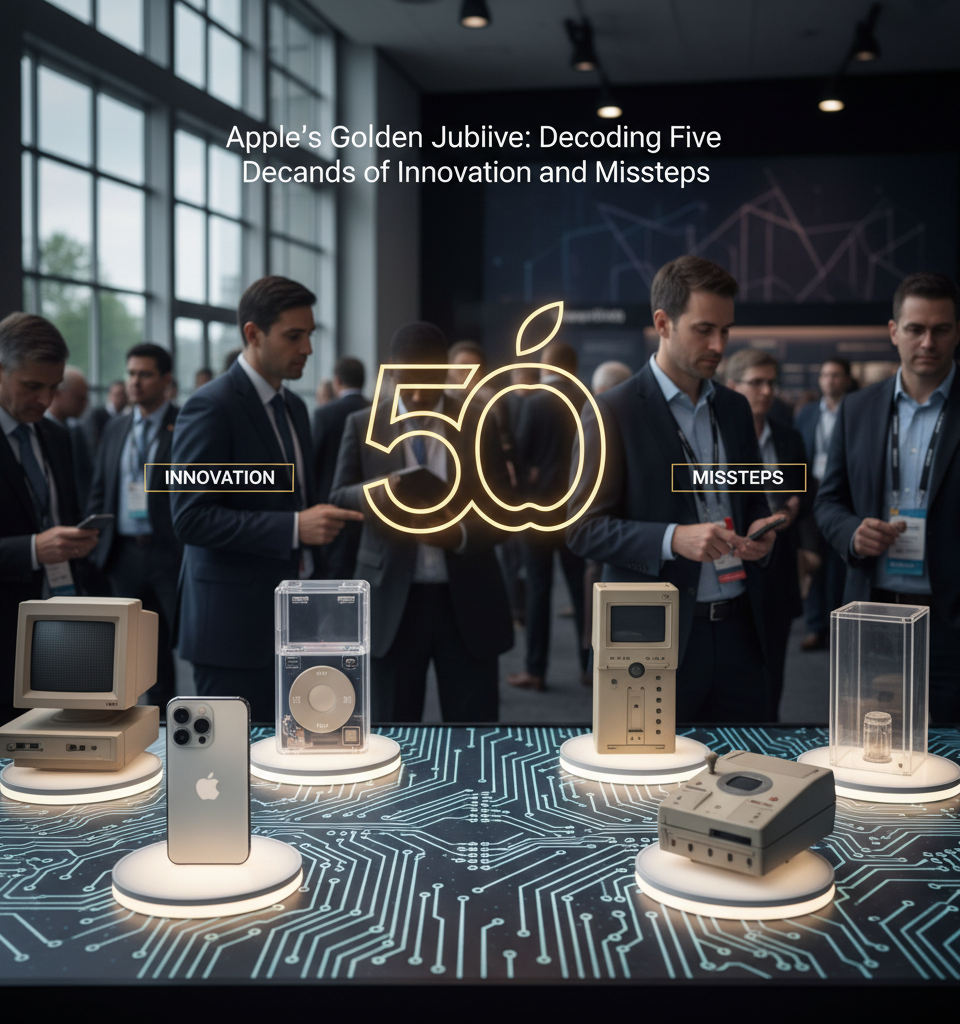
On the eve of its momentous 50th anniversary, Apple Inc. stands at a pivotal juncture, prompting a deep dive into its half-century legacy of groundbreaking innovation and unforeseen challenges. Industry observers and technology analysts are meticulously dissecting the company's product catalog, singling out the foundational successes that reshaped consumer electronics and daily life, as well as the notable commercial duds that serve as cautionary tales in the annals of tech history.
A Legacy Forged in Innovation
Since its inception in a Los Angeles garage, Apple has consistently pushed the boundaries of technology, transforming niche gadgets into indispensable tools for billions worldwide. This retrospective underscores the company's astonishing journey from a nascent computer manufacturer to a global powerhouse. The importance of this analysis extends beyond mere historical curiosity; it provides crucial insights into the dynamics of innovation, market disruption, and the delicate balance between visionary leadership and consumer demand. The company's trajectory offers invaluable lessons for startups and established enterprises alike, illustrating the profound impact a single entity can have on the global economy and cultural landscape.
Triumphs and Tribulations: A Product Deep Dive
Analysts universally laud the iPhone, Macintosh, and iPod as Apple's quintessential game-changers. The iPhone, introduced in 2007, didn't just revolutionize mobile communication; it single-handedly created the smartphone market as we know it, with over 2.32 billion units sold globally and contributing roughly 52% of Apple's fiscal year 2023 revenue of $383.29 billion. The Macintosh, launched in 1984, democratized computing with its graphical user interface, paving the way for intuitive human-computer interaction. The iPod, released in 2001, transformed the music industry, selling over 400 million units and perfectly setting the stage for iTunes and the digital media ecosystem. Conversely, the Newton MessagePad (1993), the Pippin gaming console (1996), and the G4 Cube (2000) are frequently cited as Apple's most significant commercial failures. The Newton, despite its pioneering spirit, suffered from poor handwriting recognition and a high price point. The Pippin, a collaboration with Bandai, was a spectacularly ill-conceived foray into gaming, selling only a few tens of thousands of units. The G4 Cube, while aesthetically lauded, was overpriced and suffered from overheating issues, quickly becoming a collector's item rather than a market leader.
Reshaping Industries and Market Dynamics
Apple's successes have not just introduced new products; they have fundamentally reshaped entire industries. The iPhone's app ecosystem fueled a multi-trillion dollar developer economy, while the iPod's success paved the way for streaming services and digital music distribution. The ripple effects extend to competitor strategies, supply chain efficiencies, and even global consumer behavioral patterns. The company's market capitalization, which has fluctuated around the $3 trillion mark, underscores its unparalleled influence on global financial markets and technological advancements. Its ability to command premium pricing and maintain high customer loyalty sets a formidable benchmark across various sectors.
Analyst Consensus: Visionary Leadership with Occasional Blind Spots
Leading industry analyst Sarah Chang from TechInsights notes, "Apple's sustained success stems from its relentless focus on user experience and ecosystem integration, a testament to Steve Jobs's original vision and Tim Cook's operational mastery. However, even the most innovative companies have their misses. The key is in learning from those failures to inform future successes, which Apple has demonstrably done." Another analyst, David Chen of GlobalData, adds, "The contrast between the iPhone and the Pippin isn't just about product quality; it's about understanding market readiness and core competencies. Apple thrives when it innovates within its strengths and missteps when it stretches too thin or misjudges consumer appetite."
The Road Ahead: Evolution and New Frontiers
Looking forward, Apple is poised to continue its quest for innovation, with significant investments in nascent technologies like augmented reality (AR), virtual reality (VR), and artificial intelligence (AI). Products like the Apple Vision Pro represent the company's commitment to defining future computing paradigms. The ongoing expansion of its services ecosystem, which now generates over $85 billion annually, is also a critical driver of future growth. Navigating regulatory scrutiny, geopolitical tensions, and an increasingly competitive landscape will be paramount for Apple to maintain its dominant position and continue its legacy of groundbreaking contributions to technology and society for the next 50 years.