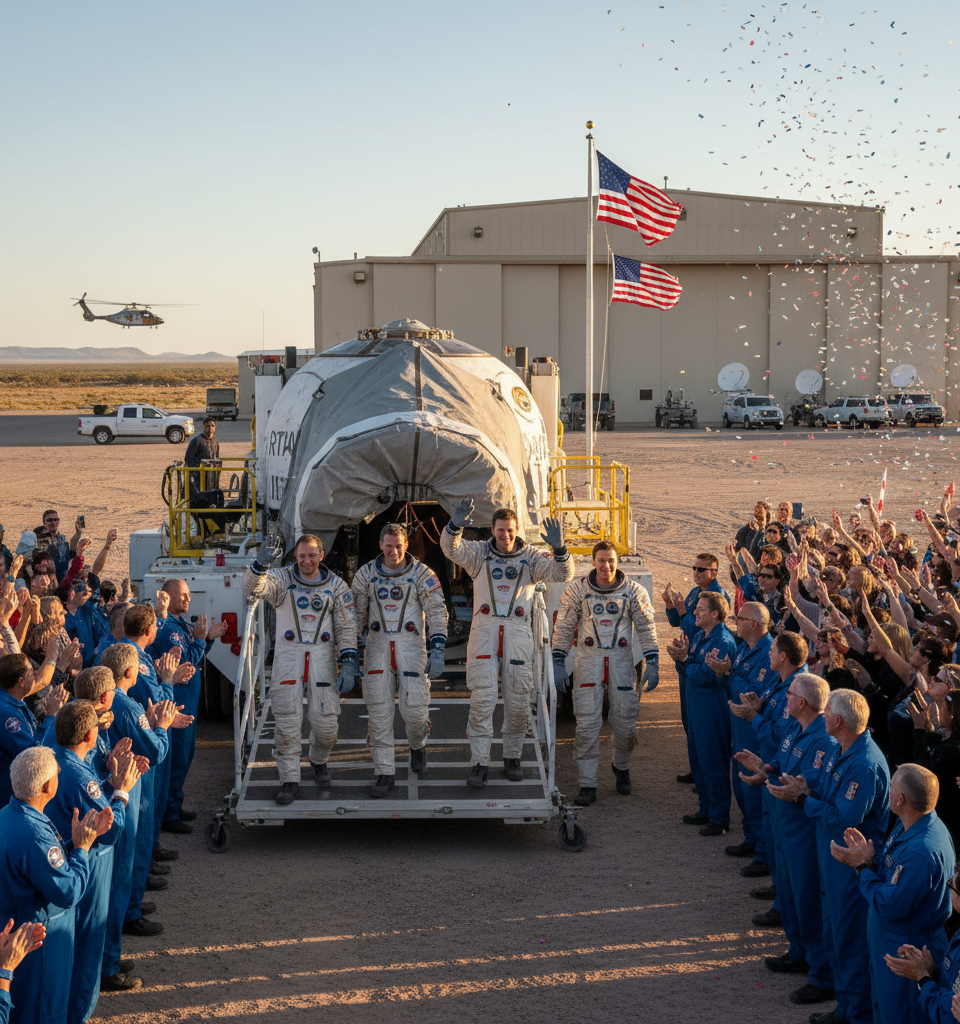
The Artemis mission's four-person crew has successfully concluded their historic nine-day journey, returning safely to Earth with a Pacific Ocean splashdown. This momentous event, occurring today, marks a significant achievement in human spaceflight, as the astronauts ventured further from Earth than any previous human expedition. The mission's success paves the way for future lunar endeavors and reinforces humanity's ambition to explore beyond low Earth orbit.
The safe return of the Artemis crew represents a pivotal moment for global space agencies and the broader scientific community. This mission was not merely a journey to the Moon and back; it was a comprehensive test of next-generation spacecraft capabilities, life support systems, and the resilience of human explorers. The data and experiences gained from this voyage will be invaluable in shaping the trajectory of future deep-space missions, including potential crewed missions to Mars. The mission also serves as a potent symbol of international collaboration and technological advancement in an increasingly competitive space landscape.
The crew embarked on their extraordinary odyssey, pushing the boundaries of human endurance and technological prowess. Their spacecraft traversed vast distances, showcasing the cutting-edge engineering and meticulous planning that underpinned the entire Artemis program. While specific details regarding orbital parameters and intermediate milestones of their nine-day expedition are still being comprehensively analyzed, the overarching success of the mission is undeniable. The journey's duration and the unprecedented distance covered highlight the robust capabilities of the spacecraft and the rigorous training undertaken by the astronauts.
Implications for Space Industry and Economy
The successful return of the Artemis crew is expected to have far-reaching implications for the burgeoning space industry. Investor confidence in space exploration ventures could see a significant boost, potentially catalyzing further investment in technologies related to long-duration spaceflight, lunar infrastructure, and deep-space resource utilization. Companies involved in manufacturing spacecraft components, propulsion systems, and advanced life support technologies are poised to benefit from renewed interest and increased funding. Furthermore, the public relations triumph associated with such a historic mission can inspire a new generation of scientists and engineers, feeding the talent pipeline for future space endeavors.
The mission's success also underscores the growing trend of commercial participation in space exploration. While government agencies lead such ambitious projects, a robust ecosystem of private companies contributes critical components and services. This collaboration is likely to intensify, leading to more economical and efficient approaches to space travel. The data gathered from the Artemis mission will be instrumental for these private entities in developing commercial applications, such as lunar tourism and in-space manufacturing, which could fundamentally alter the economic landscape of the 21st century.
The Path Forward: Deep Space and Beyond
Looking ahead, the successful conclusion of this Artemis mission sets the stage for a series of more complex and ambitious undertakings. The immediate future will involve an exhaustive review of all mission data, from spacecraft performance metrics to the physiological responses of the crew. This analysis will be critical for refining methodologies and technologies for subsequent Artemis missions, which aim to establish a sustained human presence on the Moon. These future missions envision the construction of lunar outposts, enabling longer stays and more extensive scientific research on the lunar surface.
The long-term vision for the Artemis program extends beyond the Moon. The experience gained during this record-breaking journey and subsequent lunar missions will be foundational for humanity's ultimate goal of sending astronauts to Mars. The challenges of a Martian voyage – including extended periods in deep space, radiation exposure, and the logistical complexities of landing and returning from another planet – necessitate the gradual, incremental steps being taken through programs like Artemis. The safe return of this crew is not merely the end of one mission, but a powerful beginning for the next chapter in human space exploration.