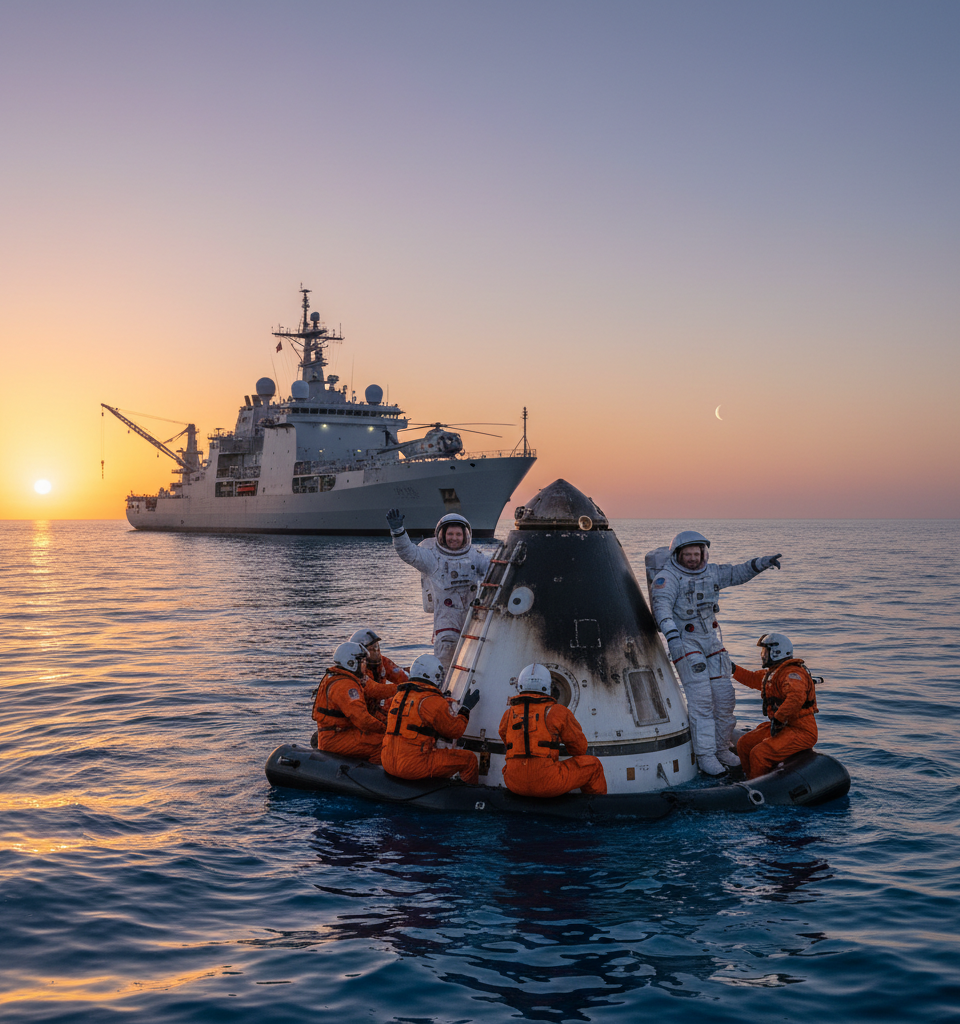
The Artemis II mission's four-person crew has concluded their groundbreaking journey, successfully returning to Earth following a meticulously executed lunar flyby. This mission marks a pivotal achievement in human space exploration, as the crew traveled a greater distance from Earth than any previous human endeavor, pushing the boundaries of deep-space travel and setting new benchmarks for future interstellar aspirations.
A Monumental Leap for Space Exploration
The importance of the Artemis II mission extends far beyond its record-breaking distance. It served as a critical test flight for the Orion spacecraft and its life-support systems in a deep-space environment, paving the way for future lunar landings and eventually, missions to Mars. This successful flyby demonstrates NASA's renewed capability to send humans beyond low Earth orbit, a feat not accomplished since the Apollo era. The data collected during this lengthy voyage will be invaluable for understanding the long-term effects of deep space radiation on the human body and for refining propulsion and navigation technologies necessary for prolonged absence from Earth.
Journey Highlights and Presidential Praise
Among the notable events of their journey, the Artemis II astronauts were afforded a rare and spectacular view of a solar eclipse from their unique vantage point in lunar orbit. This celestial observation not only provided unparalleled scientific data but also offered a breathtaking perspective on our solar system, showcasing the beauty and complexity of cosmic phenomena. The crew's monumental achievement also garnered direct recognition from the highest office, with President Trump personally calling the astronauts to commend their bravery, skill, and the historic nature of their mission, underscoring the national and global significance of this endeavor.
Industry and International Collaboration
The success of Artemis II has significant implications for the aerospace industry and international space partnerships. Companies involved in the development of the Orion spacecraft, the Space Launch System (SLS), and ground support systems are poised for increased investment and prestige. This mission reinforces the collaborative spirit of the Artemis program, which includes contributions from international partners such as the Canadian Space Agency and the European Space Agency. The data and operational experiences gained are expected to inform the design and implementation of subsequent Artemis missions, fostering a robust ecosystem for lunar exploration and beyond. The technical validation achieved provides a strong foundation for future commercial ventures in lunar resource utilization and space tourism, signaling a new era of opportunity in the final frontier.
Paving the Way for Artemis III and Beyond
The immediate implications of Artemis II's successful return are centered on the preparations for Artemis III, the mission slated to return humans to the lunar surface. The extensive data gathered on Orion's performance, the crew's health, and operational procedures during this deep-space traverse will be meticulously analyzed to mitigate risks and optimize the success of future lunar landing attempts. This mission provided invaluable insights into the physiological and psychological challenges of prolonged spaceflight outside the Earth's protective magnetosphere. Engineers and mission planners will now delve into the telemetry, health data, and crew feedback to refine everything from spacecraft shielding to astronaut training protocols. The knowledge gained promises to significantly enhance the safety and effectiveness of humanity's sustained presence on and around the Moon.
The Future of Deep Space Exploration
Looking ahead, Artemis II's success invigorates the long-term vision for human exploration of the solar system. It validates the foundational technologies required for Mars missions, including autonomous navigation, deep-space communication, and extended life support systems. The confidence instilled by this mission is critical for securing continued public and political support for ambitious space initiatives. As humanity contemplates longer voyages to destinations like Mars, the experiences from missions like Artemis II will be essential in developing the strategies and technologies needed for such monumental undertakings, marking a definitive step towards establishing a permanent human presence in space.