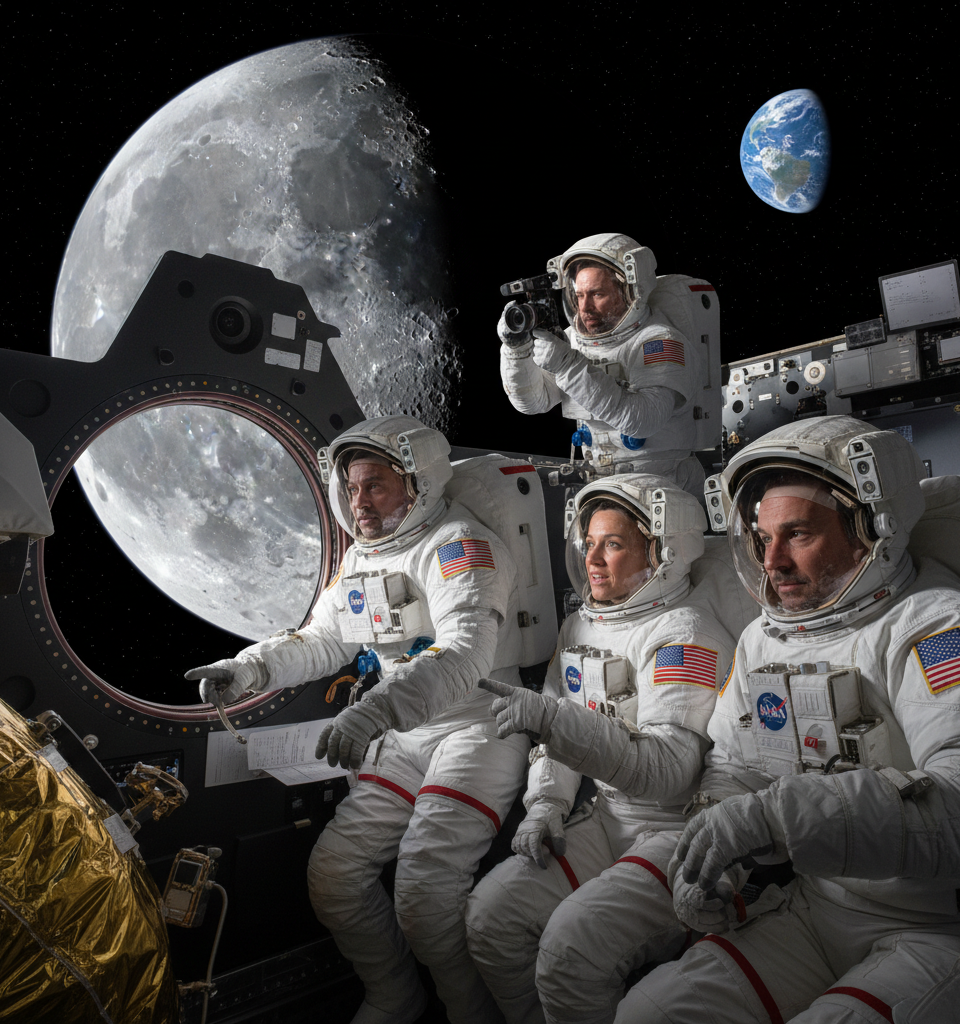
CAPE CANAVERAL, FL – In a monumental achievement for human spaceflight, the four astronauts aboard NASA's Orion spacecraft successfully completed a historic lunar flyby, establishing a new record for the farthest human travel from Earth. This pivotal maneuver, executed with precision on, saw the Orion capsule and its intrepid crew – Commander Reid Wiseman, Pilot Victor Glover, Mission Specialist Christina Koch, and Canadian Space Agency astronaut Jeremy Hansen – circle the Moon before slingshotting back towards Earth. The critical event, which serves as a dress rehearsal for future lunar landings, sets the stage for a new era of lunar exploration and potential long-duration missions.
Contextual Significance and Historical Parallels
This record-breaking journey carries immense historical weight, echoing the daring spirit of the Apollo missions of the mid-20th century while incorporating cutting-edge 21st-century technology. For over 50 years, the furthest humans had ventured from Earth was during Apollo 13 in 1970, which reached a distance of approximately 400,171 kilometers (248,655 miles). Artemis II surpassed this benchmark, demonstrating the enhanced capabilities of the Orion spacecraft and the Space Launch System (SLS) rocket. The mission is a foundational step in NASA's broader Artemis program, which aims not only to return humans to the Moon but to establish a sustained presence there, paving the way for future missions to Mars. This flyby validates critical systems and procedures for human deep-space travel, crucial for the ambitious goals ahead.
Key Mission Execution and Technical Achievements
During its closest approach, the Orion spacecraft passed approximately 10,300 kilometers (6,400 miles) above the lunar surface, a trajectory carefully calculated to achieve the record-setting distance from Earth. The crew meticulously performed various in-flight tests, including checks on life support systems, communication relays, and navigation capabilities, all essential for the safety and success of future missions. The 90-second video encapsulating the flyby, disseminated globally, offered a compressed yet awe-inspiring view of humanity's reach beyond Earth's immediate vicinity. The mission's total duration is expected to be around 10 days, during which the crew will assess Orion's performance in the deep-space environment, enduring radiation exposure and testing manual flight operations crucial for future lunar rendezvous and docking maneuvers. The Orion capsule itself, a marvel of engineering, is designed to accommodate four astronauts and withstand the extreme conditions of deep space and Earth re-entry at speeds exceeding 40,000 km/h (25,000 mph).
Impact on the Commercial Space Sector and International Partnerships
The success of Artemis II has significant implications for the burgeoning commercial space sector. With NASA increasingly relying on private partners for elements of its lunar program, from landers to habitation modules, successful missions like this bolster investor confidence and accelerate technological development. Companies like SpaceX, Blue Origin, and Dynetics, all vying for lunar contracts, observe these milestones as validation of the overall strategic direction. Furthermore, the inclusion of a Canadian astronaut, Jeremy Hansen, underscores the growing international collaboration in space exploration. The Canadian Space Agency (CSA) is contributing the Canadarm3 robotic arm to the lunar Gateway space station, a vital component of the Artemis architecture. This synergistic approach, valued in the billions of dollars across various contracts, promises to diversify capabilities and share the immense financial and intellectual burdens of deep-space endeavors.
Expert Analysis and Future Prospects
Space industry analysts commend the precision and execution of the Artemis II mission. Dr. Elena Petrova, a renowned aerospace engineer, commented, "This flyby is more than just a distance record; it's a critical stress test of the Orion spacecraft and the human element. The data gathered from this mission will be invaluable for optimizing the Artemis III lunar landing and ensuring astronaut safety." Experts believe the success reinforces NASA's timeline for a human return to the Moon's surface by the mid-2020s. The psychological impact on the public, witnessing humanity push its boundaries once again, is also seen as crucial for maintaining public and political support for continued federal investment in space exploration, which, for NASA, averages approximately $25-30 billion annually.
The Road Ahead: Artemis III and Beyond
Looking forward, the success of Artemis II directly paves the way for Artemis III, which aims to land the first woman and the first person of color on the lunar south pole. This mission involves the crew transferring from Orion to a Human Landing System (HLS) – likely SpaceX's Starship – for the final descent to the Moon's surface. Following Artemis III, subsequent missions envision the assembly and operationalization of the Gateway, a lunar orbiting outpost that will serve as a hub for scientific research and a staging point for deeper space exploration. The long-term vision includes establishing a sustainable human presence on the Moon, utilizing its resources, and ultimately, launching crewed missions to Mars, leveraging the lunar experience. This ambitious roadmap represents a multi-decade, multi-billion-dollar investment in humanity's future in space.