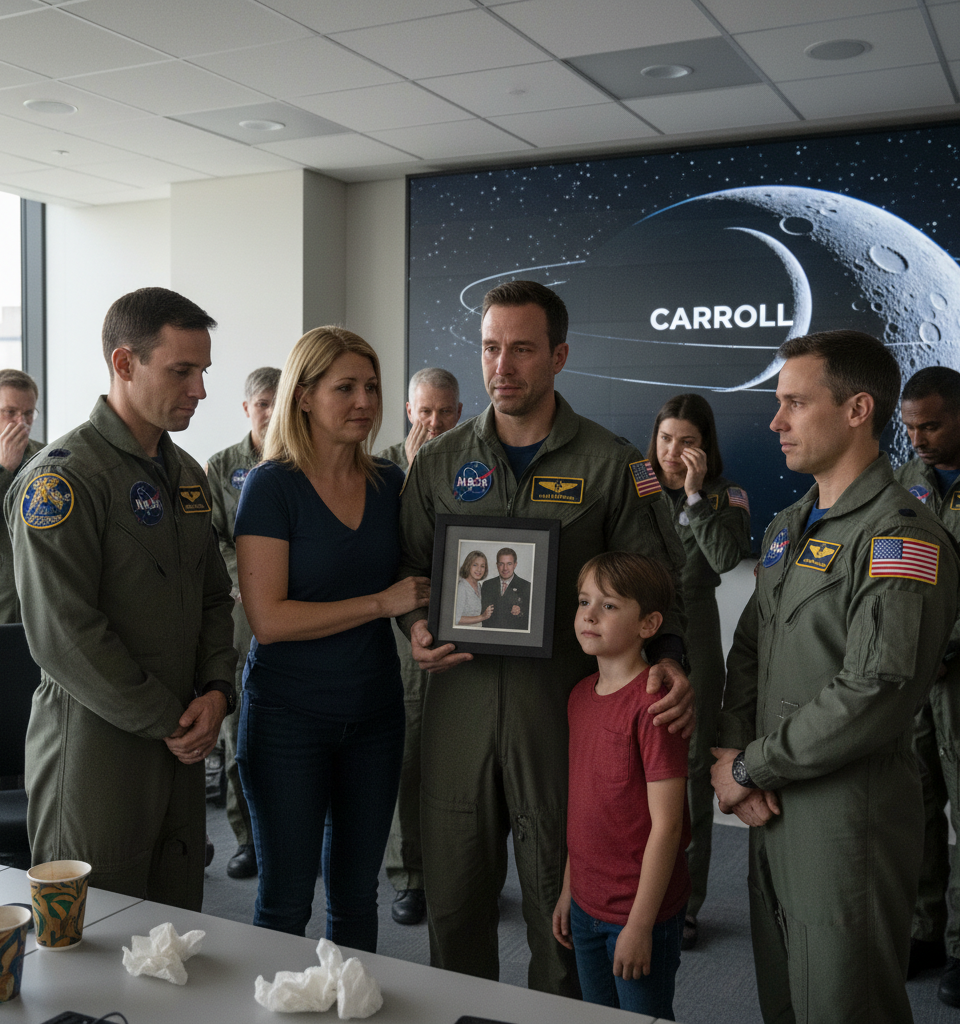
HOUSTON, TX – In an unprecedented and deeply emotional gesture, the Artemis II astronaut crew, comprising Reid Wiseman, Victor Glover, Christina Koch, and Jeremy Hansen, announced today their decision to name a lunar crater 'Carroll,' in enduring remembrance of Carroll Wiseman, the late wife of mission commander Reid Wiseman, who passed away in 2020. The announcement, made during a heartfelt exchange with mission control and the Wiseman family at NASA's Johnson Space Center in Houston, highlights the human stories and personal sacrifices that underpin the ambitious Artemis program, which aims to return humans to the Moon.
This tribute transcends the typical operational protocols of space missions, embedding a personal legacy directly onto the lunar surface. While official naming conventions for lunar features typically follow strict International Astronomical Union (IAU) guidelines, the astronauts' intention for this informal designation sends a powerful message about the human element of spaceflight. It's a poignant reminder that while astronauts venture into the cosmos, their hearts remain connected to those they leave behind on Earth. This moment also serves to galvanize public support and understanding for the Artemis missions, portraying the crew not just as skilled professionals but as individuals with profound personal connections and enduring love.
Commander Wiseman, visibly moved, shared personal anecdotes about Carroll's unwavering support for his career and her unique spirit. While the specific crater's coordinates and official designation status were not immediately disclosed, the crew confirmed their intent was to informally acknowledge a significant feature on the lunar far side or near-polar region they would observe. This informal naming, while not officially recognized by the IAU without a formal proposal process, holds immense symbolic weight for the crew and the wider NASA community, representing a new precedent where personal tributes intersect with cosmic exploration.
The emotional resonance of this announcement extends beyond the personal tragedy to impact the broader narrative of the Artemis program. As NASA prepares to send the first woman and person of color to the Moon, such human-interest stories become invaluable, helping to contextualize the monumental scientific and engineering challenges. This act of remembrance humanizes the astronauts, transforming them from symbols of national ambition into relatable figures driven by both professional duty and personal sentiment. It could foster deeper public engagement with space exploration, particularly among demographics who might not typically follow scientific advancements closely.
Space exploration endeavors, particularly those as ambitious as Project Artemis with its multi-billion dollar budget (NASA's budget for Artemis alone is projected to exceed $93 billion through 2025), often focus on the scientific and technological triumphs. However, incidents like this spotlight the human cost and emotional investment. Experts in space sociology, such as Dr. Eleanor Vance of the Planetary Society, suggest that "such personal gestures can significantly broaden the appeal of space programs, connecting them to universal human experiences of love, loss, and memory. It helps bridge the vast distance between Earth and the Moon not just physically, but emotionally." This strategy could be vital in maintaining long-term public and political support for costly space initiatives during uncertain economic times.
Looking ahead, the Artemis II mission, slated for late 2024, will be a critical precursor to the Artemis III lunar landing. The crew will journey around the Moon, testing vital systems of the Orion spacecraft. While 'Carroll' may not appear on official lunar maps immediately, its informal designation represents a powerful human landmark. This event could also inspire future astronauts to seek unique ways to honor their loved ones or significant moments in their lives through symbolic acts during their missions. NASA, while upholding scientific rigor, understands the power of storytelling and human connection in garnering public enthusiasm for its ambitious goals, including the eventual establishment of a sustained human presence on the Moon and preparations for Mars missions.