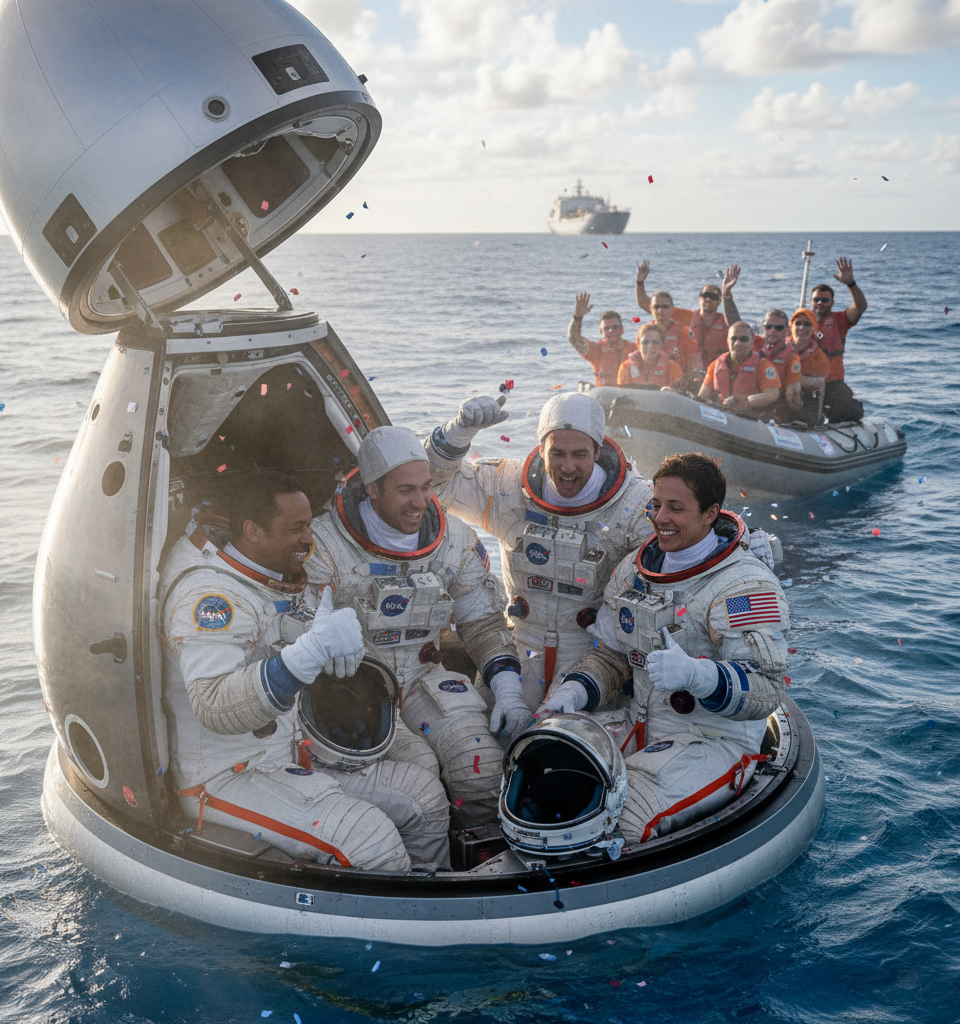
CAPE CANAVERAL, FLORIDA – The four-person crew of NASA's Artemis II mission – Commander Reid Wiseman, Pilot Victor Glover, Mission Specialist Christina Koch, and Canadian Space Agency (CSA) astronaut Jeremy Hansen – successfully splashed down in the Pacific Ocean today, concluding their historic deep-space orbital test flight. The mission, a critical precursor to returning humans to the lunar surface, saw the crew travel approximately 230,000 miles from Earth, surpassing any human-flown distance since Apollo 17 in 1972. This successful return marks a monumental step in NASA's Artemis program, designed to establish a long-term human presence at the Moon and explore Mars.
This momentous journey is not merely a technical achievement but a powerful symbol of humanity's enduring quest for exploration. For over five decades, the Moon has remained beyond human reach, save for a few robotic probes. Artemis II shatters that hiatus, re-igniting public imagination and scientific ambition. The mission directly feeds into the broader goals of the Artemis program, which seeks to land the first woman and first person of color on the Moon, build a sustainable lunar orbiting platform (Gateway), and ultimately leverage lunar resources for future deep space expeditions to Mars. The successful testing of the Orion spacecraft's life support systems, communication, and navigation capabilities in a true deep-space environment was paramount for validating safety protocols for subsequent missions.
Throughout their multi-day mission, the crew performed a series of critical maneuvers and tests, validating the Orion spacecraft's performance and habitability far beyond Earth orbit. Key milestones included the successful completion of the Trans-Lunar Injection (TLI) burn, propelling Orion towards the Moon, and a precise lunar flyby that brought them within 6,400 miles of the lunar surface. The crew diligently tested communication systems with ground control, exercised manual flight controls, and assessed the radiation environment in deep space. Notably, they executed a challenging trajectory correction burn in lunar orbit, showcasing the vehicle's maneuverability and the crew's proficiency. NASA Administrator Bill Nelson lauded the crew's performance, stating, "This mission wasn't just about reaching a distance; it was about proving our capabilities, refining our technologies, and demonstrating the indomitable spirit of human exploration."
The successful completion of Artemis II has profound implications for the commercial space sector and the global space economy. Private companies like SpaceX and Blue Origin, significant partners in the Artemis program, stand to benefit from the validated technologies and increased confidence in lunar missions. The program is projected to inject billions into the U.S. economy, with estimates suggesting a $100 billion economic impact by 2040 and the creation of tens of thousands of jobs across various industries, from advanced manufacturing to software development. International partnerships, including the CSA, European Space Agency (ESA), and Japan Aerospace Exploration Agency (JAXA), are also strengthened, fostering a collaborative approach to lunar exploration.
Space industry analysts have lauded the mission as a pivotal moment. Dr. Anya Sharma, a senior aerospace consultant, commented, "Artemis II was the ultimate dress rehearsal. The data collected from this flight – from life support performance to radiation dosimetry – will be invaluable for designing future deep-space habitats and ensuring astronaut safety on extended lunar and eventually Martian missions. This success significantly de-risks the ambitious Artemis III crewed lunar landing." Others emphasize the geopolitical significance, highlighting the renewed American leadership in space exploration and the collaborative framework it establishes for international partners amidst increasing global competition.
Looking ahead, the successful conclusion of Artemis II clears the path for the highly anticipated Artemis III mission, which aims to land astronauts near the Moon's South Pole by the mid-2020s. This will be followed by Artemis IV and subsequent missions, which will continue to build out the Gateway lunar orbiting outpost and establish sustained human presence on the lunar surface. The experience gained from Artemis II, particularly concerning human factors, deep-space operations, and radiation exposure, will directly inform the planning and execution of these future ventures. Beyond the Moon, the long-term vision of Artemis remains Mars, with the lunar missions serving as crucial testing grounds for the technologies and procedures necessary for interplanetary travel.