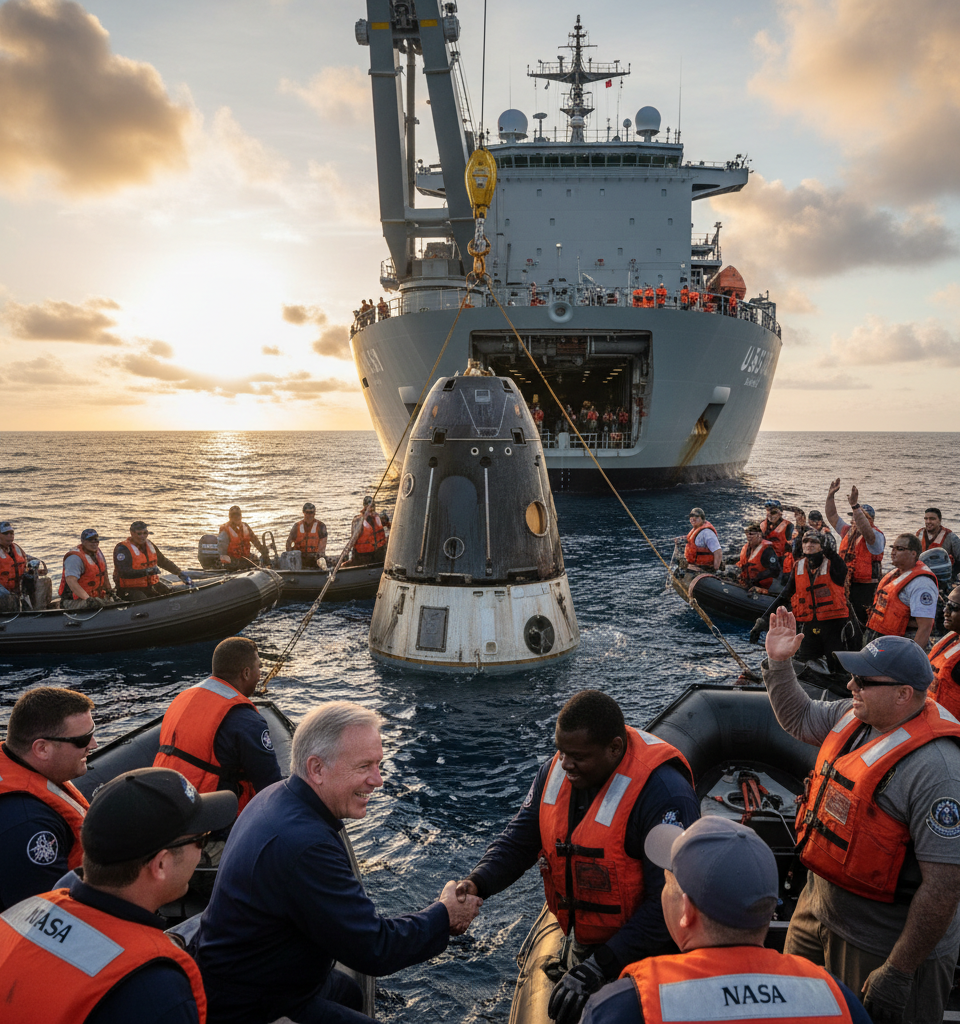
The monumental splashdown of the Artemis II mission on 2026-05-19 has provided a substantial injection of momentum for NASA, propelling the agency forward in what is increasingly being described as a renewed global race to the Moon. The mission's conclusion, marked by the safe return of its four-person crew, not only validated critical technological advancements but also reignited public enthusiasm for human spaceflight on an international scale. This successful endeavor is poised to serve as a crucial stepping stone for the Artemis program's ambitious long-term goals, including the establishment of a sustainable human presence on the lunar surface.
The significance of the Artemis II mission extends far beyond its immediate operational success. In an era witnessing intensified competition among nations and private entities in space exploration, this mission reaffirms the United States' leadership in deep-space endeavors. The crew — comprising three American astronauts and one Canadian — captivated a global audience, transforming their historic journey into a powerful symbol of international collaboration and scientific aspiration. Their mission represents the furthest humans have traveled beyond low Earth orbit since the Apollo era, laying vital groundwork for future lunar landings and eventual missions to Mars. The data collected from their journey will be instrumental in refining spacecraft systems, life support, and operational procedures for subsequent, more complex missions.
Global Implications of Lunar Endeavors
The successful return of Artemis II is particularly pertinent given the accelerating pace of lunar exploration efforts by other spacefaring nations. Countries like China and India have articulated their own ambitious Moon programs, with robotic missions already yielding significant scientific returns and human missions on the horizon. This growing international interest underscores the strategic importance of the Moon, not just for scientific discovery but also for potential resource extraction and as a proving ground for technologies needed for even more distant destinations. NASA's sustained successes, spearheaded by missions like Artemis II, are crucial for maintaining its competitive edge and fostering collaborative frameworks rather than purely rivalrous dynamics.
The global space industry stands to benefit significantly from the data and experience gained during the Artemis II mission. Companies involved in aerospace manufacturing, propulsion systems, life support technology, and ground operations will leverage these insights for future contracts and innovations. The mission demonstrates the viability of next-generation spacecraft and human-rated systems, encouraging further investment and development in these high-tech sectors. This ripple effect extends beyond government contracts, inspiring private ventures to consider lunar infrastructure, tourism, and resource utilization as tangible future possibilities.
Paving the Way for Artemis III and Beyond
The immediate aftermath of the Artemis II splashdown will see intensive data analysis covering every aspect of the mission, from astronaut health and psychological responses to spacecraft performance and radiation exposure. These critical insights will directly inform the planning and execution of Artemis III, the mission slated to return humans to the lunar surface. The successful completion of Artemis II is a non-negotiable prerequisite for Artemis III, validating the Orion spacecraft's capabilities and the rigorous training protocols for its crew.
Looking further ahead, the momentum generated by Artemis II is expected to bolster support for the broader Artemis program, which envisions a sustained human presence on and around the Moon. This ambitious goal includes the construction of the Lunar Gateway, a small space station orbiting the Moon, and ultimately, the establishment of a human base on the lunar south pole. The technical and political capital accumulated from Artemis II's success is vital for securing the necessary funding and international partnerships to realize these long-term objectives, thereby solidifying humanity's enduring return to the Moon and laying critical groundwork for pioneering voyages to Mars.