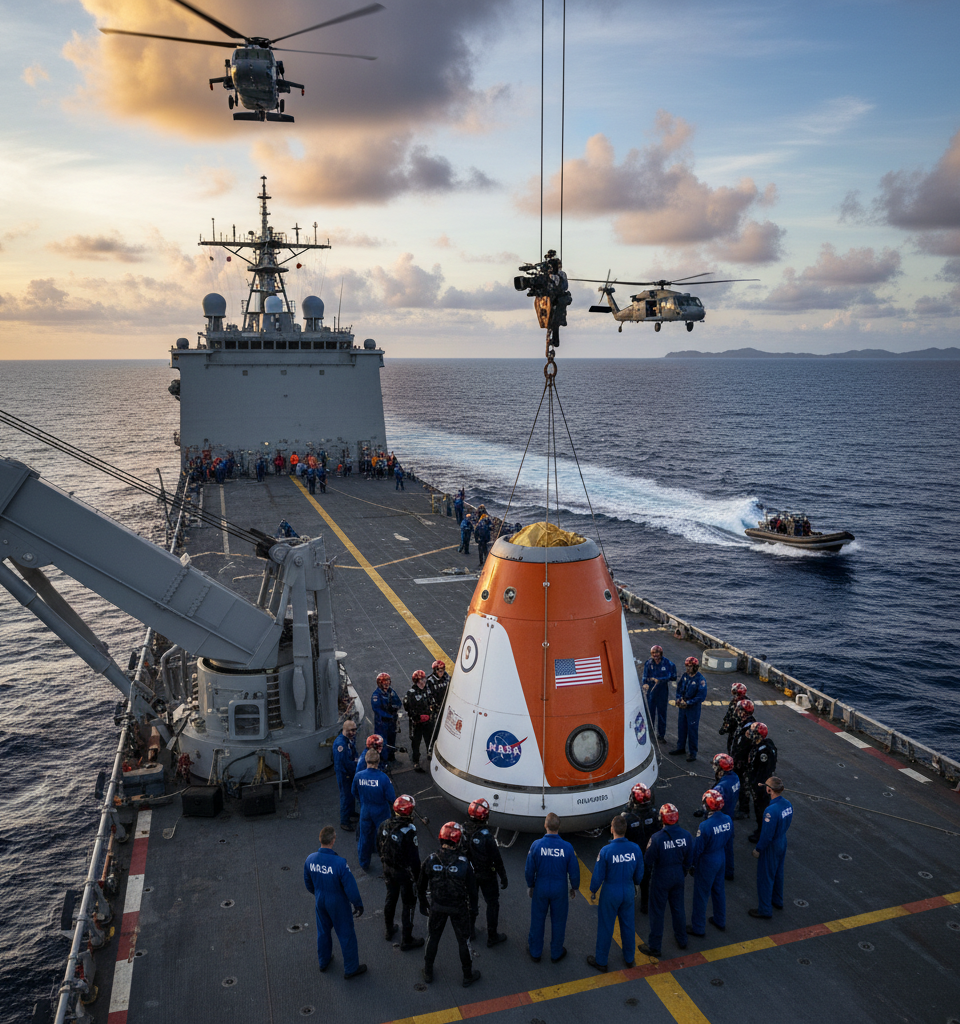
PACIFIC OCEAN – With the Artemis II crewed mission to the Moon rapidly approaching its critical re-entry and splashdown phase, a combined force of NASA and U.S. Navy recovery personnel is meticulously preparing for a complex, high-stakes operation to secure the Orion capsule and its jettisoned hardware from the vast expanse of the Pacific Ocean. This intricate endeavor, leveraging decades of experience in human spaceflight recovery, is not merely about retrieving a spacecraft but is fundamental to post-flight data analysis, crew safety protocols, and the overarching success of the Artemis program's ambitious lunar exploration goals.
The Gravity of Retrieval: Why Every Piece Matters
The successful recovery of the Orion capsule and associated components is paramount to the Artemis II mission's post-flight evaluation. Each piece of hardware, from the heat shield to the various jettisoned fairings, carries invaluable telemetry data and structural integrity information crucial for engineers to assess vehicle performance, identify potential design improvements, and validate models for future missions, including the Artemis III lunar landing. Historically, post-splashdown inspections have been instrumental in advancing spacecraft design, from the Mercury missions to Apollo, ensuring cumulative learning and enhanced safety for astronauts. The lessons learned from this recovery will directly inform the next generation of deep-space vehicles.
A Symphony of Coordination: The Recovery Process Detailed
As the Orion capsule descends through the atmosphere, a flotilla of recovery ships, including a primary U.S. Navy vessel, will position itself within a designated recovery zone in the Pacific. Onboard, specialized NASA and Navy teams, comprising divers, engineers, and medical personnel, will be ready to execute a precisely choreographed sequence. Upon splashdown, while the capsule bobs in the ocean, recovery personnel will utilize specially designed fixtures and winches to carefully hoist the 22-ton, 11-foot diameter capsule onto the deck of the recovery ship. Simultaneously, assets will be deployed to track and retrieve other jettisoned components, such as the forward bay cover, ensuring a comprehensive collection of mission-critical hardware. The entire operation is expected to take several hours, contingent on sea conditions and equipment performance, with a robust contingency plan in place for adverse weather.
Beyond Engineering: The Broader Impact on Space Commerce
While primarily a government-led endeavor, the meticulous recovery protocols established for Artemis II have broader implications for the burgeoning commercial space industry. As private companies like SpaceX and Blue Origin develop their own crewed deep-space capabilities, they will undoubtedly draw upon the best practices and lessons learned from NASA's decades of experience in safe and efficient recovery operations. The validation of systems and procedures on missions like Artemis II helps de-risk future commercial ventures, potentially paving the way for lucrative contracts in lunar tourism, asteroid mining, and sustained human presence beyond Earth orbit. This mission reinforces the foundational requirements for robust return-to-Earth capabilities, a cornerstone for any sustainable space economy.
Expert Insights: "A Testament to Terrestrial Logistics"
Dr. Elaine Chen, a retired aerospace engineer and former NASA recovery specialist, emphasized the logistical complexities. "While the spaceflight aspect captures headlines, the terrestrial logistics and engineering of recovery are equally, if not more, challenging," Dr. Chen commented. "You're dealing with immense forces during re-entry, followed by the unpredictable environment of the open ocean. The precision required to locate, secure, and safely transport a multi-ton spacecraft is a testament to the interagency cooperation and continuous innovation in recovery technology. A single improperly secured tether or hydraulic malfunction could jeopardize the entire operation." She added that the emphasis on data integrity and environmental protection during recovery reflects a matured approach to space exploration.
The Road Ahead: From Pacific Waters to Martian Horizons
Following the successful recovery and initial inspection at sea, the Orion capsule will be transported to NASA's Kennedy Space Center for comprehensive post-flight analysis, which typically takes several months. This detailed examination will validate spacecraft performance, assess astronaut physiological responses, and inform the final design modifications for the subsequent Artemis missions. Looking ahead, the insights gained from Artemis II's recovery will directly contribute to the long-term feasibility of human missions to Mars, where recovery scenarios will be significantly more complex, potentially involving uncrewed cargo returns or even in-situ resource utilization for re-entry vehicles. The precision and thoroughness of this current operation are thus foundational steps towards humanity's ultimate goal of becoming an interplanetary species.
Environmental Stewardship in Recovery Operations
Beyond the technical challenges, NASA and U.S. Navy teams are also implementing stringent environmental protocols during the recovery. Measures are in place to minimize any potential impact on marine ecosystems, including rapid cleanup of any debris and careful handling of any materials that could pose an environmental risk. The recovery zone is meticulously selected to avoid protected marine areas, and all personnel are trained in environmentally responsible practices. This commitment reflects a modern approach to space exploration, where scientific advancement is balanced with ecological responsibility, ensuring that our pursuit of the cosmos does not compromise our home planet.