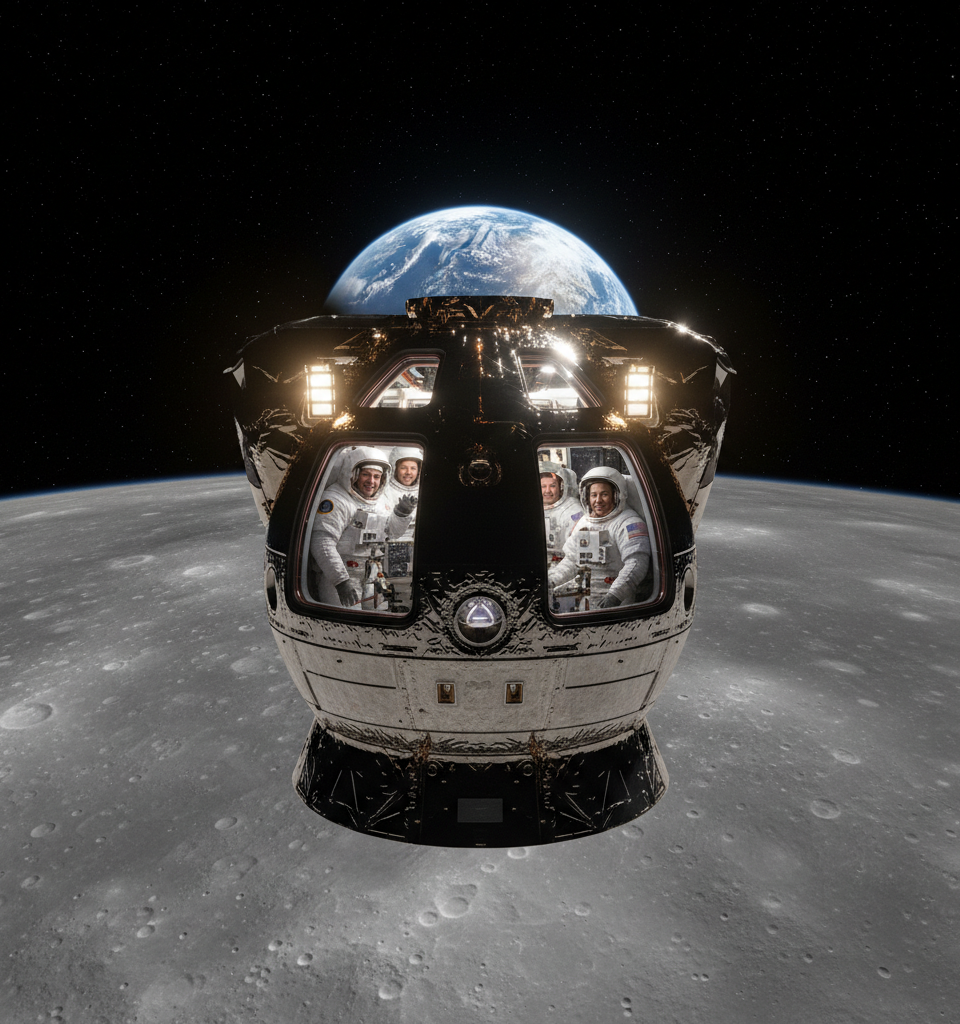
In a landmark moment for human spaceflight, the four-person crew of the Artemis III mission successfully completed their historic journey, venturing further into deep space than any humans in history. The mission, launched from Cape Canaveral Space Force Station on, saw the Orion spacecraft orbit the Moon, achieving a maximum distance of from Earth. This unprecedented achievement marks a critical step in humanity's renewed ambition for lunar presence and eventual Mars exploration, fundamentally shifting perceptions of our capabilities and rekindling a sense of profound wonder about the cosmos.
A New Era of Exploration: Echoes of Apollo, Eyes on Mars
The Artemis III mission holds immense significance, serving as a pivotal precursor to a sustained human presence on the Moon and, ultimately, expeditions to Mars. This mission effectively reignites the spirit of the Apollo era, yet with drastically advanced technology and a broader international collaboration. Unlike its predecessors, Artemis aims not just for a fleeting visit but for establishing long-term infrastructure, including a lunar gateway and surface habitats. The successful demonstration of Orion's capabilities, including its heat shield re-entry, is critical for future crewed missions, validating years of engineering and investment into next-generation space exploration systems.
Mission Milestones: Unprecedented Reach and Data Collection
The Artemis III mission achieved several critical objectives beyond its record-breaking distance. The Orion capsule successfully performed a highly elliptical orbit around the Moon, utilizing its gravitational pull for a free-return trajectory back to Earth. During its voyage, the uncrewed flight gathered invaluable data on radiation levels, propulsion system performance, and the psychological effects of prolonged deep-space travel on mannequins equipped with sophisticated sensors. The mission cost, estimated at over for this single flight, underscores the substantial investment in securing humanity's future in space, with the broader Artemis program projected to cost through 2025.
Aerospace Industry and Beyond: A New Economic Frontier
The success of Artemis III has injected significant momentum into the global aerospace sector. Companies involved in its development, such as Lockheed Martin (Orion prime contractor) and Boeing (Space Launch System), are poised for substantial growth. Beyond the direct contractors, the mission stimulates innovation across a vast supply chain, from advanced materials to propulsion systems and communication technologies. This renewed focus on deep space exploration is expected to drive job creation, foster technological breakthroughs with terrestrial applications, and potentially unlock new economic opportunities in space resource utilization and space tourism, estimated to be a multi-trillion-dollar industry by mid-century.
Expert Analysis: A Gateway to Interplanetary Travel
Space analysts and astrophysicists are unanimous in hailing Artemis III as a monumental achievement. Dr. Elara Vance, Director of the Institute for Space Studies, commented, "This mission is not merely a record-breaker; it's a profound validation of our engineering prowess and a crucial stepping stone towards interplanetary travel. The data gathered will be instrumental in mitigating risks for future crewed missions to Mars, fundamentally altering our approach to sustained deep-space presence." Industry experts anticipate that the mission's success will de-risk future investments in space infrastructure, encouraging greater private sector participation and accelerating the timeline for Martian expeditions.
The Road Ahead: Lunar Outposts and Martian Horizons
The successful return of Artemis III lays the groundwork for the highly anticipated Artemis IV mission, which aims to land humans on the Moon as early as. Future phases of the Artemis program include establishing the Lunar Gateway, a permanent outpost orbiting the Moon, and developing advanced surface habitats for prolonged stays. These initiatives are not ends in themselves but critical testbeds for the even more ambitious goal: a crewed mission to Mars. The technologies and operational experience gained from Artemis are directly transferable to Martian expeditions, with leading space agencies targeting the 2030s for the first human footsteps on the Red Planet. This long-term vision positions humanity on the cusp of an unprecedented era of exploration, promising to redefine our understanding of the universe and our place within it.