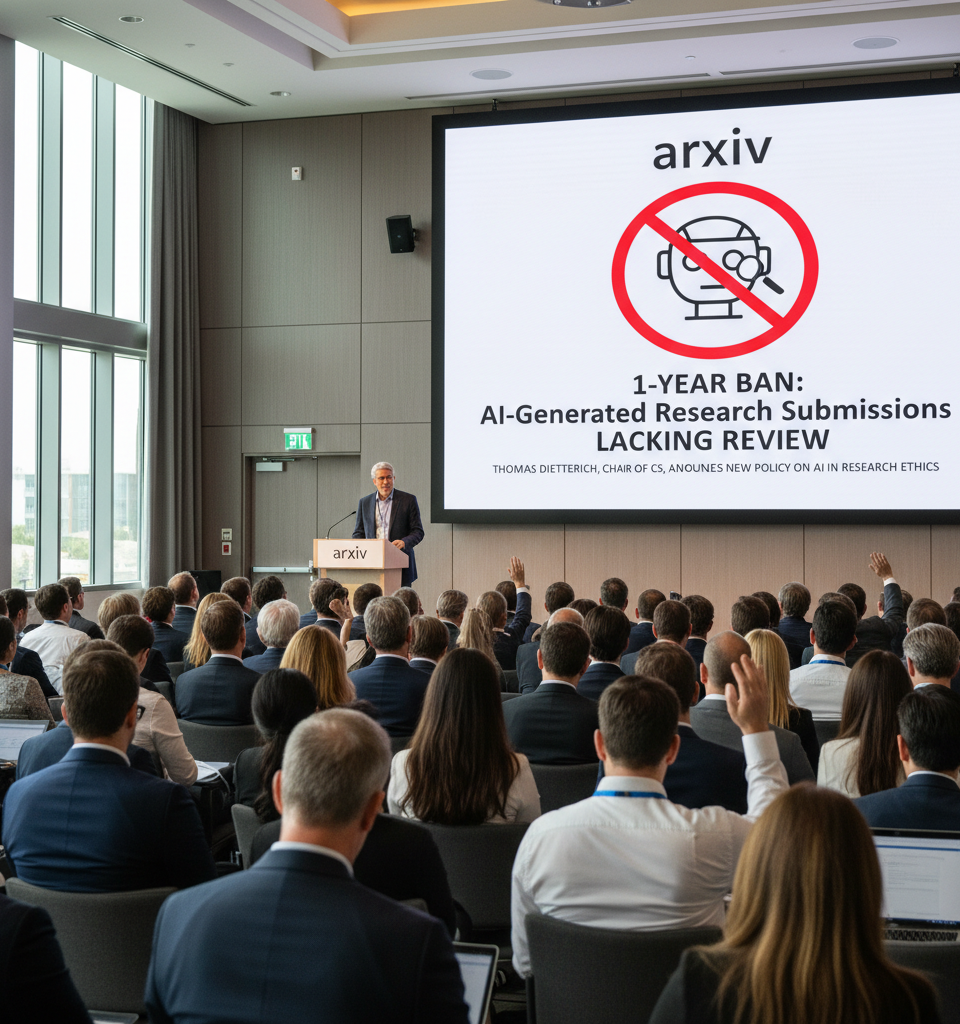
In a significant move to safeguard academic rigor, ArXiv, the preeminent open-access repository for scholarly preprints in computer science, mathematics, and physics, has announced a strict new policy. Authors found to be submitting papers with evident indications of unverified AI generation will now face a one-year prohibition from the platform. This landmark decision, spearheaded by Thomas Dietterich, chair of ArXiv’s computer science section, signals a critical juncture in the ongoing battle to maintain scientific credibility in an increasingly AI-driven research landscape.
Upholding Academic Integrity Amidst AI Proliferation
For over three decades, ArXiv has served as a cornerstone of rapid knowledge dissemination, enabling researchers to share findings ahead of formal peer review. Its open and accessible nature has accelerated scientific progress, but also presents vulnerabilities to misuse. The explosion of sophisticated large language models (LLMs) and generative AI tools has introduced new challenges, blurring the lines between human authorship and machine-generated content. This policy directly addresses concerns that some researchers might be leveraging AI to produce academic work without adequately reviewing, understanding, or verifying the content, thereby compromising the foundational principles of scholarly contribution.
Policy Specifics and Enforcement
While the exact criteria for identifying "obvious signs of unchecked AI generation" are still being refined, the policy's intent is clear: to penalize submissions that demonstrate a lack of critical human oversight. This could include papers containing factual inaccuracies, nonsensical statements, or stylistic inconsistencies characteristic of unedited AI output. The one-year ban, a severe penalty in academic circles, underscores ArXiv's commitment to quality control. The enforcement mechanism will likely involve a combination of automated detection tools and human review by section editors, who are already grappling with an increasing volume of submissions. This proactive stance is designed to deter authors from using AI as a shortcut for genuine research and writing.
Broader Implications for Scientific Publishing
ArXiv’s decision is expected to send ripples across the broader academic publishing ecosystem. As other journals and repositories grapple with similar issues, ArXiv's policy could serve as a precedent, prompting wider adoption of stricter guidelines regarding AI-assisted authorship. The move highlights a growing tension between the efficiency offered by AI tools and the imperative for human accountability in scholarly work. It also raises important questions about intellectual honesty, the definition of authorship in an AI era, and the evolving role of editorial oversight in maintaining the integrity of the scientific record.
Expert Perspectives on AI in Academia
Academic leaders and ethicists have widely acknowledged the double-edged sword that generative AI presents. Dr. Eleanor Vance, a professor of research ethics at a leading university, commented, "ArXiv's policy is a necessary step. While AI can be a powerful assistant, it cannot replace the critical thinking and meticulous verification that define sound research. Without such guardrails, we risk diluting the quality and trustworthiness of the entire scientific endeavor." Others argue that clear guidelines are crucial for fostering responsible AI use, rather than outright prohibition, recognizing AI's potential to accelerate discovery when used thoughtfully.
The Evolving Landscape of Research Integrity
Looking ahead, this policy is likely just the beginning of a broader reckoning within academia regarding AI's role. Future developments might include enhanced AI detection technologies, mandatory disclosure policies for AI tool usage, and educational initiatives to inform researchers about ethical AI integration. The scientific community will need to continuously adapt, balancing the immense potential of AI with the unwavering demand for human intellectual rigor and accountability. ArXiv's bold step underscores an ongoing commitment to preserving the reliability and credibility that underpin scientific progress for generations to come.