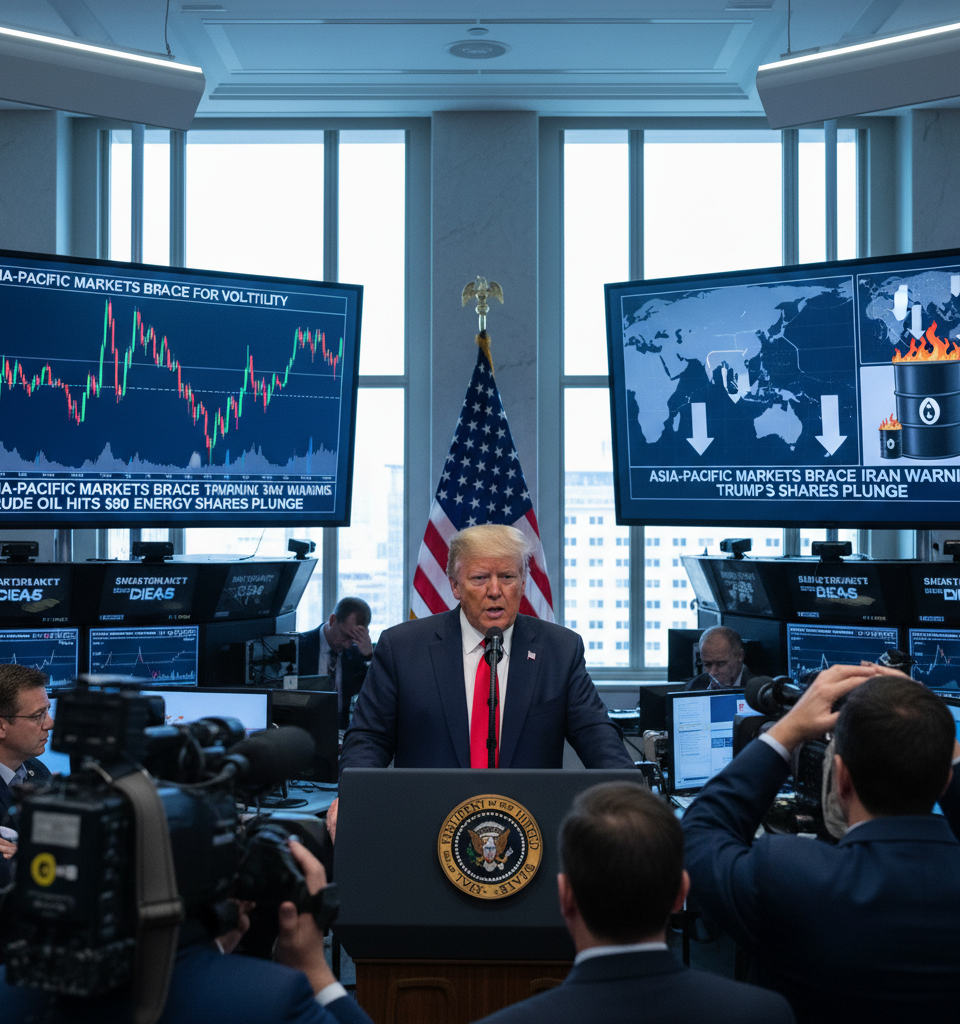
Financial markets across the Asia-Pacific region are bracing for a period of heightened volatility, with indices set for a mixed opening as investors digest the implications of renewed geopolitical friction. The catalyst for this cautious sentiment arrived in the form of a pointed warning from former U.S. President Donald Trump to Iran, advising the nation to "get moving, FAST." This statement, widely interpreted as a threat of potential military action or intensified sanctions, has swiftly rekindled fears of disruptions to crude oil supplies from the Middle East, a critical artery for global energy markets.
The timing of Trump's remarks adds a layer of complexity to already delicate energy market dynamics, coming amid ongoing global efforts to stabilize inflation and navigate a sluggish economic recovery. Historically, geopolitical flashpoints in the Middle East have directly translated into elevated oil prices, impacting everything from transport costs to manufacturing inputs. The region's strategic importance, particularly the Strait of Hormuz through which a significant portion of the world's oil transits, makes any threat to its stability a matter of paramount global economic concern. Previous escalations, such as the 2019 attacks on Saudi oil facilities or the targeted killing of Iranian General Qassem Soleimani in 2020, demonstrated the swift and substantial impact on crude benchmarks like Brent and WTI.
While the specific context of Trump's warning remains somewhat ambiguous, the market reaction underscores the persistent fragility of global energy supply chains. Oil futures saw an immediate, albeit modest, uptick in early Asian trading following the news, with Brent crude futures rising by approximately 0.5% and WWTI crude futures by 0.6% in overnight trading. Beyond immediate price movements, the broader concern is the potential for protracted instability that could push crude prices well beyond current levels. Analysts are closely monitoring rhetoric from both Washington and Tehran for any further escalation or clarification, particularly with global oil inventories already tighter than historical averages.
Market Impact and Regional Exposure
The ripple effects of potential oil supply disruptions are expected to be diverse across Asia-Pacific economies. Net oil importers like Japan, South Korea, India, and China, which rely heavily on Middle Eastern crude, are particularly vulnerable to price spikes. Higher energy costs could exacerbate inflationary pressures, forcing central banks to maintain or even tighten monetary policies, potentially slowing economic growth. Conversely, net oil exporters in the region, while fewer, could see some benefit from increased revenues, though this would likely be overshadowed by broader global economic slowdowns. Equity markets are expected to reflect this divergence, with airline and manufacturing stocks facing headwinds, while energy sector equities might see a temporary boost.
Expert Analysis and Outlook
Market strategists are advising caution. "Any significant geopolitical event in the Middle East invariably introduces an 'oil premium' into crude prices," noted Dr. Evelyn Lee, chief market economist at Pacific Rim Capital. "While the immediate rhetoric might be political, the market prices in the risk of supply disruption. Investors should brace for increased volatility across energy-sensitive sectors and potentially a flight to safe-haven assets in the short term, such as the Japanese Yen or gold." Other analysts point to the broader implications for international relations, suggesting that such warnings, particularly from a prominent political figure, complicate diplomatic efforts and increase the likelihood of miscalculation.
Potential Future Scenarios
The immediate future depends heavily on whether Trump's warning translates into concrete policy action or merely remains rhetorical. Should tensions de-escalate, markets would likely pare back their risk premium. However, any move towards increased sanctions, naval blockades, or military posturing could trigger a more sustained and significant market response. Furthermore, the event underscores the importance of diversifying energy sources and enhancing strategic petroleum reserves for countries heavily reliant on Middle Eastern oil. Policymakers and central banks will be keen to monitor energy price movements, as a prolonged spike could complicate their battles against inflation and their efforts to maintain economic stability. Investors are advised to review their portfolios for exposure to energy price fluctuations and geopolitical risk.