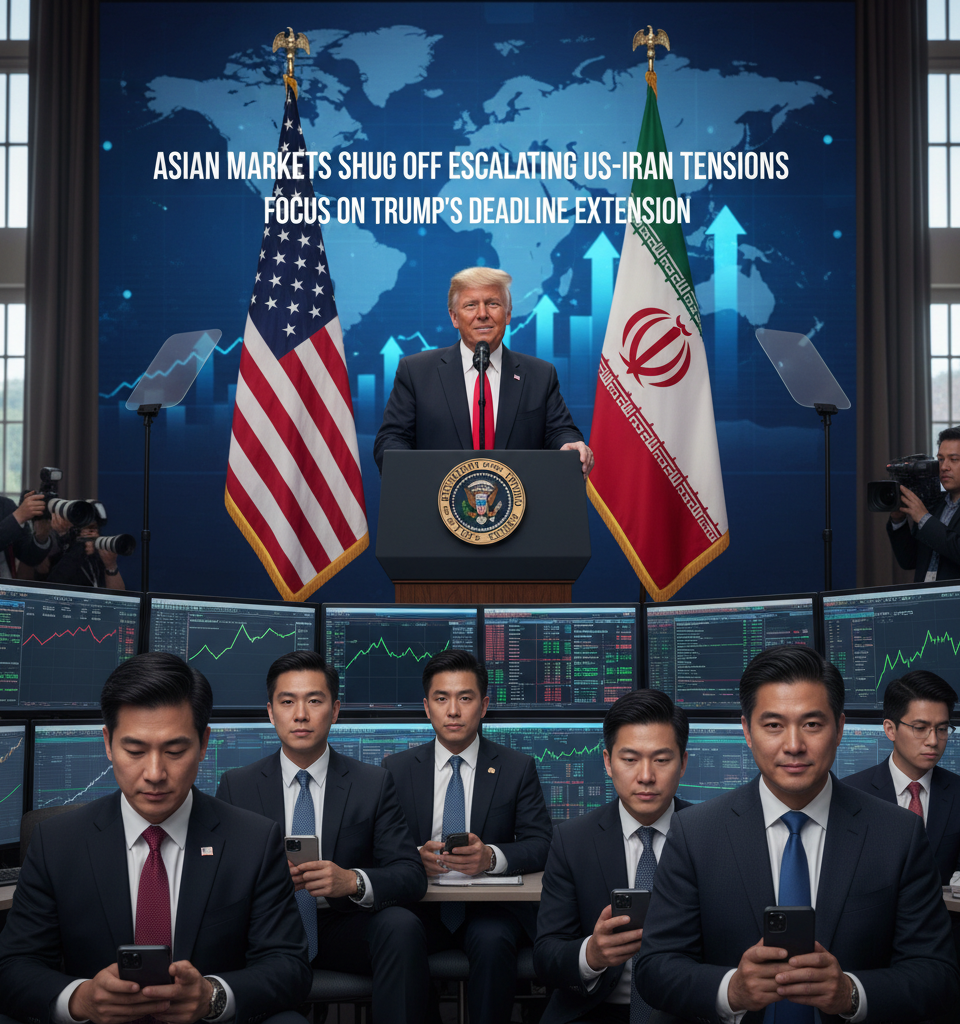
TOKYO/SEOUL – October 26, 2024 – Major Asian stock markets, notably Japan's Nikkei 225 and South Korea's KOSPI, registered opening gains today, largely shrugging off heightened US-Iran geopolitical tensions. The market sentiment reflects a complex interplay of investor apprehension over former U.S. President Donald Trump's recent aggressive pronouncements against Tehran and a concurrent, albeit fragile, sense of relief following reports of an extended deadline for diplomatic engagement.
Contextualizing the Geopolitical Climate
The current geopolitical landscape between the United States and Iran has been notoriously volatile since the U.S. withdrawal from the Joint Comprehensive Plan of Action (JCPOA) in 2018. Trump's recent statements, delivered via social media, explicitly threatened severe repercussions for Iran, including a vow to bring "Hell" upon the nation. This stark warning followed the alleged rescue of an American airman downed in Iranian territory last week, an incident that served to further inflame already strained relations. Historically, such escalations have often rattled global markets, particularly oil prices and defense sector stocks, due to concerns over supply chain disruptions and regional instability.
Key Developments and Market Reaction
Despite the incendiary rhetoric, a crucial development appears to have mitigated immediate market panic: an unconfirmed but widely reported extension of a deadline for diplomatic initiatives. While details remain sparse, the implication of a prolonged negotiation window has seemingly offered investors a measure of relief, suggesting that immediate military conflict might be averted. The Nikkei 225, a benchmark for Japanese equities, climbed by approximately 0.45% in early trading, while South Korea's KOSPI index saw a gain of roughly 0.38%. This muted but positive reaction suggests that while the geopolitical backdrop remains concerning, market participants are prioritizing potential diplomatic avenues over immediate conflict risks.
Broader Market & Industry Implications
The resilience of Asian markets in the face of such significant geopolitical headwinds is noteworthy. It signals a sophisticated assessment by investors, distinguishing between inflammatory rhetoric and concrete actions. While oil prices saw a marginal uptick, typically a direct response to Middle Eastern instability, the increases were not drastic enough to derail broader market confidence. Defense stocks globally, while often benefiting from such tensions, also did not experience an explosive surge, indicating a cautious wait-and-see approach. Should tensions escalate further into sanctions or military action, sectors such as energy, shipping, and insurance would face significant impacts, potentially triggering broader economic instability.
Expert Insights and Analysis
Market strategists are cautiously optimistic. Dr. Elaine Chen, Senior Geopolitical Analyst at Meridian Capital, stated, "While Trump's comments are undoubtedly aggressive, the market is keenly focused on the reported extension of the diplomatic deadline. This suggests a perception among investors that open channels, however tenuous, remain. It's a testament to the market's evolving ability to filter noise from actual actionable threats." Other analysts pointed to robust corporate earnings reports within key Asian economies as a foundational support that is currently cushioning against external shocks, allowing investors to stomach higher geopolitical risk premiums.
The Path Forward: What's Next?
The immediate future hinges on the veracity and duration of the reported diplomatic deadline. Investors will be closely monitoring official statements from Washington and Tehran for corroboration and details regarding any potential mediation efforts. The next significant market movements will likely be dictated by whether this diplomatic window closes prematurely or if it leads to substantive de-escalation talks. Furthermore, any verifiable incident of Iranian retaliation or increased military posturing from the U.S. side would undoubtedly trigger a sharp market correction. The global economy, already grappling with inflation and interest rate uncertainties, can ill afford prolonged instability in a critical energy-producing region. The current environment is a delicate balance, and market participants remain on high alert for any shift in the geopolitical winds.