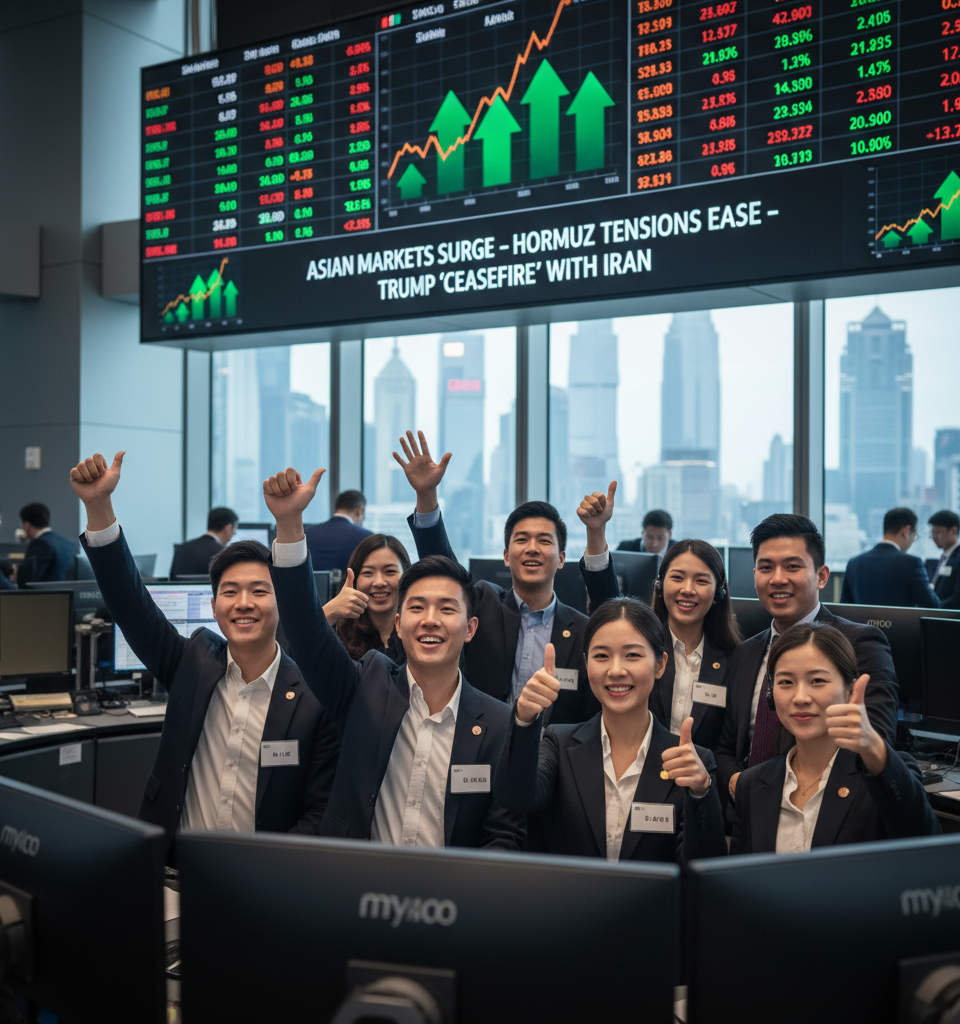
Singapore, January 9, 2020 – Asian stock markets witnessed a robust surge across the board today, propelled by a perceived de-escalation of hostilities between the United States and Iran and President Donald Trump's assertive statement regarding the "immediate" opening of the strategically vital Strait of Hormuz. The dramatic reversal from recent geopolitical anxieties sparked widespread optimism among investors, who are now anticipating a smoother flow of crucial oil, gas, and commodity shipments through the critical maritime chokepoint, despite persistent ambiguities surrounding the strait's actual operational status.
This newfound optimism marks a significant turning point after weeks of heightened tensions in the Persian Gulf, culminating in a tit-for-tat escalation following the US drone strike that killed Iranian General Qassem Soleimani and Iran's retaliatory missile attacks on US bases in Iraq. The Strait of Hormuz, a narrow waterway between the Persian Gulf and the Gulf of Oman, is globally recognized as the world's most important oil transit chokepoint. Approximately one-fifth of the world's total petroleum liquids consumption, roughly 21 million barrels per day (bpd), passed through the strait in 2018, according to the U.S. Energy Information Administration (EIA). Any disruption in this artery can send shockwaves through global energy markets and the broader economy.
Key Market Movements and Driving Factors
The market’s pronounced positive response was immediate. Japan's Nikkei 225 jumped by an impressive 2.31%, while Hong Kong's Hang Seng Index climbed 1.68%. South Korea's KOSPI also saw a healthy gain of 1.25%, and China's Shanghai Composite closed up by 0.91%. This broad-based rally was primarily attributed to President Trump's Wednesday address, where he indicated a willingness to de-escalate, stating, "Iran appears to be standing down, which is a good thing for all parties concerned and a very good thing for the world." Crucially, his assertion of the Strait of Hormuz being "immediate and open for world shipping" assuaged fears of prolonged disruptions.
Broader Economic and Industry Impact
Beyond equities, the impact resonated deeply within commodity markets. Crude oil prices, which had spiked by over 4% after the Iranian missile strikes, pared much of those gains as supply disruption fears abated. Brent crude futures, the international benchmark, fell by nearly 4.5% to below $68 per barrel, reflecting renewed confidence in the stability of oil supply routes. The energy sector, which had been bracing for severe headwinds, breathed a collective sigh of relief. Shipping industries, too, are poised to benefit from decreased insurance premiums and the removal of operational uncertainties that had plagued routes through the Persian Gulf throughout 2019.
Expert Insights on Geopolitical De-escalation
Market analysts were quick to weigh in on the developments. "The market's reaction clearly indicates that investors were pricing in a significant risk premium for a full-blown regional conflict," commented Dr. Lena Soh, Chief Strategist at Zenith Capital Management. "Trump's conciliatory tone, combined with no immediate further retaliation from Iran, has effectively removed that black swan event for now. However, the underlying tensions in the region remain, and markets will continue to be sensitive to any rhetoric." She also noted that while the Strait of Hormuz is technically always open, the president's strong declaration aimed at reassuring global trade and shipping. "The real question is the security perception, and words matter in shaping that."
Navigating the Ambiguity: The Strait's True Openness
Despite Trump's definitive statement, the practical reality of the Strait of Hormuz's "openness" remains nuanced. The strait has never been physically closed by Iran, but its security has been compromised by incidents such as tanker attacks and vessel seizures. While there was no explicit mention of new agreements or guarantees from Tehran regarding maritime safety, the perceived political ceasefire has shifted the narrative. The absence of immediate military confrontation is interpreted by markets as a de-facto return to navigable and insurable transit conditions, at least for the short to medium term.
What's Next: A Cautious Optimism
Looking ahead, market participants will closely monitor any further diplomatic overtures between Washington and Tehran, as well as the implementation of any new sanctions or modifications to existing ones. While the immediate crisis seems to have abated, the long-term resolution of US-Iran relations remains elusive. Businesses reliant on Middle Eastern oil and trade flows will likely maintain a degree of caution, but the immediate crisis has averted the most dire economic predictions. The focus will now shift to assessing the durability of this de-escalation and its sustained impact on global supply chains and energy prices. Investors will also be watching for any signs of renewed sabre-rattling or disruptions as the region continues to navigate its complex geopolitical landscape.