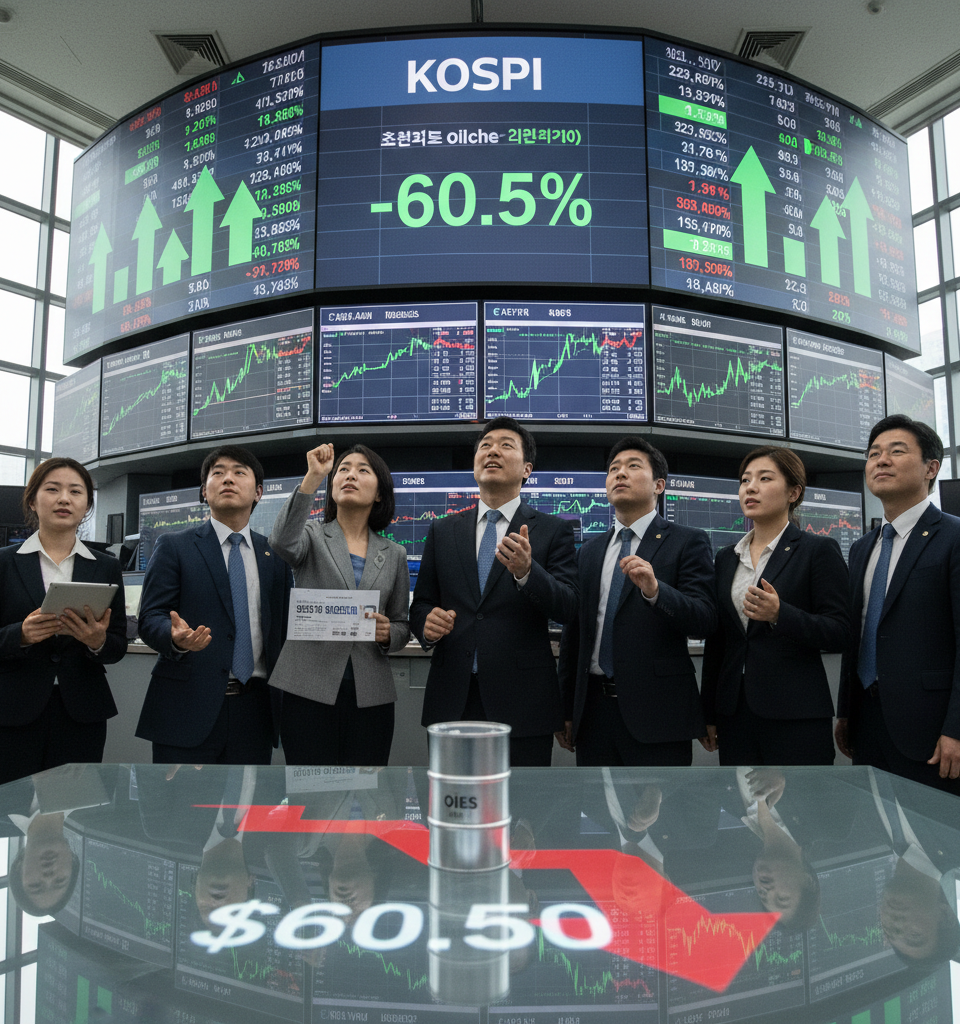
Seoul, South Korea – Asian-Pacific markets opened with robust gains on Tuesday, with South Korea's Kospi index leading the charge, following news of a tentative de-escalation in the fraught relationship between the United States and Iran. The catalyst for this market optimism was an announcement from President Donald Trump, indicating a two-week suspension of planned US military actions against Iranian infrastructure. This unexpected diplomatic overture has triggered a notable drop in global oil prices, subsequently alleviating concerns over supply disruptions and inflationary pressures across the region.
Geopolitical Thaw Ignites Market Relief
The market's jubilant response underscores the acute sensitivity of global financial instruments to geopolitical stability, particularly in the oil-rich Middle East. For weeks, investors had been grappling with the specter of a wider conflict in the Persian Gulf after a series of provocative incidents, including attacks on oil tankers and drone strikes. The prospect of a direct military confrontation between Washington and Tehran had cast a long shadow over global economic forecasts, prompting many to hold back on significant investments. The current development, while not a definitive resolution, offers a crucial sigh of relief, suggesting a pragmatic shift towards dialogue rather than immediate military engagement.
Key Market Indicators and Commodities React
South Korea's Kospi index, a bellwether for regional sentiment, surged by over 1.8% in early trading, primarily driven by gains in technology and manufacturing sectors that are highly sensitive to energy costs. Elsewhere in the region, Japan's Nikkei 225 climbed by 1.1%, and Hong Kong's Hang Seng index saw an increase of 0.9%. The most immediate and pronounced impact was felt in the crude oil markets. Brent crude futures, the international benchmark, tumbled by over 3.5%, dropping below $60 per barrel, while West Texas Intermediate (WTI) futures also saw a sharp decline of similar magnitude. This decline is largely attributable to the reduced risk premium associated with Middle Eastern oil supply.
Broader Economic Implications and Sectoral Impact
The ripple effects of lower oil prices are multifaceted. For net oil-importing nations in Asia, such as South Korea, Japan, and China, the drop translates into lower import bills, which can stimulate domestic consumption and industrial output. Energy-intensive industries, including airlines, transportation, and manufacturing, are expected to benefit significantly from reduced fuel costs. Conversely, oil-exporting nations and energy companies may face downward pressure on their revenues and stock valuations. The broader narrative is one of improved consumer purchasing power and potentially reduced inflationary pressures, allowing central banks more flexibility in monetary policy. The
Analyst Perspectives on De-escalation
Market analysts are cautiously optimistic, stressing that while the immediate threat has receded, the underlying tensions remain. "This is a strong positive signal for market stability in the short to medium term," commented Dr. Eun-Jung Kim, a senior economist at KB Securities in Seoul. "However, the complete resolution of US-Iran issues is a long road. Investors should view this as a pause, not a definitive end to volatility." Other experts echoed this sentiment, highlighting that the two-week suspension provides breathing room for diplomatic efforts but leaves room for potential reversals if negotiations falter or new provocations emerge. Many are awaiting further details on the nature and extent of the proposed dialogue.
The Road Ahead: Diplomacy and Diligence
The coming weeks will be critical in determining whether this de-escalation translates into a more durable peace or merely a temporary reprieve. Key developments to watch include the progression of diplomatic channels, any formal statements from both the US and Iranian governments outlining specific conditions or pathways for negotiation, and the market's sustained reaction to potential updates. Investors will be keenly observing for signs of genuine commitment to dialogue and any agreement on mutual concessions. While the current market surge is a welcome development, sustained global economic stability will ultimately hinge on concrete steps towards a lasting resolution of the intricate US-Iran standoff, rather than merely a temporary cooling of hostilities.