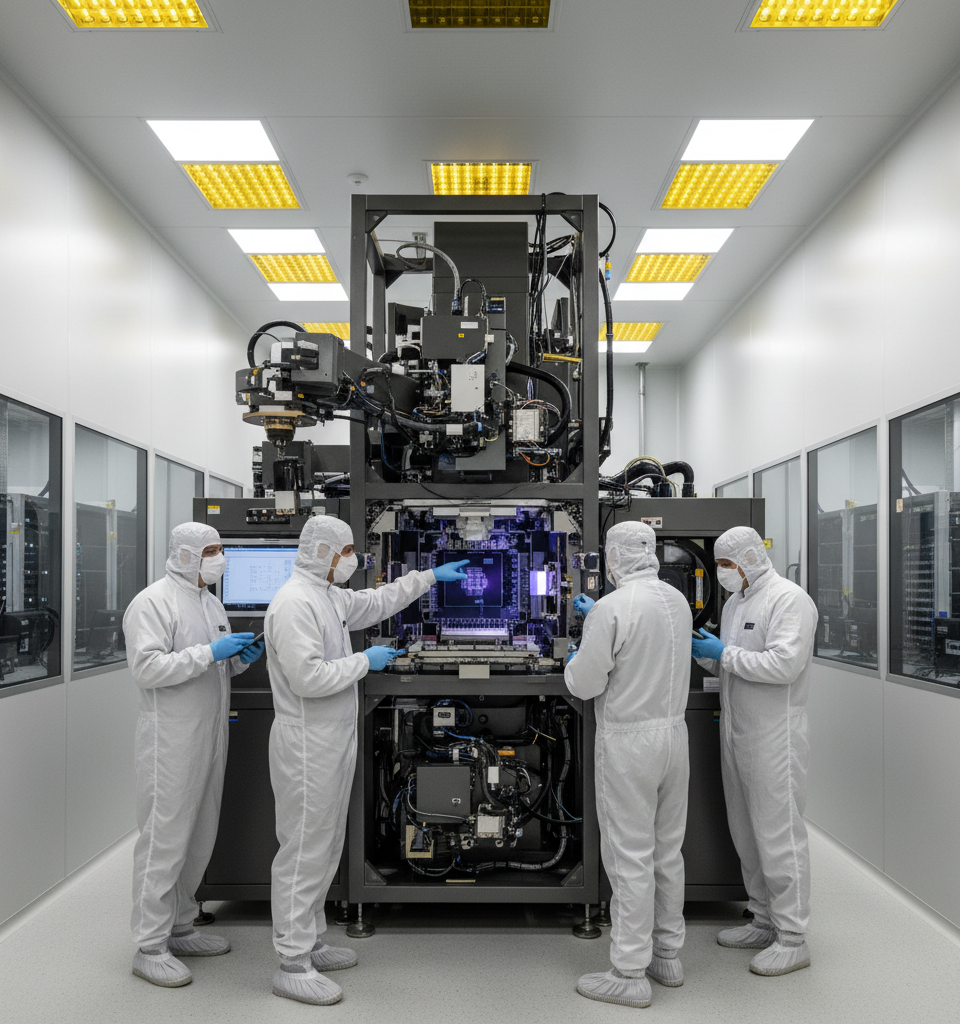
V. – a company few outside the semiconductor industry have heard of. As major players like Nvidia, Microsoft, and Google commit unprecedented capital to build out their AI capabilities, the rapid advancement and deployment of these systems are utterly dependent on ASML's highly specialized and extraordinarily complex lithography equipment, without which the world's most advanced chips simply cannot be manufactured.
This critical reliance on a single European entity is shaping the future of global technology and geopolitical power dynamics.
The Unsung Kingmaker of Chip Manufacturing
This obscure reliance underscores a profound truth: the future of AI isn't solely in software algorithms or data centers, but in the physical machines enabling their creation. ASML, based in Veldhoven, Netherlands, holds a near-monopoly on Extreme Ultraviolet (EUV) lithography systems, the cutting-edge technology essential for producing the most advanced microprocessors that power sophisticated AI models. Each EUV machine, weighing more than two Airbus A320s and costing upwards of $200 million, is a marvel of engineering, requiring thousands of components and years of intricate assembly. This unique position means that ASML isn’t just a vendor; it is the bottleneck and the enabler for the entire semiconductor industry's most ambitious advancements, and by extension, the AI revolution.
Unparalleled Complexity and Market Dominance
ASML's dominance is less about aggressive marketing and more about unparalleled engineering prowess and decades of strategic investment in R&D, totaling billions annually. The company's EUV technology is the culmination of a 20-year, more than $6 billion research effort, involving intricate laser systems and optics from partners like Carl Zeiss. Currently, ASML is the sole manufacturer capable of producing these machines at commercial scale. In 2023, the company reported net sales of approximately €27.6 billion (approximately $30 billion USD), shipping a limited number of these highly sought-after EUV tools. Its order book remains robust, signaling continued demand as chipmakers like TSMC, Samsung, and Intel vie for production slots to supply the insatiable appetite for AI chips.
Choke Point in the Global Tech Race
This concentration of power in one entity creates significant implications for global supply chains and national security. Nations recognize that control over, or access to, ASML’s technology translates directly to competitive advantage in the AI era. For instance, the US government has actively lobbied the Dutch government to restrict ASML from selling its most advanced machines to China, highlighting the technology's strategic importance. This geopolitical maneuvering underscores that ASML’s equipment is not merely commercial hardware but a tool of immense state power, influencing who can innovate and lead in the forthcoming technological paradigm.
Analyst Predictions and Future Demand
Industry analysts widely concur that ASML’s position will remain unchallenged for the foreseeable future. "There's no viable competitor on the horizon for EUV," states Jan-Pieter Minnaar, an analyst at ING. He projects that demand for advanced lithography will only intensify, driven by the exponential growth of generative AI applications and increasing computational needs. Projections suggest that the global semiconductor market, largely underpinned by ASML's technology for leading-edge nodes, could exceed $1 trillion by the end of the decade. ASML itself anticipates continued double-digit growth for several years, fueled by the accelerating silicon intensity of AI. The company is already developing next-generation High-NA EUV systems, offering even higher resolution, with the first shipments expected around 2025-2026, pushing the boundaries of chip density further.
Scaling for the AI Future
Looking ahead, ASML faces the immense challenge of scaling its highly specialized production to meet surging demand without compromising quality or security. The company is actively expanding its manufacturing capabilities and supply chain partnerships, recognizing that its output directly dictates the pace of global AI development. Furthermore, as geopolitical tensions persist, ASML navigates a complex landscape of trade agreements and export controls, its decisions deeply impacting the technological trajectory of nations. The ongoing development of AI, from self-driving cars to advanced medical diagnostics, will be inextricably linked to ASML’s ability to innovate and deliver, making it an unprecedented linchpin in the unfolding technological revolution.