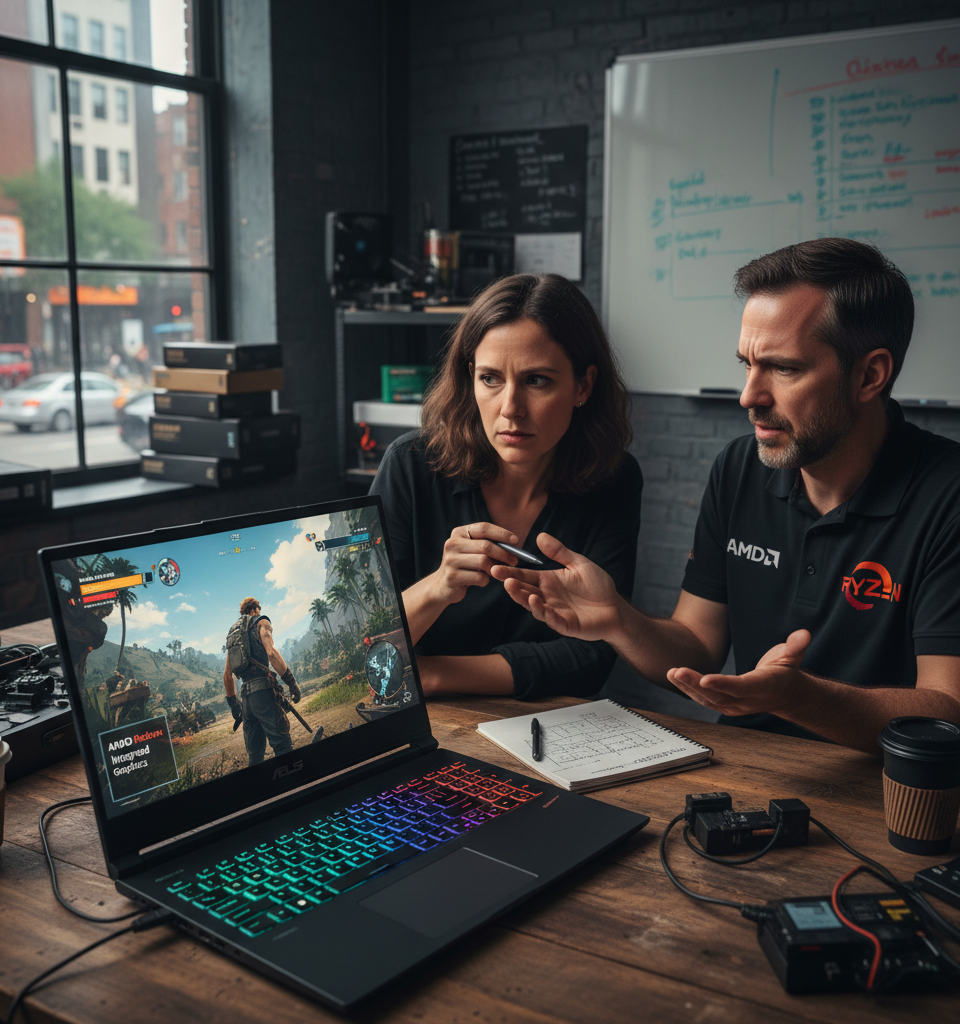
Taipei, Taiwan – In a surprising move that aims to disrupt the high-performance computing market, Asus has unveiled its 2026 TUF Gaming A14, a gaming laptop conspicuously lacking a discrete graphics card. This pioneering device, reviewed recently, hinges its entire performance proposition on AMD's cutting-edge integrated graphics technology. While the vision of a powerful, GPU-less gaming machine promises efficiency and potentially lower costs, initial assessments indicate the TUF Gaming A14, despite its revolutionary design, has yet to fully capitalize on AMD's ambitious silicon, leaving industry observers to question the immediate viability of this paradigm shift.
The Integrated Graphics Gamble: A Historical Context
For decades, dedicated gaming performance has been synonymous with the presence of discrete GPUs from giants like Nvidia and AMD. Integrated graphics, historically relegated to casual use and business applications, have seen exponential improvements in recent years, particularly with AMD's Ryzen APUs. The TUF Gaming A14 represents a significant departure from this established norm, essentially asking consumers to embrace a future where a high-end gaming experience doesn't demand a separate graphics processor. This strategy aims to reduce power consumption, laptop thickness, and potentially retail price, tapping into a market segment yearning for capable yet more portable and affordable gaming solutions.
Underwhelming Performance and Missed Opportunities
Key details from early reviews highlight a performance paradox. While AMD's integrated solution within the TUF Gaming A14 is undoubtedly powerful for an embedded chip – benchmarks suggest it can handle popular esports titles like Valorant and CS2 at over 120 FPS in 1080p on medium settings – it struggles with graphically intensive AAA titles. For instance, Cyberpunk 2077 reportedly only achieves playable framerates (around 30-40 FPS) with significant compromises on resolution and graphical fidelity. The device, priced at an estimated $1,200-$1,500, places it squarely against entry-level conventional gaming laptops that often feature Nvidia's RTX 4050 or AMD's RX 7600S, frequently delivering superior raw performance for demanding games. Reviewers noted that specific software optimizations or driver enhancements that could fully unleash the integrated chip's potential were conspicuously absent, leaving a significant portion of its theoretical power untapped.
Industry Repercussions and Market Dynamics
Asus's gamble with the TUF Gaming A14 creates ripples throughout the gaming laptop ecosystem. If successful, it could force discrete GPU manufacturers to rethink their mid-range strategies and accelerate the development of even more powerful integrated solutions from both AMD and Intel. Conversely, if the A14 fails to capture significant market share due to performance concerns, it could delay widespread adoption of GPU-less gaming designs for years, reinforcing the traditional discrete GPU model. Laptop manufacturers will be closely watching sales figures and consumer reception to gauge the appetite for such innovative, yet potentially compromise-laden, designs. The move also intensifies the competition in the 'thin and light' gaming segment, where integrated solutions hold a distinct advantage.
Expert Skepticism and Measured Optimism
Industry analysts offer mixed perspectives. Dr. Evelyn Reed, a lead analyst at TechInsights, commented, "Asus and AMD are pushing boundaries, and that's commendable. However, the market isn't just about technological prowess; it's about perceived value and meeting established performance expectations. The TUF Gaming A14's current iteration might be ahead of its time, or it simply needs better software integration to justify its asking price against powerful discrete alternatives." Conversely, Mr. Kenji Tanaka of GlobalData points out, "This is a foundational product. Even if the A14 isn't a blockbuster, it lays the groundwork for future generations of integrated graphics that could genuinely challenge entry-to-mid-tier discrete GPUs within the next three to five years, especially for efficiency-focused consumers."
The Road Ahead: Optimization and Evolution
The future of GPU-less gaming laptops, as championed by the TUF Gaming A14, hinges critically on several factors. AMD must continue to refine its integrated graphics architecture, pushing performance boundaries while maintaining power efficiency. More importantly, software developers and driver teams need to optimize games to better leverage these advanced integrated solutions, ensuring that raw silicon power translates into tangible in-game performance. Asus, for its part, may need to adjust pricing strategies or better communicate the specific target audience for such a device. Future iterations of the TUF Gaming A14, perhaps in 2027 or 2028, will likely feature even more potent integrated graphics, coupled with more robust software ecosystems, potentially addressing the current model's shortcomings and finally delivering on the promise of high-performance integrated gaming.
Ultimately, the Asus TUF Gaming A14 (2026) is a testament to innovation, a daring experiment in a market ripe for disruption. While not a definitive home run in its current form, it serves as a critical stepping stone towards a future where the line between integrated and discrete graphics in gaming laptops becomes increasingly blurred, challenging industry norms and redefining consumer expectations for gaming on the go.