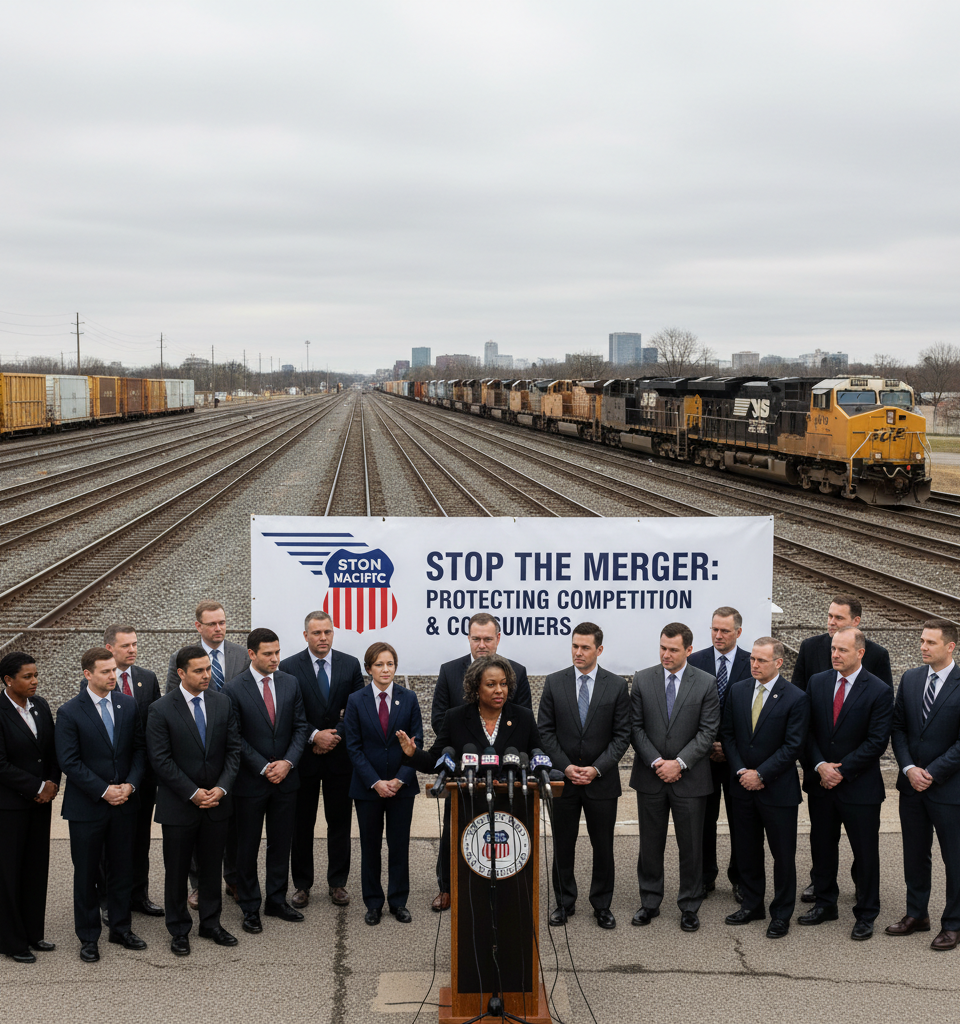
A consortium of state Attorneys General has formally urged the Surface Transportation Board (STB) to reject the application for the proposed transcontinental rail merger involving Union Pacific (UP) and Norfolk Southern (NS). This intervention highlights a persistent opposition to the consolidation of major freight rail operators, citing potential negative consequences for competition and service quality across the United States.
The pushback from state legal officers underscores a broader sentiment within various sectors concerning market concentration in critical infrastructure. Mergers of this scale in the rail industry have historically faced intense scrutiny due to their potential to reshape transportation networks, affecting everything from agricultural shipments to consumer goods. The STB, as the primary economic regulatory agency for freight railroads in the United States, bears the ultimate responsibility for evaluating such applications against public interest criteria, including fostering competition and ensuring adequate service.
While specific details of the Attorneys General's latest filing were not immediately released, their renewed exhortation builds upon previous objections raised against the proposed merger. Arguments generally revolve around the fear of reduced competition, which could lead to increased shipping costs for businesses and, by extension, higher prices for consumers. Concerns also frequently include the potential for diminished service reliability, longer transit times, and reduced choices for shippers who rely heavily on rail transport for their supply chains.
Industry and Market Impact
The transcontinental nature of the proposed Union Pacific-Norfolk Southern merger means that its approval or rejection would have profound implications for the entire North American freight rail landscape. Such a consolidation would create one of the largest rail entities globally, potentially altering competitive dynamics in numerous corridors. Shippers, particularly those without access to multiple rail carriers, fear becoming captive to a single provider with enhanced pricing power. This could particularly affect industries reliant on bulk commodity shipping, such as agriculture, energy, and manufacturing.
Economists and industry analysts often debate the trade-offs of such mergers. Proponents typically argue that larger, integrated networks can achieve greater efficiencies, streamline operations, and offer seamless, single-line service across vast distances, potentially leading to lower overall costs for the railroad and improved transit times. Opponents, however, contend that these potential benefits rarely translate into savings for shippers and consumers, or improved service, when effective competition is removed.
Historical Context and Regulatory Scrutiny
Historically, the STB and its predecessor, the Interstate Commerce Commission (ICC), have approached major rail mergers with caution. The last significant Class I rail merger was in the late 1990s, and since then, regulatory standards have become more stringent, emphasizing competitive effects and public interest. The STB’s current merger rules are designed to prevent undue harm to competition and ensure that any proposed consolidation would enhance the overall efficiency and effectiveness of the national rail network without compromising service for shippers.
The involvement of multiple state Attorneys General signals a coordinated and robust opposition, indicating that the concerns extend beyond individual state borders to a broader regional or national economic impact. These state legal officers often bring a unique perspective to federal regulatory proceedings, representing the direct interests of businesses and consumers within their respective jurisdictions who would be affected by changes in transportation costs and services.
What Lies Ahead
This renewed call from the Attorneys General will undoubtedly add significant weight to the ongoing review process at the STB. The Board is mandated to conduct a thorough and impartial assessment of the merger application, soliciting input from a wide range of stakeholders, including other government agencies, shippers, labor unions, and communities. The STB’s decision will hinge on whether the applicants can sufficiently demonstrate that the proposed merger is in the public interest and does not substantially lessen competition or create a monopoly. The ultimate outcome of this application remains uncertain, but the intensified opposition suggests a challenging path forward for the merging rail entities.