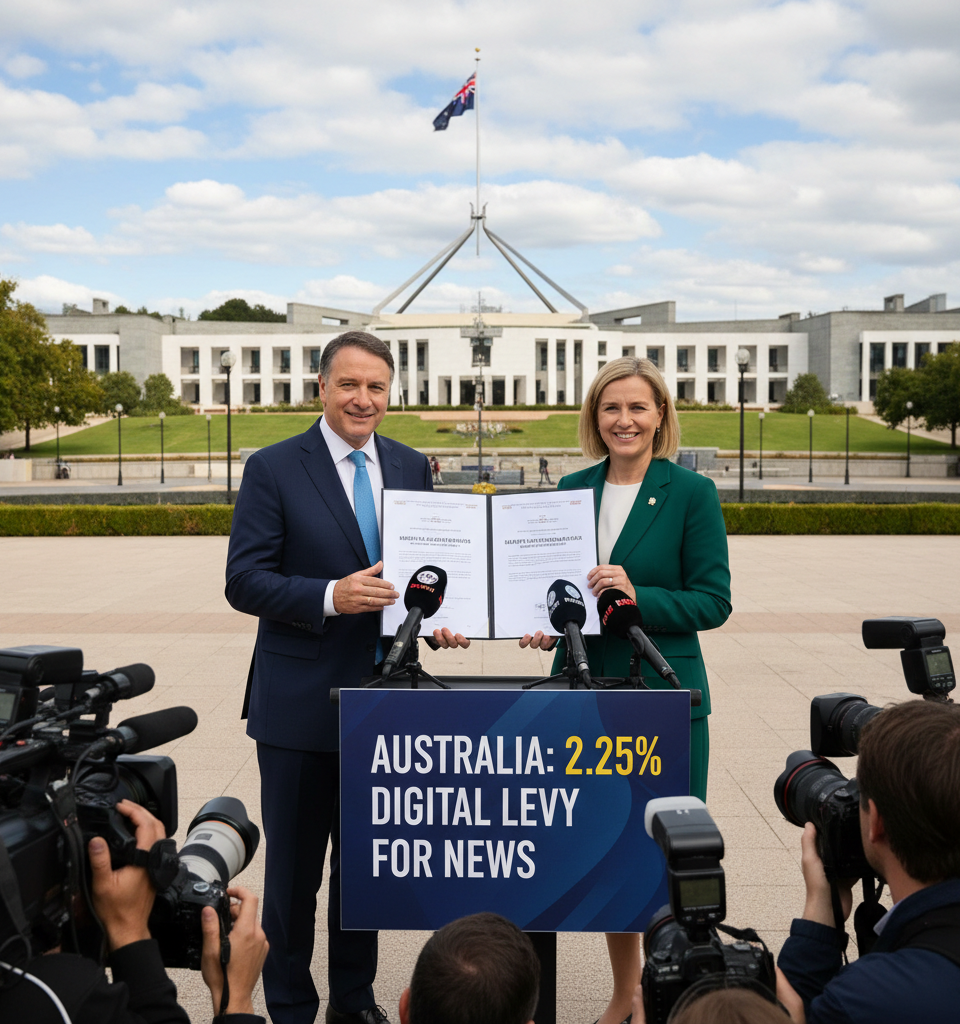
Canberra, Australia – The Australian government today announced draft legislation to impose a 2.25% levy on the local revenues of major digital platforms, including Meta, Google, and TikTok, if they fail to reach fair compensation agreements with domestic news publishers. This bold initiative, dubbed the 'News Bargaining Incentive,' is set to commence on July 1, 2026, and signals a renewed commitment by the Albanese government to support local journalism amidst declining advertising revenues and the dominance of tech behemoths.
Context and Background
This development is the latest chapter in Australia's long-running efforts to recalibrate the financial relationship between digital platforms and news organizations. Australia was a pioneer in 2021 with its News Media Bargaining Code, which mandated negotiations and, if necessary, arbitration between tech companies and publishers. While that code led to some significant agreements, notably with Google, Meta controversially pulled news content from its platforms in Australia for a period, highlighting the contentious nature of these negotiations. The new levy comes as many of those initial agreements under the voluntary code are set to expire, creating uncertainty for the future of news funding.
Key Details of the Legislation Under the proposed legislation, platforms that successfully negotiate agreements with news organizations will receive full or partial offsets against the 2.25% levy.
This incentive-based approach aims to encourage genuine bargaining rather than simply penalizing non-compliance. Communications Minister Anika Wells and Prime Minister Anthony Albanese formally announced the draft legislation on Tuesday, emphasizing the government's commitment to a "sustainable and diverse Australian news sector." Crucially, the legislation explicitly excludes pure AI chatbot services from its scope, focusing instead on platforms that directly benefit from news content in traditional ways through advertising and engagement. The levy applies to gross local revenues from digital advertising, search, social media, and other ancillary services derived from Australian users.
Industry and Market Impact
The prospect of a 2.25% levy could translate into hundreds of millions of dollars annually, significantly impacting the operating models of these tech giants in Australia. For example, if a platform like Google generates hypothetical annual local revenues of $5 billion, a 2.25% levy would amount to $112.5 million. This financial pressure is designed to make fair compensation agreements with news publishers a more economically attractive option than incurring the levy. The move is expected to bolster the financial stability of Australian media outlets, ranging from large media conglomerates to smaller, independent newsrooms, by providing a new revenue stream.
Expert Perspective Industry analysts widely view this as a more direct and punitive approach than the previous bargaining code. "While the initial code aimed to facilitate negotiations, this levy directly targets the bottom line, making non-cooperation significantly more costly," stated Dr. Emily Chen, a digital economy expert at the University of Sydney.
"It sends a clear message that the Australian government expects these platforms to contribute meaningfully to the public good of journalism." Others suggest it could set a global precedent, influencing other nations grappling with similar issues of platform power and news sustainability, potentially leading to a fragmentation of global tech business models.
What's Next The draft legislation is now open for public consultation, providing an opportunity for industry stakeholders, tech companies, and news organizations to present their feedback.
Following this period, the government intends to introduce the bill to Parliament, with an expected passage before the July 2026 implementation date. There is anticipation of strong lobbying efforts from the affected digital platforms, who have historically resisted similar regulatory interventions. The success of this new framework will ultimately be measured by its ability to drive more widespread and equitable agreements between tech giants and Australian news publishers, ensuring the continued viability of local journalism.