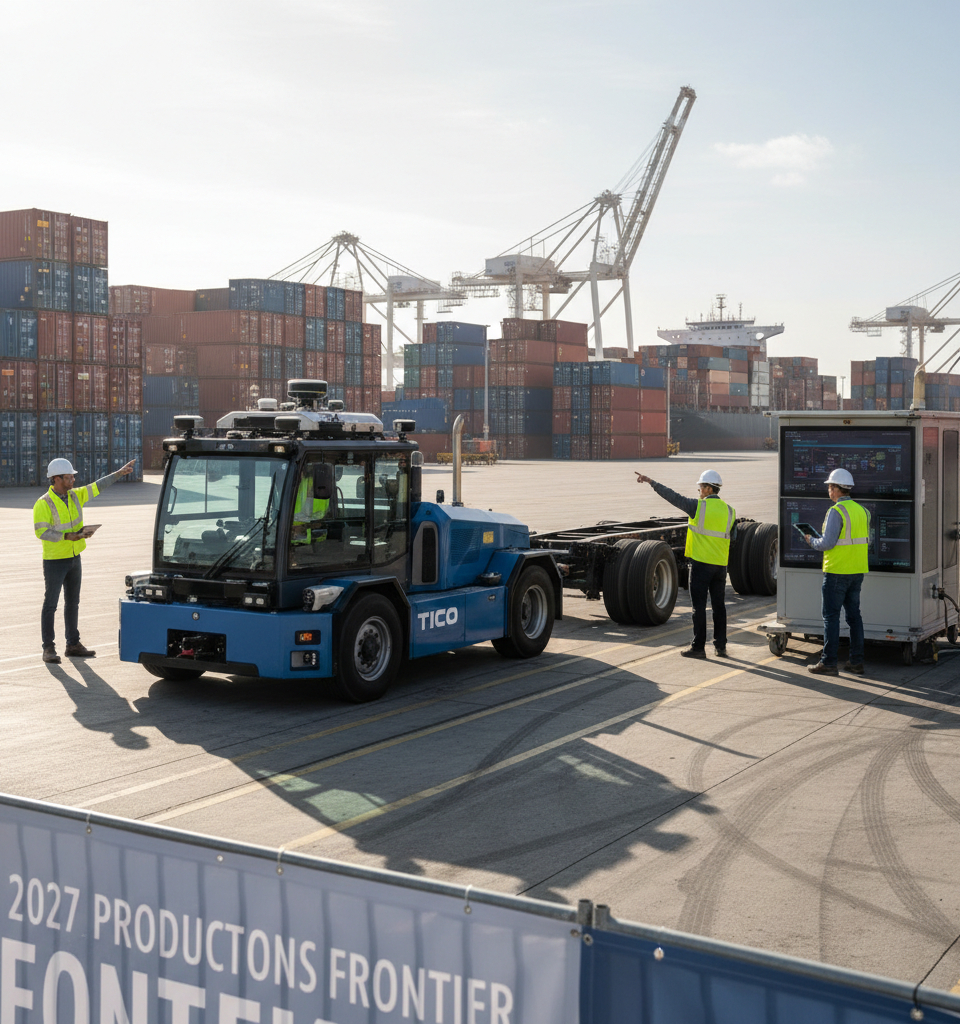
The nascent field of autonomous trucking is poised for a significant expansion, not on public highways, but within the confines of private industrial and commercial yards. This strategic shift is underscored by the collaboration between ISEE AI and TICO, which aims to commence production of autonomous yard tractors by 2027. This development, powered by Gen-7 technology and a meticulously defined and closed safety case, is anticipated to unlock hundreds of orders for these specialized vehicles in the immediate term.
The Strategic Importance of Private Yards
Private yards, including distribution centers, port terminals, and manufacturing facilities, represent a critical yet often overlooked segment of the logistics chain. These controlled environments offer a more contained and predictable operational domain compared to public roads, making them an ideal proving ground and early adoption site for autonomous technology. The inherent challenges of these spaces – repetitive tasks, dense traffic, and the need for precision maneuvering – align perfectly with the strengths of advanced AI-driven systems. Addressing these challenges autonomously promises to enhance efficiency, reduce operational costs, and improve safety within these vital logistics arteries.
Technological Advancements and Production Timelines
Central to this initiative is ISEE AI's Gen-7 autonomous technology. While specific technical details of Gen-7 were not explicitly provided, its role as a foundational element suggests advanced capabilities in perception, decision-making, and control algorithms necessary for navigating complex yard environments. The partnership with TICO, a well-established manufacturer of terminal tractors, is critical for bringing this technology to market. Their combined expertise is expected to culminate in the production of autonomous yard tractors as early as 2027. This production timeline is ambitious but reflects the increasing maturity and confidence in autonomous systems within confined operational domains.
The Significance of a Closed Safety Case
A pivotal aspect enabling this rapid progression is the establishment of a "closed safety case." In autonomous systems development, a closed safety case signifies that all foreseeable operational scenarios and potential hazards within a defined environment have been identified, analyzed, and mitigated by the system design and operational protocols. This rigorous approach to safety demonstrates a high level of technical readiness and is crucial for gaining regulatory approval, insurance coverage, and, most importantly, customer trust. The existence of such a safety case is a strong indicator that the technology is deemed robust enough for broader commercial deployment, hence the expectation of substantial orders.
Anticipated Market Impact and Future Orders
The immediate impact of this development is anticipated to be a surge in orders for autonomous yard tractors. The current projections indicate that "hundreds of truck orders" could materialize soon after the technology's readiness. This influx would represent a significant step forward for autonomous vehicle adoption beyond pilot programs, establishing a tangible market for specialized autonomous solutions. Businesses operating large logistics hubs are likely to be early adopters, driven by the potential for substantial operational efficiencies, labor optimization, and enhanced safety within their yards. The success within private yards could also serve as a blueprint and a source of valuable data for developing autonomous highway trucking solutions.
Broader Implications for Autonomous Trucking
While the focus is on private yards, the success of autonomous yard tractors holds broader implications for the autonomous trucking industry. It demonstrates a phased approach to deployment, starting with less complex environments before tackling the intricacies of public roads. The experience gained in developing robust perception systems, predictive analytics, and fail-safe mechanisms for yard operations will undoubtedly inform and accelerate the development of long-haul autonomous trucks. Furthermore, the commercial validation and economic benefits realized in yard operations could foster greater investor confidence and public acceptance of autonomous transportation technology across the board.
The Road Ahead: 2027 and Beyond
Looking ahead, the period leading up to 2027 will be critical for ISEE AI and TICO. This timeframe will likely involve continued testing, refinement of the Gen-7 system, finalization of manufacturing processes, and securing initial customer commitments. The successful mass production and deployment of these autonomous yard tractors could fundamentally reshape logistics operations globally. It represents a tangible step towards a more automated and efficient supply chain, marking private yards not just as a proving ground, but as a crucial initial frontier in the commercialization of autonomous trucking technology.