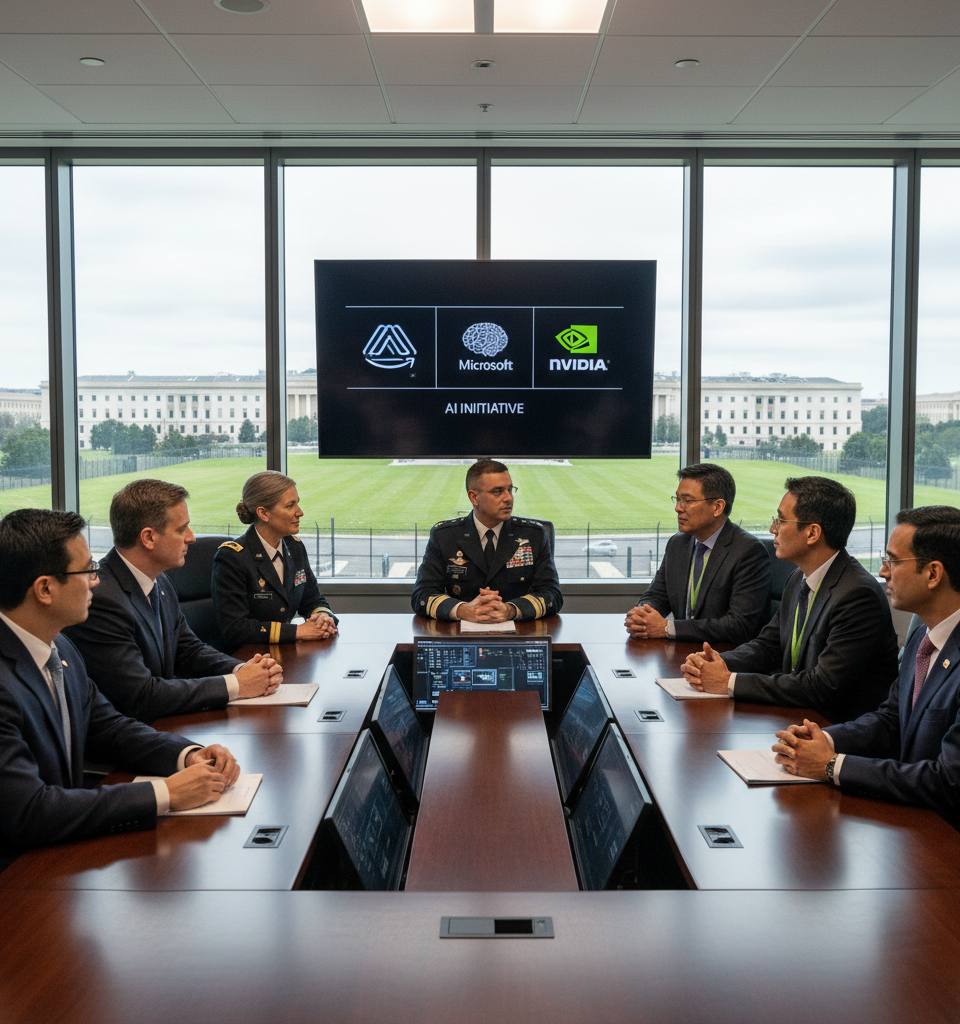
The U.S. Department of Defense (DoD) has significantly expanded its artificial intelligence (AI) strategic partnerships by enlisting Amazon Web Services (AWS), Microsoft, and NVIDIA. These industry titans will join an existing consortium that includes Google, OpenAI, and xAI, forming a formidable alliance to integrate advanced AI capabilities into military and intelligence operations. This unprecedented collaboration, announced recently, underscores the Pentagon's aggressive drive to harness private sector innovation to maintain a technological edge, particularly in rapidly evolving AI domains.
This initiative marks a pivotal moment in the DoD's modernization efforts, recognizing AI as a critical enabler for future defense capabilities. For years, the Pentagon has grappled with the challenge of integrating nascent technologies into a vast and often bureaucratic system. By directly engaging leading AI developers, the DoD aims to streamline development cycles, access proprietary algorithms, and leverage the immense computational power offered by these companies. The move also reflects a broader recognition within national security circles that commercial AI advancements are outpacing traditional defense R&D pipelines, necessitating closer ties with Silicon Valley.
Key details of the collaboration involve these companies providing a range of services, from cloud-based AI processing and machine learning models to specialized hardware for AI acceleration. AWS, a dominant force in cloud computing, is expected to offer its extensive AI/ML services and secure cloud infrastructure. Microsoft, with its Azure AI platform and significant investment in AI research, will contribute its diverse suite of AI tools and expertise in enterprise-scale deployments.
NVIDIA, a global leader in GPU technology crucial for AI training and inference, will likely supply its state-of-the-art processors and software platforms, essential for handling computationally intensive AI tasks. While specific contract values were not disclosed, such partnerships typically involve multi-year agreements worth hundreds of millions, if not billions, of dollars, reflecting the strategic importance of this technological infusion.
The entry of AWS, Microsoft, and NVIDIA into the Pentagon's AI orbit is poised to have a profound impact on the broader technology and defense markets. It signals a further blurring of lines between commercial tech and national security apparatuses, potentially setting new precedents for industry engagement. For the tech companies, these partnerships represent significant revenue streams and opportunities to prove the robustness and security of their AI offerings in high-stakes environments.
For smaller AI firms and startups, it may create new avenues for collaboration as sub-contractors or partners, but also intensifies competition for talent and resources as the defense sector attracts top AI engineers. Moreover, it solidifies the perception that these leading firms are indispensable players in the global AI landscape, with their technologies becoming foundational to government-level strategic initiatives.
Industry analysts widely view this expansion as a strategic imperative for the DoD. Dr. Evelyn Stone, a senior fellow at the Center for Strategic and International Studies, noted, "The Pentagon's previous reliance on bespoke, slow-moving defense contractors for cutting-edge tech was unsustainable. Bringing in giants like Microsoft and NVIDIA directly shortens the innovation cycle dramatically. This isn't just about software; it's about leveraging the enormous R&D budgets and talent pools that only these companies possess." Some legal experts also point to potential ethical considerations and oversight challenges arising from private entities developing and deploying AI for military applications, issues that are expected to be addressed through robust ethical AI frameworks and ongoing dialogues between the DoD and its partners.
Looking ahead, this expanded collaboration is expected to accelerate AI integration across numerous DoD functions, from intelligence analysis and logistics to autonomous systems and predictive maintenance. Future developments will likely include the establishment of specialized AI innovation labs, joint R&D initiatives focusing on areas like explainable AI and robust AI, and the development of new training programs for military personnel to utilize these advanced tools effectively. The success of these early deployments will undoubtedly shape the future trajectory of DoD's AI strategy, potentially leading to even deeper and broader partnerships.
The ultimate goal is to create a dynamic AI ecosystem that is resilient, adaptable, and capable of delivering asymmetric advantages on the future battlefield, driving a continuous cycle of innovation and technological superiority against peer competitors for the foreseeable future.