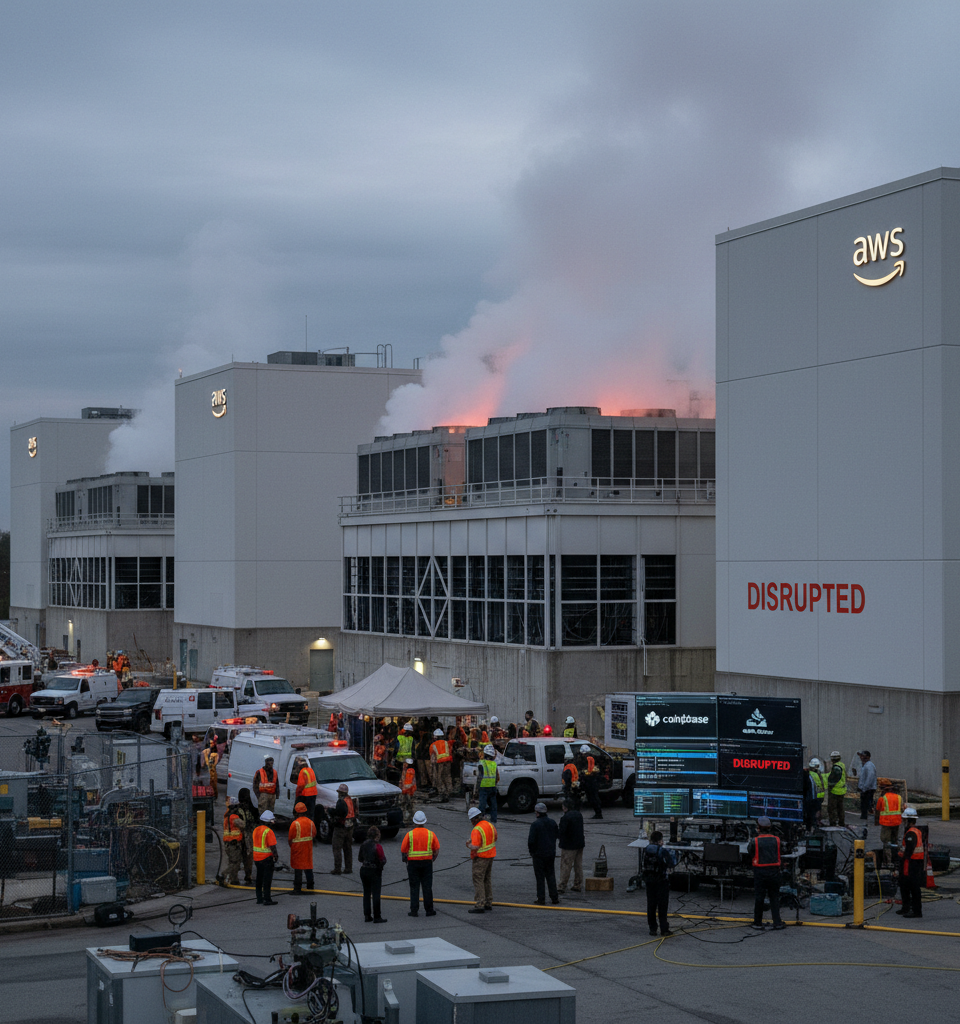
Last Thursday, a critical overheating incident at an Amazon Web Services (AWS) data center in Northern Virginia triggered substantial service outages, impacting numerous high-profile clients, including the cryptocurrency exchange Coinbase and the CME Group, a leading derivatives marketplace. The malfunction, which AWS confirmed stemmed from a single data center's cooling system failure, prompted immediate traffic shifts and warnings of prolonged restoration efforts, sending ripples of concern through the digital financial sector and beyond.
Context and Background
This incident is not an isolated event in the history of cloud computing, but it resonates particularly deeply due to the increasing reliance of global businesses on a handful of dominant cloud providers. Northern Virginia, often referred to as 'Data Center Alley,' is home to a significant concentration of AWS infrastructure, making outages in the region especially impactful. Previous AWS outages, while often quickly resolved, have consistently highlighted the single points of failure inherent in even the most robust distributed systems. The very interconnectedness that makes cloud services powerful also makes them susceptible to widespread disruption when core infrastructure falters. The financial industry, in particular, with its demand for high availability and low latency, is acutely sensitive to such disruptions.
Key Details
AWS engineers identified that a localized failure within the cooling system of a specific data center was allowing temperatures to rise to critical levels, threatening hardware integrity and customer workloads. In response, AWS initiated a strategic rerouting of traffic away from the compromised availability zone. However, the company cautioned that the full restoration of all affected services would be a protracted process, exceeding initial estimations.
Coinbase, a prominent cryptocurrency exchange, publicly acknowledged its services were offline and operating with degraded performance due to the AWS issues. Similarly, the CME Group, a vital player in global financial markets, also reported experiencing disruptions. While AWS did not disclose the exact number of affected customers or precise financial impacts, the operational slowdowns at these high-volume platforms suggest significant if unquantified, financial repercussions.
Industry and Market Impact
The ripple effects of this outage extended far beyond the directly affected clients. For the cryptocurrency market, a platform like Coinbase going offline, even temporarily, can lead to significant price volatility and trader frustration. In traditional finance, disruptions experienced by entities like CME Group can impact futures trading, derivatives clearing, and overall market stability, albeit in a more controlled and often pre-planned manner due to robust disaster recovery protocols. The event served as a stark reminder to enterprises across all sectors about the importance of multi-cloud strategies and geographically diverse infrastructure to mitigate risks associated with reliance on a single provider or region. Analysts estimate that even brief outages can cost large enterprises millions of dollars in lost revenue and reputational damage.
Expert Perspective
Industry analysts were quick to weigh in on the incident's implications. Sarah Chen, a leading cloud infrastructure expert at Tech Insights Group, commented, "While AWS’s swift response to shift traffic was commendable, the incident underscores that even the most advanced cloud architectures are not immune to fundamental physical failures. Companies need to review their own resilience strategies, specifically focusing on how resilient their applications are to a single availability zone failure, not just a full region." Another analyst, Mark Davies from Global Market Watch, emphasized, "For highly transactional businesses like financial services, even minutes of downtime can translate into significant financial losses and erode consumer trust. This will undoubtedly prompt a renewed push for greater decentralization and redundancy in mission-critical applications."
What's Next
AWS has initiated a thorough post-mortem analysis to ascertain the precise cause of the cooling system failure and to implement preventative measures. Affected clients will also conduct their own internal reviews to evaluate the effectiveness of their disaster recovery plans and to identify potential vulnerabilities. The incident is likely to accelerate discussions within the cloud industry about enhanced transparency regarding infrastructure health and potentially stricter SLAs (Service Level Agreements) for critical services. Furthermore, we can anticipate increased investment in and adoption of multi-cloud and hybrid-cloud strategies by enterprises aiming to insulate themselves from such localized failures in the future, fostering a more distributed and resilient digital ecosystem globally.