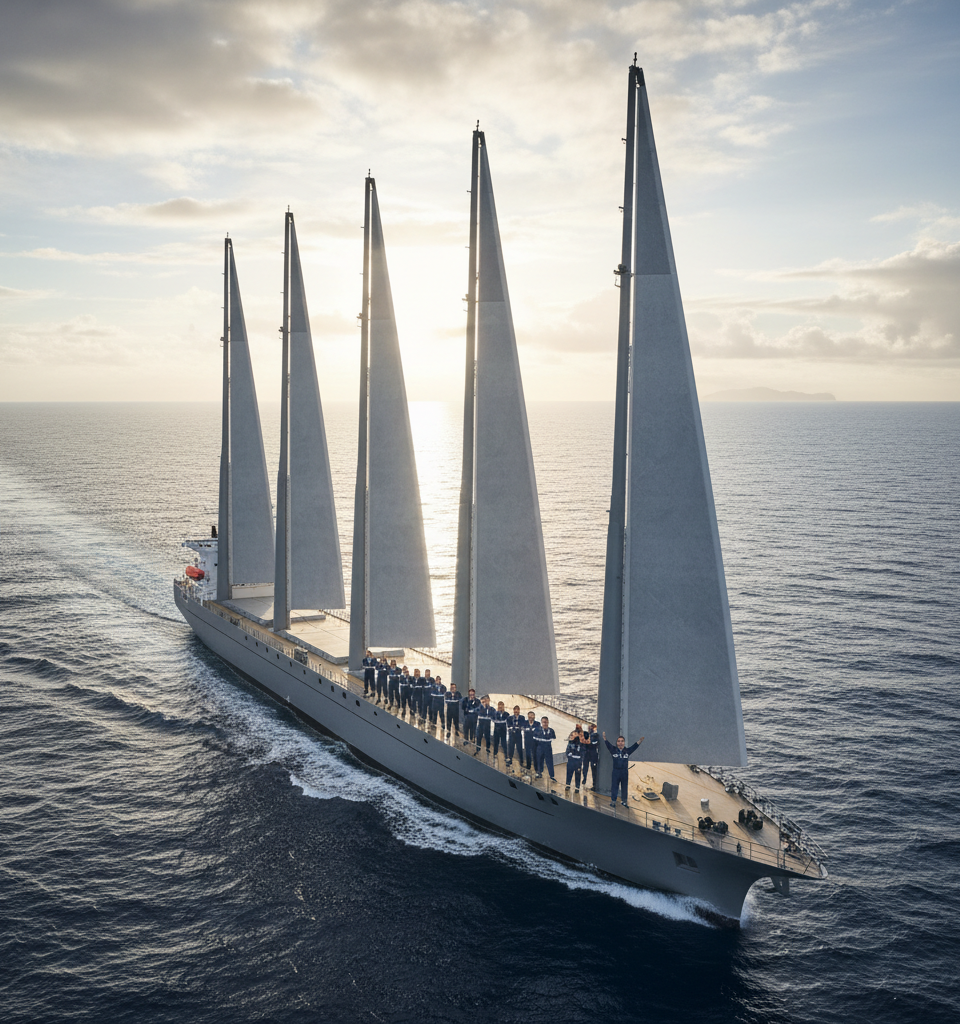
In a landmark development for green shipping, French maritime powerhouse CMA CGM has officially integrated its groundbreaking hybrid diesel-wind-powered vessel, the Neoliner Origin, into its critical trans-Atlantic service rotations. This strategic deployment, announced this week, represents a tangible commitment to reducing carbon emissions within its vast logistics network, setting a new precedent for sustainable practices across the global supply chain.
Shifting Tides: The Imperative for Sustainable Shipping
The introduction of the Neoliner Origin arrives at a crucial juncture for the shipping industry, which accounts for approximately 3% of global Greenhouse Gas (GHG) emissions. Facing mounting regulatory pressure from bodies like the International Maritime Organization (IMO) – which targets a 20% reduction in emissions by 2030 and a net-zero ambition by 2050 – and increasing demands from environmentally conscious consumers and corporations, carriers are compelled to explore and adopt innovative decarbonization strategies. The Neoliner Origin's design, resurrecting the ancient art of sail power with modern technological advancements, offers a compelling solution to mitigate the industry's environmental footprint while maintaining operational efficiency.
The Neoliner Origin: A Fusion of Innovation and Heritage
The Neoliner Origin is not merely a novelty; it embodies a sophisticated engineering marvel. Measuring approximately 136 meters in length, the vessel is equipped with advanced rigid sails, which complement its optimized diesel engines. This hybrid propulsion system is projected to achieve a significant reduction in fuel consumption and associated CO2 emissions, estimated to be between 15% to 25% on specific routes, depending on wind conditions. While specific figures on the vessel's initial cargo capacity and speed capabilities are still emerging, CMA CGM emphasizes that the Neoliner Origin will maintain competitive transit times crucial for its trans-Atlantic clientele, primarily serving routes connecting Europe with North America.
Industry Repercussions: A Catalyst for Wider Adoption
CMA CGM, one of the world's largest container shipping companies, deploying such a vessel sends a powerful signal across the entire maritime sector. This move is expected to accelerate research, development, and investment in wind-assisted propulsion technologies. Smaller operators and even competitors, observing CMA CGM's pioneering efforts, may be incentivized to explore similar solutions, particularly as the economic viability stemming from fuel savings becomes more apparent and regulations on carbon intensity tighten. This could trigger a renaissance in sail-assisted shipping, transforming a niche technology into a mainstream solution for certain routes and vessel types.
Expert Insights: A Promising Yet Challenging Horizon
Maritime analysts largely commend CMA CGM's initiative, viewing it as a robust step towards operationalizing decarbonization goals. Dr. Eleanor Vance, a lead researcher in sustainable maritime transport, stated, "The Neoliner Origin represents a crucial proof-of-concept. While wind propulsion won't be a universal panacea for all vessel types and routes, its effective integration on a major trans-Atlantic service by a top-tier carrier validates its potential to meaningfully contribute to emission reduction targets. The challenge now lies in scaling this technology and optimizing its performance across diverse weather patterns and operational demands." Concerns remain regarding the initial capital expenditure for such vessels and the potential impact of adverse weather on schedule reliability, yet the long-term fuel cost savings present a compelling business case.
The Path Ahead: Expanding the Green Fleet
The deployment of the Neoliner Origin is likely the first in a broader strategy for CMA CGM. The company has previously articulated ambitious environmental targets, and this vessel serves as a tangible demonstration of that commitment. Future developments could include an expanded fleet of similar hybrid vessels, potentially incorporating even more sophisticated wind-propulsion systems or exploring alternative low-carbon fuels in conjunction with sail assistance. The success of the Neoliner Origin on its trans-Atlantic rotation will provide invaluable data and operational experience, paving the way for further innovation and the potential for larger, more efficient wind-powered or wind-assisted mega-vessels across the global shipping lanes, fundamentally altering the energy dynamics of international trade.